
 EN
EN
C&I BESS Warranty Guide 2026: What “10-Year Warranty” Actually Means for Your Project IRR
A practical framework for B2B buyers to separate real warranty value from marketing language — and why active balancing BMS changes the math.
Key Takeaways
- In 2026 C&I BESS procurement, a “10-year warranty” alone is not enough to protect project IRR.
- Warranty protection should be decoded in at least four layers: product/workmanship, performance/capacity, cycle/throughput, and availability. Each layer needs its own definition and boundary conditions.
- “6,000 cycles” means different things at different depths of discharge. 6,000 cycles at 90% DoD is not equivalent to 6,000 cycles at 50% DoD; compare offers by lifetime usable energy throughput.
- Active balancing BMS helps maintain cell consistency over time, protecting capacity retention and strengthening the technical basis for performance-warranty execution.
Why “10-Year Warranty” Is Not Enough
A battery energy storage system is not a short-term equipment purchase. For most C&I projects, it is an energy asset expected to operate for 10 years or more while facing daily cycling, electricity-price changes, grid constraints, and temperature variation.
One supplier may emphasize a product warranty, another may highlight cell cycle life, and a third may quote system availability. These terms can sound similar in a proposal, but they protect the buyer in different ways and can expire under different conditions.
For a C&I buyer, the real question is not simply “How many years is the warranty?” It is: What exactly is guaranteed, under which operating conditions, and which data will prove whether the system did or did not meet the guarantee?
The Four Warranty Layers You Must Decode Separately
Marketing material often compresses multiple warranty concepts into a single phrase such as “10 years / 6,000 cycles.” In an RFQ, require the supplier to list the definition, operating limits, exclusions, and remedy for each layer separately.
| Warranty Layer | What It Covers | Key Metrics | Common Risk | Buyer Question |
|---|---|---|---|---|
| Product / Workmanship | Hardware defects, workmanship issues, and material failures. | Coverage years, covered components, repair and replacement terms. | Improper installation, physical damage, unauthorized repair. | Which components are covered — cells, BMS, PCS, enclosure? |
| Performance / Capacity | Battery degradation, capacity retention, and round-trip efficiency. | Remaining capacity %, EOL threshold, test method. | Over-cycling, extreme temperature, unsupported EMS settings. | At what DoD and temperature is performance measured? |
| Cycle / Throughput | Total lifetime energy processed or the number of defined cycles. | Cycle definition, MWh throughput, early-termination conditions. | Non-standard cycle definitions make bids difficult to compare. | How is a cycle defined, and what can terminate the guarantee early? |
| Availability (Optional) | System uptime and readiness for operation. | Annual uptime %, response time, allowed downtime. | PCS, HVAC, communication, or EMS issues. | Are grid outages and scheduled maintenance excluded? |
Source: Compiled from industry BESS warranty frameworks, 2026.
? Key point: Many financed C&I projects in 2026 increasingly favor throughput-based warranty language because peak-shaving duty can be irregular: some days use shallow cycles while others use deeper cycles. Tracking throughput can align warranty wear more closely with actual energy processed.
Cycle Life vs. Throughput: The Only Comparison That Matters
Cycle-Based Warranty
Claim: “6,000 cycles to 70% SOH at 90% DoD”
- ❌ May not explain how partial cycles are accumulated.
- ❌ May omit temperature conditions from the headline claim.
- ❌ Cannot be inserted into a project IRR model until cycle assumptions are converted into energy.
- Question: 6,000 cycles at 90% DoD ≠ 6,000 cycles at 50% DoD.
Throughput-Based Warranty
Claim: “Guaranteed 12 GWh throughput, ≥70% capacity floor”
- ✅ Directly quantifies total energy output.
- ✅ Connects more directly with financial modeling.
- ✅ Can be reconciled against the actual duty profile.
- Advantage: The guaranteed quantity is total energy, even when daily cycle depth varies.
Example: 64 kWh system × 6,000 cycles × 90% DoD × 90% RTE = approximately 311,040 kWh lifetime throughput.
Example: 64 kWh system × 6,000 cycles × 50% DoD × 90% RTE = approximately 172,800 kWh lifetime throughput.
Conclusion: the same “6,000 cycles” headline can represent an 80% difference in usable lifetime energy between these two operating assumptions.
How Active Balancing BMS Protects Your Warranty Value
Delivering on a performance warranty depends on the battery pack’s ability to maintain cell consistency throughout its operating life. In a series-connected pack, cell imbalance can accumulate over time, reducing usable capacity, creating uneven heat generation, and ultimately shortening pack life.
Passive balancing commonly dissipates excess energy from higher-voltage cells near the end of charging, often at currents of ≤250 mA. Active balancing can instead transfer charge between cells during charging and discharging at currents such as 2A. Research cited in this guide indicates that an SOC-estimation-based active balancing strategy can extend battery life by approximately 49 cycles after 100 charge-discharge cycles compared with voltage-based methods.
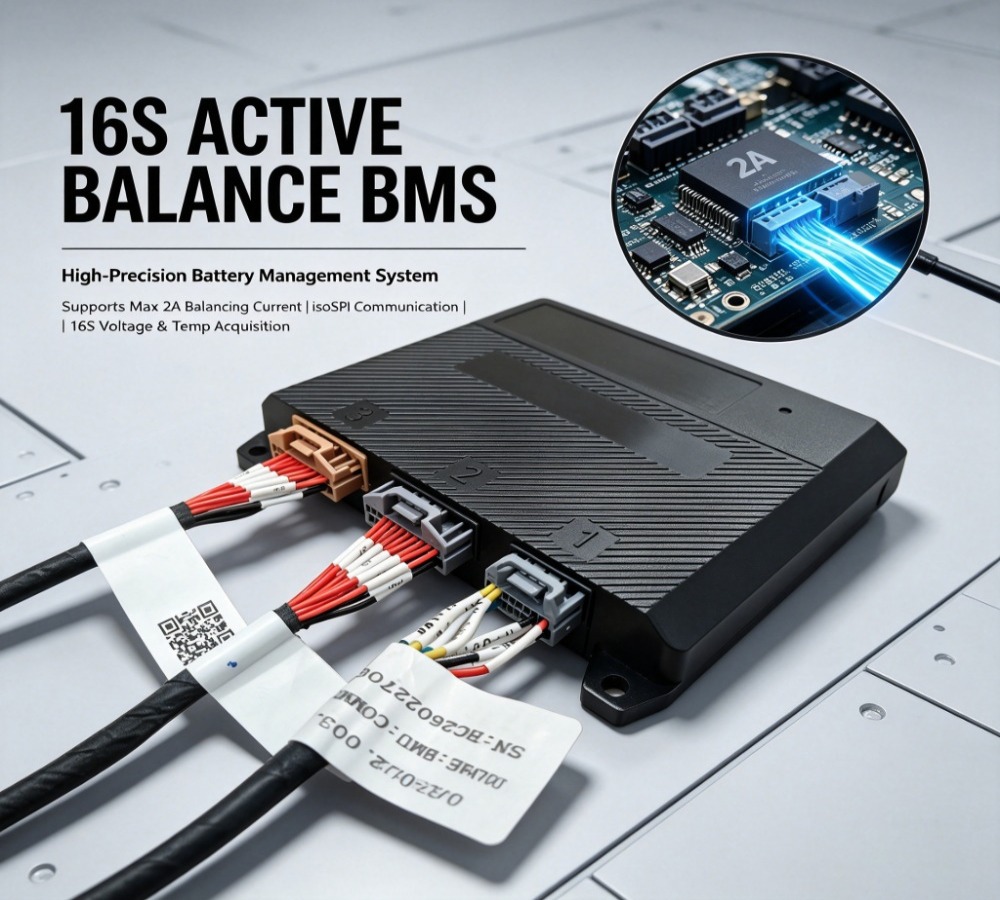
JKESS technical anchor: The JKESS BMU-H5-16 slave control unit integrates 2A active balancing, ±0.005V voltage sampling accuracy, ±2°C temperature sampling accuracy, and support for 16S LiFePO4 cells in series. In daily operation, the BMS can continuously reduce cell-to-cell voltage drift, helping protect capacity retention and providing technical support for performance-warranty execution.
Warranty Trends Reshaping C&I BESS Procurement in 2026
Lower EOL Thresholds
End-of-life capacity thresholds are moving from 70% toward 65% in some contracts, with 60% appearing in selected terms. Buyers should map the contracted floor directly into the financial model.
Throughput First
More financed projects in 2026 are choosing MWh-throughput language because it better matches irregular operating patterns, including peak shaving with changing daily cycle depth.
Augmentation Terms Shape 15-Year Cost
When capacity falls to the agreed floor, who pays for augmentation — buyer or supplier? Contract language determines the future incremental capital burden.
Your RFQ Checklist: 7 Questions to Ask Every Supplier
- Which components are covered — cells, BMS, PCS, and enclosure — and what terms apply to each?
- What are the capacity-retention test method and test conditions, including temperature, DoD, and C-rate?
- How is a cycle defined — full equivalent cycle or accumulated micro-cycles? Is the warranty measured by energy rather than cycle count?
- Does the warranty include a throughput limit in MWh? If the limit is reached before the calendar term ends, does coverage terminate?
- Which operating limits for temperature, DoD, or C-rate can invalidate coverage?
- How is augmentation handled, and who pays for added capacity?
- What data is required for a warranty claim, and how is that data collected? Does the claim depend on a supplier-operated monitoring platform?
Frequently Asked Questions
What is the difference between product warranty and performance warranty for a BESS?
Product warranty covers hardware defects, workmanship issues, and component failures for a set calendar period. Performance warranty separately guarantees battery degradation thresholds (remaining capacity %), throughput in MWh, and round-trip efficiency under defined operating conditions. A system can have a 10-year product warranty and a much shorter performance warranty, or vice versa — always request both as separate schedules.
How is a “cycle” defined in a BESS warranty, and why does it matter?
A cycle is not a universal unit. Suppliers may count a full equivalent cycle at a stated depth of discharge (DoD), or count incomplete cycles with different formulas. A claim of “6,000 cycles to 70% SOH” at 90% DoD is not comparable to “8,000 cycles” at 50% DoD. Convert both into approximate lifetime energy throughput (kWh) under your expected daily profile before scoring the bid.
What is a throughput warranty, and when should I prefer it over a cycle-based warranty?
A throughput warranty guarantees total energy charged or discharged, often in MWh, over the term, sometimes with a residual capacity floor. For C&I projects with irregular peak-shaving duty — some days shallow, some days deep — throughput tracks wear closer to real use. Many 2026 financed projects prefer throughput language for this reason.
How does active balancing BMS affect warranty performance?
Cell-to-cell imbalance in a series battery pack accumulates over time, reducing usable capacity and accelerating degradation. Active balancing continuously transfers charge between cells during both charging and discharging, maintaining voltage uniformity and protecting capacity retention. Research shows SOC-based active balancing can extend battery lifespan by approximately 49 cycles after 100 charge-discharge cycles compared to voltage-based methods. A BMS with higher balancing current, such as 2A, can eliminate typical drift within hours rather than days.
What operating conditions can void a BESS warranty?
Temperature excursions beyond the manufacturer’s specified range, exceeding the contracted DoD or C-rate limits, using unsupported EMS settings, failing to perform required maintenance, and unauthorized repairs are common warranty void conditions. Always verify that your actual site conditions fall within the warranty’s operating envelope before signing.
What is an augmentation clause in a BESS warranty?
An augmentation clause specifies who is responsible for adding capacity when the battery degrades below the contracted floor during the warranty term. The contract determines whether augmentation cost is borne by the buyer or the supplier. For a 100 MWh system fading 2.5%/year against an 80% floor, capacity first drops below the floor around Year 9, requiring about 12.4 MWh of augmentation across 7 years.
How should I compare warranty terms when evaluating multiple BESS suppliers?
Request separate schedules for each warranty layer: product/workmanship, performance/capacity, throughput/cycles, and availability. For each, identify the coverage period, the measurement method, the operating envelope, and the remedy (repair, replace, or compensate). Convert cycle-based claims into lifetime energy throughput under your expected duty cycle. Compare on lifetime usable energy — not on the largest cycle number printed on a brochure.
What data is needed to file a BESS warranty claim?
Most claims require proof of purchase and installation date, evidence that the system operated within approved conditions (temperature, DoD, C-rate), continuous SOH monitoring data, and a standard capacity test report. Annual warranty validation reports comparing delivered capacity and RTE against contractual curves produce documented evidence for claim escalation. Verify the data collection method before purchase — if it relies on the supplier’s proprietary platform, you may not have independent evidence.
Does a longer warranty period always mean better protection?
No. A 15-year blended warranty can expire at Year 8 on throughput if the system is heavily cycled. A 10-year warranty with unclear cycle definitions may offer less real protection than a 7-year warranty with explicit MWh throughput guarantees. The warranty’s value depends on the definitions, conditions, exclusions, and remedy language — not on the number of years on the brochure.
How does JKESS support warranty transparency for its HV BESS products?
JKESS provides self-developed BMS with 2A active balancing, enabling verifiable cell-level data through the BMU-H5-16 slave control unit (±0.005V sampling accuracy, 8 temperature sensors). The master control unit supports CAN/RS485/daisy chain communication, allowing independent data access. JKESS HV-BC250 (200A) and HV-BC150-100A (100A) master boxes support 4–16 slave battery boxes (64–256kWh), enabling buyers to start with a minimal configuration and validate performance data before scaling.
Need Help Decoding BESS Warranty Terms?
Our engineering team can walk you through the warranty structure for your specific project — including cycle definitions, throughput calculations, and augmentation planning.
Request a Custom Quote →