
 EN
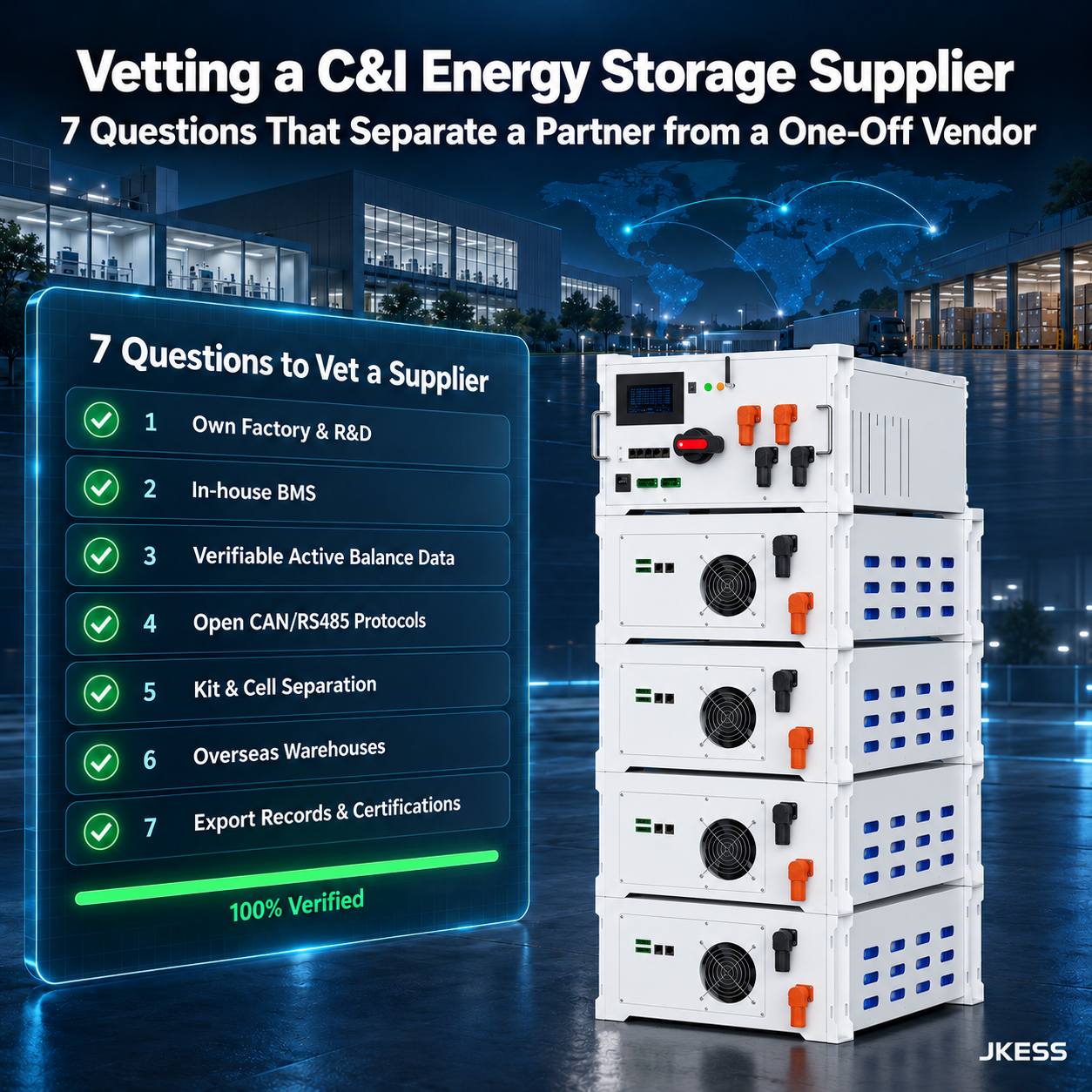
Vetting a C&I Energy Storage Supplier: 7 Questions That Separate a Partner from a One-Off Vendor
The real risk in BESS procurement isn’t price — it’s whether the supplier still exists in Year 3, whether the software still updates, and whether the warranty is still executable. Here is the 7-question framework that reveals the difference.
Key Takeaways
- For overseas installers and system integrators, the central concern is not price: it is whether the supplier will still exist in Year 3, continue software updates, and respond to after-sales requests.
- A battery energy storage system (BESS) is a 10+ year asset, yet supplier evaluation often takes only a few days. That mismatch creates long-term project risk.
- Seven verifiable questions cover factory ownership and R&D, in-house BMS development, active balancing verification, communication protocol openness, separate kit and cell procurement, overseas stock, and export records and certification documents.
- Each question should be answered with documents, data, or an on-site demonstration, rather than sales claims.
- JKESS provides a case study in a supplier that can be evaluated through its self-developed BMS, own factory, exports to 80+ countries, and overseas warehouse network.
The Real Risk Isn’t Price — It’s Supplier Longevity
In B2B energy storage procurement, price is usually the focus of negotiation, but it is not the biggest risk. The biggest risk is whether your chosen supplier will still be operating in three years, and whether it will still provide software updates, spare parts, and warranty service.
An energy storage system is a 10+ year energy asset, but supplier evaluation often takes only a few days. During the quotation stage, buyers tend to focus on specification comparisons and price negotiations, with little systematic assessment of the supplier’s ability to fulfill long-term commitments. This mismatch is a source of long-term project risk.
A less visible problem is that many B2B buyers do not know how to evaluate a supplier. They receive an attractive product brochure and a promise of a “10-year warranty.” But the brochure does not answer the questions that determine long-term system availability: Is the battery management system (BMS) developed in-house or purchased? Are communication protocols open? Are spare parts stocked overseas?
This guide gives system integrators, EPC contractors, energy storage installers, and project developers seven verifiable questions for commercial and industrial (C&I) BESS vendor evaluation. Every question is designed to be answered with documents, data, or on-site verification, rather than sales language.
One-Off Vendor vs Long-Term Partner: What Separates Them
| One-Off Vendor | Long-Term Partner |
|---|---|
| No owned factory; private-label or trading model | Own factory and R&D center |
| Purchased BMS; parameters cannot be customized | Self-developed BMS with verifiable active balancing parameters |
| Proprietary communication protocols; difficult integration | Standard CAN/RS485 communication with open integration |
| Complete systems only; no kit-based procurement | Kits and cells can be sourced separately |
| No overseas stock; 4–8 week lead times | Overseas warehouse stock; 3–7 day delivery |
| Unclear certification documents with no traceability | Verifiable CE/RoHS/FCC documentation |
| Software updates depend on a third party | An in-house team maintains firmware updates |
| May no longer operate in three years | Verifiable ability to fulfill long-term commitments |
| Result: High long-term project risk | Result: A stronger basis for sustained availability over a 10-year service life |
The 7 Questions That Reveal the Difference
-
Does the supplier have its own factory and R&D center?
Why it matters: Suppliers operating through private-label or trading models have less direct control over product quality, delivery, and long-term technical support. If the upstream supplier changes or discontinues a product, buyers may face a shortage of spare parts.
How to verify: Request the factory address, a factory tour video, or an opportunity for an on-site audit. Review the size and technical background of the R&D team.
JKESS in practice: JKESS has its own factory and R&D center, with R&D investment of at least 10% of sales revenue.
-
Is the BMS developed in-house or purchased?
Why it matters: The BMS is the core controller of an energy storage system. A purchased BMS can limit a supplier’s ability to customize balancing strategies, sampling accuracy, and communication protocols, or respond to customer requirements at the firmware level.
How to verify: Request BMS hardware design documentation or firmware update records. Ask about the adjustable range of active balancing current and whether sampling accuracy can be customized.
JKESS in practice: JKESS develops its BMS range in-house, including the BMU-H5-16 with 2A active balancing, ±0.005V sampling accuracy, and eight NTC temperature channels, together with the BCU master controller series.
-
Can the active balancing parameters be verified on-site?
Why it matters: “2A active balancing” is a common marketing claim, but some suppliers cannot provide test data. Buyers should be able to verify on-site or through remote monitoring whether the balancing current reaches the stated value.
How to verify: Request an active balancing test report based on the actual cell configuration. Ask for a demonstration of the balancing status shown on the LCD or app.
JKESS in practice: The BMU-H5-16 operates with 2A balancing current and ±0.005V sampling accuracy. The balancing status of each slave battery box can be viewed in real time on the master box LCD or in the CloudESS app.
-
Are the communication protocols open?
Why it matters: Proprietary protocols can lock buyers into a single supplier’s ecosystem, increasing integration costs and replacement difficulty. Documented CAN/RS485 protocols help buyers select power conversion systems (PCS), energy management systems (EMS), and other components with greater flexibility.
How to verify: Request communication protocol documents, including CAN message definitions and RS485 register maps. Ask whether the system supports CAN at 250k/500k and RS485 at 9600/115200 baud. Matching interfaces and baud rates should be followed by verification of the application-level messages and integration behavior.
JKESS in practice: JKESS supports standard CAN (250k/500k) and RS485 (9600/115200) communication and provides communication protocol documentation.
-
Can battery box kits and cells be purchased separately?
Why it matters: Kit-based procurement — enclosure, BMS, and wiring harness, without cells — lets buyers source cells according to local supply chains, budgets, and project schedules. Shipping a kit without cells also avoids shipping lithium cells as part of that kit consignment.
How to verify: Ask explicitly whether cells are included. Check that the packing list identifies them as “Not Included.”
JKESS in practice: HV-B6U, 4U Kits, and the 261kWh liquid-cooled BESS system support kit-based procurement with customer-supplied cells.
-
Is stock available in overseas warehouses?
Why it matters: Conventional shipping from Asia to Europe or the Americas can take 4–8 weeks, with customs clearance adding uncertainty to the project schedule. Available overseas stock can reduce delivery to 3–7 days.
How to verify: Ask for the specific warehouse locations and current stock status. Request logistics records for recent shipments dispatched from an overseas warehouse, and confirm the delivery window for your destination and order.
JKESS in practice: JKESS maintains stock in an EU warehouse in Poland and a US warehouse, with a standard delivery window of 3–7 business days for locally stocked orders.
-
Are export records and certification documents traceable?
Why it matters: Export records indicate real international market experience. Compliance documents and test evidence should be checked for the exact product model and target market; a general list of marks or standards is not enough.
How to verify: Request export customs records or overseas customer case studies. Verify the authenticity and scope of the supplied documents through the issuing organization, including its online verification service where available.
JKESS in practice: JKESS reports exports to 80+ countries and annual exports exceeding US$50 million. Its stated certification and compliance documentation includes CE, RoHS, FCC, and GB34131-2017; request the files applicable to the product under evaluation.
Supplier Evaluation Scorecard
Use this scorecard to compare multiple suppliers. Score each question from 0 to 5, for a maximum of 35 points. A score of 25 or above is the suggested threshold for advancing a supplier to the next round of negotiations.
The priority column indicates review importance, not a numerical multiplier: all seven dimensions contribute up to five points to the total. Use scores 1–4 for progressively stronger but incomplete evidence.
| Evaluation dimension | Verification method | Scoring criteria | Priority |
|---|---|---|---|
| Own factory and R&D | Factory address, tour video, R&D team size | 0 = None 5 = Own factory and R&D team |
High |
| In-house BMS development | Hardware design documents, firmware update records | 0 = Purchased BMS 5 = Fully developed in-house |
High |
| Verifiable active balancing | Balancing test report, LCD/app demonstration | 0 = No data 5 = Verifiable on-site |
High |
| Open communication protocols | Protocol documents, supported baud rates | 0 = Proprietary protocols 5 = Documented standard CAN/RS485 |
Medium |
| Separate kits and cells | Packing list, confirmation of whether cells are included | 0 = Complete systems only 5 = Kit-based procurement supported |
Medium |
| Overseas warehouse stock | Warehouse locations, logistics records | 0 = None 5 = EU and US warehouses |
Medium |
| Export records and certification | Customs records, certification documents | 0 = None 5 = Verifiable export records and complete applicable documentation |
High |
| Total: /35 | — | ≥25: Recommended for the next round | — |
Pre-Contract Due Diligence: Documents to Request
Technical documents
- BMS hardware design documentation or specifications
- Communication protocol documents: CAN message definitions and RS485 register maps
- Active balancing test report based on the actual cell configuration
- Firmware update history and release notes
- Product specifications with complete parameter tables and dimension drawings
Quality and compliance files
- Applicable CE / RoHS / FCC / GB34131-2017 certification and compliance documents
- Factory audit report or ISO certification
- Product test reports: insulation resistance, dielectric withstand, and EMC
- Packing list and shipment inspection records
Supply chain and fulfillment files
- Overseas warehouse locations and current inventory statement
- Recent export customs records or logistics tracking
- A spare parts commitment covering key components for 10 years
- Warranty terms and execution details, including exclusions
Software and support files
- Monitoring platform access: LCD / app / web
- Firmware update procedures and compatibility notes
- Technical support response times and contact details
- Installation manual and maintenance guide
5 Common Traps in Supplier Evaluation
1. Checking specifications without checking verification methods
A supplier’s specification table may show design values rather than measured results. Request a test report based on the actual cell configuration, rather than relying solely on a general datasheet.
2. Overlooking communication protocol openness
Proprietary protocols can create difficulties when expanding the system or replacing a PCS. Before purchasing, confirm whether the protocols are open and whether the supplier provides documentation.
3. Assuming warranty terms are executable
A warranty is only as useful as the supplier’s ability to fulfill it and the specific definitions in its terms. Before signing, clarify coverage, measurement methods, exclusions, and remedies.
4. Underestimating the value of overseas stock
Overseas stock can shorten delivery times and reduce the exposure of individual orders to international transport costs and customs delays. For time-sensitive projects, a local warehouse can be decisive.
5. Failing to verify certification documents
Check certification documents with the issuing organization, using its online verification service where available. Do not accept documents whose authenticity and scope cannot be established, especially where target-market access is involved.
How JKESS Answers the 7 Questions
| Evaluation question | JKESS answer | Verifiable evidence |
|---|---|---|
| Own factory and R&D? | Yes. Own factory and R&D center. | Factory address; evidence of R&D investment of at least 10% of sales revenue |
| Self-developed BMS? | Yes. BMS products developed in-house. | BMU-H5-16, BCU-1000-B3, and EMS-E2 technical documentation |
| Verifiable active balancing? | Yes. 2A active balancing. | Real-time balancing status on the LCD/app, supported by test data |
| Open communication protocols? | Yes. Standard CAN/RS485 communication. | Protocol documents; CAN 250k/500k and RS485 9600/115200 support |
| Separate kits and cells? | Yes. Kits do not include cells. | Packing list marked “Cells Not Included” |
| Overseas warehouse stock? | Yes. EU (Poland) and US warehouses. | Current stock confirmation; standard 3–7 business day delivery for locally stocked orders |
| Export records and certification? | Yes. Exports to 80+ countries. | Export records and applicable CE/RoHS/FCC/GB34131-2017 documentation |
JKESS product scope for technical evaluation
The HV BESS range includes HV-BC250 (200A master box), HV-BC150-100A (100A master box), HV-B6U (6U slave battery box kit), and 4U Kits. Related control products include BMU-H5-16, BCU-1000-B3, and EMS-E2.
Modular high-voltage system configurations cover 4–16 slave units, 64–256kWh, and 80–1000V, depending on the selected product, cell capacity, and configuration. The BMU-H5-16 specification includes 2A active balancing, ±0.005V sampling accuracy, and eight NTC channels. Confirm the exact configuration in the project-specific specification.
The portfolio also includes a 261kWh liquid-cooled BESS system. For kit-based orders, cells are customer-supplied and the packing list identifies them as “Cells Not Included.”
Frequently Asked Questions
Why is supplier longevity more important than price in BESS procurement?
A BESS is a 10+ year asset. If the supplier stops operating or discontinues support after 3 years, the buyer faces spare parts shortages, no firmware updates, and an unenforceable warranty. The initial price advantage of a low-cost vendor can be completely erased by the cost of replacing an unsupported system. Evaluate supplier longevity before negotiating price.
How do I verify whether a supplier has a self-developed BMS?
Request hardware design documentation, firmware update history, and evidence of in-house R&D capability. A supplier with self-developed BMS can customize balancing strategies, sampling accuracy, and communication protocols. A supplier that purchases BMS from third parties cannot offer this flexibility and may face supply disruptions.
Why does communication protocol openness matter for BESS integration?
Proprietary protocols lock buyers into a single supplier’s ecosystem, making it difficult to integrate third-party PCS, EMS, or monitoring systems. Open CAN/RS485 protocols allow buyers to freely choose system components and avoid vendor lock-in. Before purchase, request the communication protocol document and verify support for standard baud rates.
What is the advantage of buying battery box kits without cells?
Kit-based procurement (enclosure + BMS + wiring harness, without cells) gives buyers flexibility to source LiFePO4 cells based on local supply chains, budget, and project timelines. It also avoids the regulatory complexity of cross-border lithium battery shipping, as cells are subject to stricter transport rules than empty enclosures.
How much does local warehouse stock reduce delivery time?
Shipping from Asia to Europe or the Americas typically takes 4–8 weeks plus customs clearance. Local warehouse stock reduces delivery to 3–7 business days. For time-sensitive projects, local stock can be the decisive factor in meeting installation schedules.
What certifications should I verify before purchasing a BESS?
Verify CE, RoHS, FCC, and GB34131-2017 certifications. For specific target markets, check grid code compliance and local safety requirements. Certificates can be verified through the issuing certification body’s website. Do not accept unverifiable certification documents.
What warranty terms should I review before signing?
Request separate schedules for product warranty, performance/capacity warranty, throughput/cycle warranty, and availability guarantee. For each, identify the coverage period, measurement method, operating envelope, and remedy. Convert cycle-based claims into lifetime energy throughput under your expected duty cycle before comparing suppliers.
How does JKESS support supplier evaluation for B2B customers?
JKESS provides technical documentation, communication protocol documents, active balancing test data, certification files, and factory information for evaluation. JKESS HV BESS products include HV-BC250 (200A master box), HV-BC150-100A (100A master box), HV-B6U (6U slave battery box kit), 4U Kits, and the 261kWh liquid-cooled BESS system.
What should be in a BESS supplier due diligence checklist?
A due diligence checklist should cover technical documents (BMS design documents, protocol documents, and test reports) and quality and compliance files (certifications, factory audits, and product test reports). It should also include supply chain and fulfillment files (warehouse locations, export records, and spare parts commitments) and software support files (monitoring access, firmware update procedures, and support response times).
How often should supplier evaluation be repeated?
Supplier evaluation should be repeated annually or whenever there is a significant change in supplier ownership, manufacturing location, or product line. For multi-year projects, periodic re-evaluation ensures the supplier still meets the original criteria and has not outsourced critical components or reduced support capacity.
Evaluating a BESS Supplier for Your Next Project?
Request our technical documentation package — including BMS specifications, communication protocol documents, active balancing test data, and certification files — to support your supplier evaluation.
Request a Custom Quote →