
 EN
JKESS / Technische Einblicke
Angebot anfordern→Warum Ihre Website für Energiespeicher nicht von ChatGPT zitiert wird: Eine GEO-Checkliste für B2B-Speicherhersteller
Ihr Käufer könnte ChatGPT konsultieren, bevor er Lieferanten-Websites vergleicht. Falls Ihre Produktspezifikationen ausschließlich in Bildern vorliegen, Ihre Website Such-Crawler blockiert oder Ihre Modellnummern inkonsistent sind, fehlen Ihre Informationen möglicherweise in der Antwort.
Wichtige Erkenntnisse
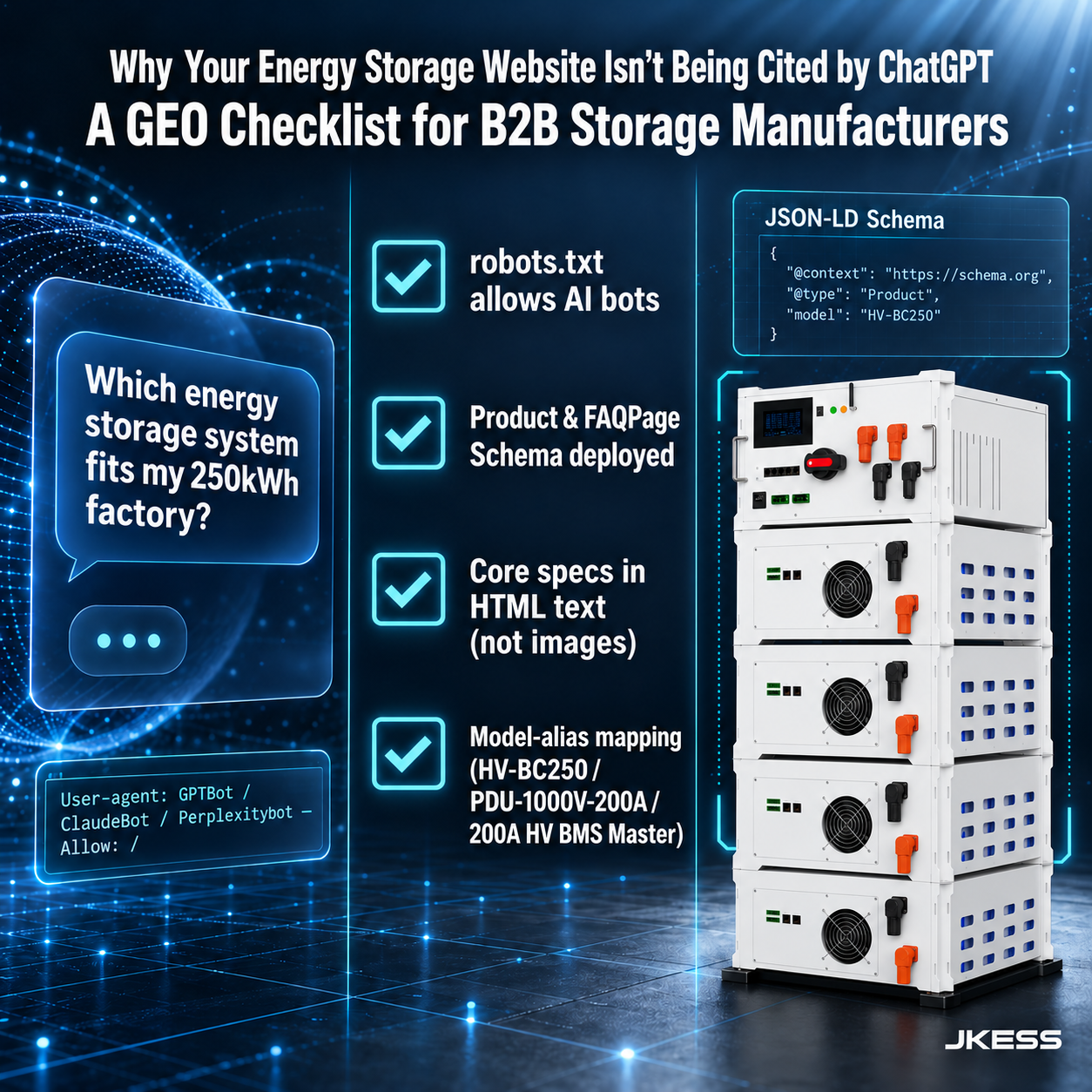
- Die Beschaffungsreise umfasst nun KI-unterstützte Recherche. Ein Käufer kann beispielsweise fragen: „Welches System erfüllt meine Anforderung von 250 kWh für die Fabrik?“, noch bevor er einzelne Lieferanten-Seiten aufruft.
- Machen Sie Ihre Fakten leicht auffindbar und überprüfbar. Veröffentlichen Sie technische Spezifikationen als sichtbaren HTML-Text mit Einheiten, Betriebsbedingungen, Quellenangaben und eindeutigen Produktidentifikatoren.
- Überprüfen Sie sieben KI-Sichtbarkeits-Checkpoints: zugriff für Crawler, geeignetes Schema, Fakten-Dichte, Konsistenz der Modell-Aliase, HTML-Spezifikationen, Frage-Antwort-Struktur sowie eine optionale Anleitung in llms.txt. Diese Aspekte decken praktische Zugriffs- und Inhaltsrisiken ab; sie stellen keine sieben zwingenden Ranking-Anforderungen dar.
- Ein Produkt benötigt eine einheitliche Identität. Stimmen Sie Bezeichnungen wie HV-BC250 – einen internen PDU-Identifikator – und „200A HV BMS Master“ erst ab, nachdem bestätigt wurde, dass sie dieselbe Revision bezeichnen.
- GEO ist ein laufendes Content-Management. Bewahren Sie die Nachweise auf, überwachen Sie Zitierungen und korrigieren Sie ungenaue Antworten. Keine Checkliste kann eine bevorzugte Platzierung in ChatGPT, Perplexity oder Google AI Overviews garantieren.
01 / Die Kaufreise
Der B2B-Beschaffungs-Funnel hat sich bereits verändert
Die vertraute Beschaffungsreise beginnt mit einer Suche, setzt sich über mehrere Lieferanten-Websites fort und endet mit einer engen Auswahl oder einem Anfrageformular. KI-Assistenten schaffen einen weiteren Zugangspunkt: Ein Einkaeufer kann bereits vor dem Besuch der Website eines Herstellers nach einer technischen Erklaerung oder einem Vergleich fragen. Damit gewinnt die Qualitaet der Informationen, die ausserhalb Ihrer Startseite verfuegbar sind, zunehmend an Bedeutung.
Betrachten Sie die Fragen, die ein Speichersystemintegrator oder ein EPC-Unternehmer stellen koennte: „Welches Hochspannungs-BESS unterstuetzt 4–16 Slave-Akkuboxen?“ „Welche technischen Parameter weist ein aktives Balancing-BMS mit 2 A auf?“ „Welche Aenderungen ergeben sich bei der Planung von Gewerbe- und Industrie-Speichersystemen fuer ein schwaches Netz?“ Dies sind Beispiele fuer Kaufabsichten, nicht fuer gemessene Adoptionsstatistiken. Jede dieser Fragen erfordert eine praezise Antwort, die zwischen einer Komponenten-Kennzeichnung und einer Gesamtsystem-Faehigkeit unterscheidet.
Falls die relevanten Fakten schwer zugänglich oder widersprüchlich sind, kann eine KI-generierte Antwort Ihr Produkt möglicherweise auslassen oder fehlerhaft beschreiben. Die praktische Reaktion besteht darin, eine klare, eindeutig zitierbare Antwort auf einer vertrauenswürdigen Webseite zu veröffentlichen. KI-generierte Antworten bedürfen weiterhin einer Überprüfung, und Sichtbarkeit in solchen Antworten ergänzt die etablierten Kanäle für Suchmaschinen, Vertriebspartner und Direktverkäufe.
02 / Suche und Zitierung
Traditionelles SEO versus GEO: Was ändert sich tatsächlich?
Beide Disziplinen überschneiden sich. Dieser Vergleich beschreibt ihre jeweiligen Schwerpunkte; nützlicher Inhalt, technischer Zugang und glaubwürdige Belege sind für beide entscheidend.
| Traditionelles SEO | GEO (Generative Engine Optimization) |
|---|---|
| Tor Sichtbarkeit in relevanten Suchergebnissen erlangen. | Tor Zu einer nützlichen, zitierten Quelle in KI-generierten Antworten werden. |
| Optimierungsschwerpunkt Suchabsicht, relevanter Inhalt, Links und technische Qualität. | Optimierungsschwerpunkt Abrufbare Fakten, Belege, klare Entitäten und geeignete strukturierte Daten. |
| Käuferverhalten Ergebnisse durchsuchen und Lieferanten-Seiten besuchen. | Käuferverhalten Eine Antwort lesen, Folgefragen stellen und unterstützende Links prüfen. |
| Inhaltsformat Nützliche Produkt- und redaktionelle Seiten, die mit der Suchabsicht übereinstimmen. | Inhaltsformat Antwortorientierte Absätze, überprüfbare Werte, Bedingungen und ausdrückliche Ausschlüsse. |
| Zugriff für Crawler Googlebot, Bingbot und die zugehörige Indexierungsinfrastruktur. | Zugriff für Crawler OAI-SearchBot, PerplexityBot, Claude-SearchBot und Googlebot für Google-Such-KI-Funktionen. |
| Strukturierte Daten Beschreiben Sie zulässigen Seitenumfang und unterstützen Sie anwendbare Suchfunktionen. | Strukturierte Daten Eigenschaften und Beziehungen dort präzisieren, wo sie genutzt werden; keine universelle Voraussetzung für Zitierung. |
| Wettbewerb Sichtbarkeit und Relevanz über die gesamte Suchergebnisseite hinweg. | Wettbewerb Ob die Antwort Ihre Belege auswählt, korrekt zuordnet und genau wiedergibt. |
| Bilder Nützliche visuelle Elemente, unterstützt durch beschreibenden Text und geeignete Alt-Attribute. | Bilder Wesentliche technische Spezifikationen im HTML wiederholen; Fähigkeiten zum Auslesen von Bildinhalten variieren je nach Dienst. |
| Marken- und Modellnamen Wiedererkennbare Namen in Titeln, Seiten und Links. | Marken- und Modellnamen Konsistente primäre Kennungen, verifizierte Aliasnamen sowie klare Versionsgrenzen. |
| Abmessungen Impressionen, Platzierungen, Klicks und qualifizierte Konversionen. | Abmessungen URL-Zitierungen, korrekte Markennennungen, Weiterleitungen und qualifizierte Anfragen. |
| SEO hilft Käufern, Sie zu finden. | GEO sorgt dafür, dass Ihre Nachweise Teil der Antwort werden. |
03 / Die Arbeits-Checkliste
Die 7-Punkte-GEO-Checkliste für B2B-Speicher-Websites
-
Überprüfen Sie die Datei robots.txt und erlauben Sie die beabsichtigten Such-Crawler.
Trennen Sie den Zugriff für Suchen von den Einstellungen für Modelltraining. OpenAI identifiziert OAI-SearchBot als seinen Such-Crawler und GPTBot als Crawler für das Training. PerplexityBot unterstützt die Suche von Perplexity; Claude-SearchBot unterstützt die Suche von Claude, während ClaudeBot die Modellentwicklung betrifft. Googlebot steuert das Crawling für Google Search, einschließlich seiner KI-Funktionen; Google-Extended ist eine separate Steuerung für andere Zwecke.
Überprüfen Sie bestehende User-Agent-Gruppen, Platzhalterregeln, Pfadbeschränkungen sowie Einstellungen für CDN oder Firewall. Gemäß dem Standardverhalten von robots.txt führt das Fehlen einer expliziten
Allownicht automatisch zur Zugriffsverweigerung. Eine explizite Gruppe kann die beabsichtigte Richtlinie klarer machen.# Example for a public marketing website.# Merge with the existing policy; preserve intentional path restrictions.User-agent: OAI-SearchBotAllow: /User-agent: PerplexityBotAllow: /User-agent: Claude-SearchBotAllow: /User-agent: GooglebotAllow: /Legen Sie die Richtlinien für GPTBot, ClaudeBot und Google-Extended separat fest, entsprechend der beabsichtigten Nutzung des Inhalts. Überprüfen Sie die endgültig zusammengeführten Regeln sowie die tatsächlichen Crawler-Anfragen.
Referenzen: OpenAI-Crawler-Dokumentation ,Perplexity-Crawler ,Anthropic-Crawler-Dokumentation , und die Google-Crawler-Steuerelemente .
-
Stellen Sie ein Schema bereit, das die sichtbare Seite genau beschreibt.
Verwenden Sie strukturierte Daten, um Kennungen und Eigenschaften explizit zu machen. Das Schema muss die Seite beschreiben, die ein Besucher tatsächlich sieht, ohne unbegründete Behauptungen hinzuzufügen oder verschiedene Produktvarianten zu vermischen.
- Produkt + zusätzlicheEigenschaft: modellspezifische Parameter, Einheiten und dokumentierte Merkmale.
- FAQPage: echte, sichtbare Fragen mit den zugehörigen Antworten.
- Anleitung: eine tatsächliche Installations- oder Inbetriebnahmeanleitung mit vollständigen Schritten und Umfang.
- Artikel 1 Absatz 1 die redaktionelle Überschrift, der Autor, das Veröffentlichungsdatum und die kanonische Seite.
- Organisation: der einheitliche Firmenname, die URL und die verifizierten Kontaktinformationen des Unternehmens.
Überprüfen Sie die JSON-Syntax und die Bedeutung der Felder und vergleichen Sie dann jede markierte Aussage mit der gerenderten Seite. Ein Blogbeitrag, der mehrere Produkte behandelt, ist nicht automatisch eine Produktdetailseite.
Die Berechtigung ist keine Zusicherung. Google erklärt, dass seine KI-Suchfunktionen keine speziellen Schema-Markups oder KI-spezifischen Dateien erfordern. Die Gültigkeit von Schema.org, die Plattformunterstützung und die tatsächliche Einbindung sind getrennte Fragen.
Referenzen: Schema.org additionalProperty ,FAQPage , und die Anleitung zu Googles KI-Funktionen .
-
Erhöhen Sie die Dichte nützlicher Fakten
Ersetzen Sie nicht unterstützte Adjektive durch eine behauptete Aussage, die ein Käufer überprüfen kann. Stellen Sie die Schlussfolgerung an den Anfang, halten Sie jeden Absatz fokussiert und geben Sie das Modell, die Einheit, die Betriebsbedingungen und die Quelle an, die zur Interpretation des Wertes erforderlich sind.
Vorher / Werblich „JKESS liefert branchenführende aktive Balancierungstechnologie mit überlegener Leistung.“Nachher / Spezifisch und nachweisbar „Die technische Dokumentation von JKESS beschreibt die BMU-H5-16 mit 2 A aktiver Balancierung, einer Genauigkeit von ±0,005 V bei der Zellspannungsmessung, acht NTC-Temperatursensoren und Unterstützung für 16S LiFePO4. Bestätigen Sie diese Werte anhand der exakt gelieferten Revision.“Kombinieren Sie keine Werte aus widersprüchlichen Dokumenten zu einer neuen Spezifikation. Falls eine Produktseite und ein Datenblatt widersprechen, klären Sie die Diskrepanz mit dem Produktverantwortlichen und aktualisieren Sie beide Quellen, bevor eine davon als verbindlich betrachtet wird.
Beispielquelle: Technische Diskussion von JKESS zur BMU-H5-16 öffentliche Seiten können Versionsunterschiede enthalten; ein aktuell genehmigtes Datenblatt bleibt die maßgebliche Veröffentlichungsreferenz.
-
Erstellen Sie eine verifizierte Zuordnung von Modell zu Alias
Vergeben Sie jedem Produkt einen primären Namen und eine kanonische Produktseite. Führen Sie eine Aufzeichnung, die den Marketing-Namen, die technische Kennung, die Produktversion und alle regionalen Namensvarianten miteinander verbindet.
Das bereitgestellte Namensbeispiel lautet HV-BC250 / PDU-1000V-200A-A001-NY / 200A HV BMS Master Box dies ist eine Alias-Beziehung, die verifiziert werden muss – kein Beleg dafür, dass die Kennungen austauschbar sind. Falls das Engineering die Übereinstimmung bestätigt, formulieren Sie: „HV-BC250, auch bekannt als PDU-1000V-200A-A001-NY, ist die 200A HV BMS Master Box.“
Verwenden Sie den primären Namen im Titel und in der Überschrift H1; stellen Sie bestätigte Aliase im Einleitungstext sowie in geeigneten Produktfeldern dar, z. B.
alternateNameodermpnbewahren Sie eine separate Identität auf, wenn eine Version Änderungen bei Nennwerten, Schnittstellen oder Lieferumfang beinhaltet. -
Halten Sie Kernspezifikationen in sichtbarem HTML fest
Schreiben Sie die Schlüsselwerte direkt in die Seite. Spannung, Strom, Genauigkeit, Abmessungen, Prüfbedingungen und Umfang der Lieferung sollten als gewöhnlicher Text und semantisch verfügbar bleiben
cells.
Image extraction and JavaScript rendering differ between crawlers and retrieval tools. Text inside a photograph, iframe, or canvas is therefore an unreliable sole source for a critical parameter. Alt text helps describe an image, but it does not replace a visible specification table.
Publish a dated datasheet alongside the HTML table. Distinguish nominal voltage from the operating envelope, continuous current from peak current, and empty-kit weight from the weight of an assembled module.
Answer real buyer questions directly
Build a useful set of questions around the buying decision: “How many slave boxes can one master box support?” “Does the kit include battery cells?” “Which communication protocols are provided?” Answer first, then give the limits and source.
Five to ten FAQs can be a practical editorial target when the topic warrants them; there is no universal minimum. Native
When adding FAQPage markup, use the same question and answer wording as the visible page. Do not add invisible FAQ claims just to target search queries. This article includes ten visible FAQs and marks up five of them.
Consider an optional llms.txt reading guide
llms.txtis a proposed Markdown convention for guiding agents to useful website content. A concise guide can list the company, core products, application pages, and maintained technical documents. It is useful only to consumers that choose to read it.# JKESS Electronic Technology BMS and active balancing solutions for energy storage.## Core Products- [HV-BC250 200A Master Box](https://www.jkess.com/200a-hv-bms-master)- [HV-B6U Slave Battery Box Kits](https://www.jkess.com/hv-slave-6u-kits)- [261kWh Liquid-Cooled BESS Kits](https://www.jkess.com/commercial--industrial-energy-storage-system-kits)## Application Guides- [Modular HV Energy Storage Kits](https://www.jkess.com/home-energy-storage-system-kits)## Technical DocumentsUse the current specifications and scope-of-supply notes on the product pages.Add approved, versioned datasheet links when those documents are published.Illustrative content, not a report of the live site’s configuration. Use verified links and clean Markdown versions where available. Maintaining this file does not deploy robots.txt rules or create search eligibility.
References: the llms.txt proposal and Google’s generative AI optimization guidance. Google Search does not use llms.txt as a special visibility or ranking input.
04 / Content in practice
Before and After: Rewriting a Storage Product Page for AI Citation
The following five examples replace broad promotion with a more useful answer. Numerical illustrations include their assumptions; commercial and certification statements require current, model-specific evidence.
Illustrative rewrites. Calculations are not measured performance guarantees. Before / Marketing copy After / Evidence-led copy “Our advanced active balancing BMS delivers superior performance and extends battery life.” “For an illustrative 314Ah cell with a 0.5% charge difference, ΔQ = 314 × 0.005 = 1.57Ah. At a constant 2A transfer current, the idealized duration is 1.57 ÷ 2 = 0.785 hours, or about 47 minutes. Real duration depends on current limits, control behavior, and losses.” “The system supports a wide voltage range for various applications.” “The HV-BC250 listing specifies an 80–1000V DC master range. A 4–16 slave-box configuration is described as approximately 64–256kWh when each box is approximately 16kWh. With 16 cells per box and 3.2V nominal per cell, 16 boxes yield 256S / 819.2V nominal. Verify the full charge/discharge range and selected cell capacity.” “Our battery boxes are designed for easy installation.” “Define the scope as one master plus five slave boxes: six enclosures in total. State empty-kit and assembled-module weights separately, together with the lifting and installation plan. A claimed 28.55kg kit weight or two-technician, 2–3 day schedule requires a matching product record and a defined site scope.” “We provide reliable products with international certifications.” “List the exact model and revision, applicable CE declaration, RoHS documentation, FCC evidence, and test-report identifiers. If citing GB34131-2017 or insulation resistance ≥1 MΩ at 1,000 VDC, verify the applicable standard edition, test method, and report scope rather than extending a component claim to the whole system.” “Contact us for more information.” “Send your required capacity, DC range, current, communication protocol, scope of supply, quantity, and delivery location to [email protected]. Request confirmation of available regional stock and a written dispatch estimate for that configuration.” Product references: HV-BC250 and modular storage kits. The 64–256kWh shorthand is configuration-dependent; a hardware kit without cells does not itself contain that stored energy.
05 / Access and extraction
Technical Access: Can AI Crawlers Actually Read Your Website?
Check 1 / robots.txt and access controls
Open
https://yourdomain.com/robots.txtand evaluate the user-agent group and path rules that apply to each intended crawler. Inspect firewall challenges, blocked IP ranges, redirects, and server errors as well.Absence of an explicit Allow is not a failure by itself. Use the actual response and verified crawler logs to determine what is accessible.
Check 2 / Core content in HTML
Disable JavaScript and reload the product page. Check the original HTML response for the model name, specification table, scope of supply, and answers.
If they disappear, the page depends on rendering that some tools may not perform. Prefer server-rendered or static core content, and use a search engine’s inspection tools where available. Also check
noindex, snippet restrictions, andX-Robots-Tagheaders.Check 3 / Descriptive alt text
Describe informative product photographs, diagrams, and screenshots with suitable alt text. Keep purely decorative images from adding noise.
Repeat important values in the visible body or a real HTML table. A long alt attribute is not a substitute for a readable technical specification.
Check 4 / Reliable loading and delivery
Confirm that the canonical page returns a successful response and delivers useful content promptly. Reduce unnecessary third-party scripts, oversized payloads, and client-side dependencies.
Timeouts, errors, and rendering limits can interfere with retrieval. A model’s context budget is a separate issue from network performance; there is no universal “AI loading time” threshold.
Check 5 / Canonical URLs and model identity
Identify duplicate URLs for the same item and use a consistent canonical URL, internal links, and sitemap entries. For example, reconcile two product paths that describe the same HV-BC250 revision.
A canonical URL signals a preferred page; it does not by itself resolve conflicting specifications or prove that two product names are equivalent.
Access references: robots.txt interpretation and the crawler documentation linked in checkpoint 1.
06 / Evidence of progress
How to Measure Whether GEO Is Working
Pair answer-level observations with business outcomes. Metric Traditional SEO measure GEO measure Visibility Search impressions and keyword positions. Share of sampled AI answers citing an owned URL; track brand mentions separately. Traffic Organic search clicks and visits. Identifiable AI referrals; brand-search changes as supporting, non-causal evidence. Content Engagement and landing-page performance. Which facts and pages are cited, and whether values and limitations are correct. Conversion Forms, qualified leads, and sales. Qualified inquiries with an AI discovery source or attributable referral. Competition Relative search visibility. Citation share and co-mentions within the same fixed question set. Audit Indexability, search-intent coverage, and page quality. Entity consistency, evidence freshness, extractable facts, and markup accuracy. A practical weekly baseline: run ten fixed buyer questions in ChatGPT search, Perplexity, and Google AI Overviews where an overview appears. Repeat the sample and log platform, date, locale, model or mode, exact question, cited URL, brand mention, and answer accuracy.
Citation rate = answers linking to your domain ÷ eligible sampled answers. Report the sample size and the number of queries without an AI answer. A brand mention without a source link is not a citation. Use a separate measure for citations to this specific article.
For example, six cited answers out of 30 eligible observations produce a 20% sample citation rate. This is an illustrative calculation, not a JKESS result. Keep the question set stable when comparing periods, and avoid treating a single answer or a small change as proof that one edit caused an improvement.
07 / Applying the method
How JKESS Applies GEO to Its Own Product Pages
The reviewed JKESS master-box and 261kWh application pages expose technical information in readable tables. That is a useful starting point. The following seven practices form an implementation and maintenance checklist, rather than a claim that every page has already passed a site-wide audit.
- Maintain structured specification tables. Keep each voltage, current, accuracy, dimension, and weight value in visible HTML, tied to a model, revision, and source. Separate component ratings from complete-system limits.
- Keep FAQs useful and consistent. Write five to ten relevant answers when justified by the product; align any FAQPage markup with the exact visible wording and recheck answers after product changes.
- Use model-specific Product markup. Validate Product and additionalProperty on the appropriate HV-BC250, HV-B6U, and 261kWh pages. Record evidence of the deployed markup rather than assuming site-wide coverage.
- Control aliases. Confirm any relationship between HV-BC250 and PDU-1000V-200A-A001-NY, then use one primary name with the approved aliases. Keep HV-BC150-100A as a distinct product identity.
- Reconcile quantitative claims. Check the 2A active balancing and ±0.005V sampling values against the supplied BMU revision. Keep the 4–16 slave-box and 64–256kWh statements linked to their cell and configuration assumptions.
- Maintain an optional llms.txt guide. If deployed, list current canonical product and documentation URLs, remove stale links, and treat it as documentation support rather than an indexing requirement.
- Verify search access. Review the live robots.txt policy and crawler delivery logs. Confirm intended access for search bots while managing training-related controls independently.
JKESS product and specification anchors
HV-BC250 · 200A HV BMS Master · HV-BC150-100A · 100A master configuration · HV-B6U · 6U slave battery box kits · BMU-H5-16 · technical reference · 261kWh liquid-cooled system
Values to keep in context: 2A active balancing · ±0.005V sampling accuracy · 4–16 slave battery boxes · approximately 64–256kWh · 80–1000V DC master range. These refer to different components or configurations, not a single universal specification. Kits are offered without battery cells; confirm the final scope of supply.
08 / Questions buyers ask
Frequently Asked Questions
What is GEO and how does it differ from traditional SEO?
GEO (Generative Engine Optimization) is the practice of making useful content easier to retrieve, understand, and cite in AI-generated answers. Traditional SEO emphasizes visibility in search results, while GEO also tracks how accurately a brand and its facts appear in generated responses. Both benefit from accessible pages, clear product identities, and reliable evidence; neither guarantees inclusion.
Why is my energy storage website not being cited by ChatGPT?
Possible causes include blocked search crawlers, unindexed pages, specifications that are difficult to extract, inconsistent model names, or weak evidence for the question being asked. For ChatGPT search, review OAI-SearchBot access rather than assuming GPTBot controls search visibility. Missing Schema or llms.txt alone does not prove why a page was omitted; compare crawl evidence, content relevance, and repeated query results.
What is llms.txt and why does it matter for B2B storage websites?
llms.txt is a proposed Markdown-based guide to a website’s useful content, which can point agents to product documentation and application guides. It can help tools that choose to use it, but adoption and behavior differ between services. Treat it as optional documentation infrastructure, not a requirement for AI citation or a replacement for HTML pages and sitemaps.
How do I check if AI crawlers can access my website?
Inspect the robots.txt groups and path rules that apply to OAI-SearchBot, PerplexityBot, Claude-SearchBot, and Googlebot, then review server and firewall logs. A missing explicit Allow rule does not by itself mean access is denied. Also check HTTP responses, indexing and snippet controls, and whether product specifications are available without JavaScript; a browser-only test does not confirm a crawler’s actual access.
What Schema markup should a B2B storage website prioritize?
Use Product with additionalProperty on product pages, Article on editorial pages, and Organization for the company identity. FAQPage can describe visible questions and answers, and HowTo can describe a genuine procedural guide. Keep markup aligned with the visible content and applicable platform documentation; valid Schema does not guarantee a rich result or an AI citation.
How does inconsistent product naming affect AI visibility?
Different names for the same item can make it harder for readers and retrieval systems to connect the information. Select one primary model name and record verified aliases, product revisions, and one canonical URL. Publish an “also known as” relationship only after the model owner confirms that the labels identify the same product and configuration.
What is fact density and why does it matter for GEO?
Fact density is an editorial measure of how much useful, verifiable information a passage contains relative to general promotional language. A model-specific value with units, operating conditions, and a dated source is more useful than an unsupported adjective. Values such as 2A active balancing, ±0.005V sampling accuracy, and an 80–1000V DC range must stay attached to the correct component; fact density is not a published universal AI ranking score.
How do I measure GEO performance for my storage website?
Run a fixed set of buyer questions repeatedly and log the date, platform, search mode, locale, cited URLs, and answer accuracy. Report URL citation rate separately from unlinked brand mentions, and track identifiable referral visits and qualified inquiries. Results fluctuate, so a small weekly sample is directional evidence rather than a complete view of all buyers or proof of causation.
Does GEO replace traditional SEO for B2B storage manufacturers?
No. Search indexing, useful content, internal links, and a dependable website remain relevant to both conventional search and AI-assisted research. GEO adds attention to answer-level representation, traceable facts, and citation measurement. An effective program maintains those foundations while checking whether buyers receive accurate product information.
How does JKESS apply GEO principles to its own product pages?
The JKESS pages reviewed for this article provide examples of HTML specifications and question-and-answer content for products including the HV-BC250 and the 261kWh liquid-cooled system. The seven-part workflow below extends that approach to the HV-BC150-100A, HV-B6U, and BMU-H5-16 through consistent naming, source review, and structured content. This article does not certify site-wide Schema coverage, crawler settings, or an existing llms.txt deployment; those require a current implementation audit.
Want to Audit Your Storage Website’s AI Visibility?
Share your website URL with our team. We’ll review your robots.txt, Schema markup, fact density, and entity consistency — and help identify where crawlers or readers may be missing your product information.
Request a Custom Quote→