
 EN
JKESS / Inseneriteaduslikud teadmised
Päringu esitamine→Miks teie energiamahtude salvestamise veebisaiti ei tsitaeri ChatGPT: GEO kontrollnimekiri B2B salvestussüsteemide tootjatele
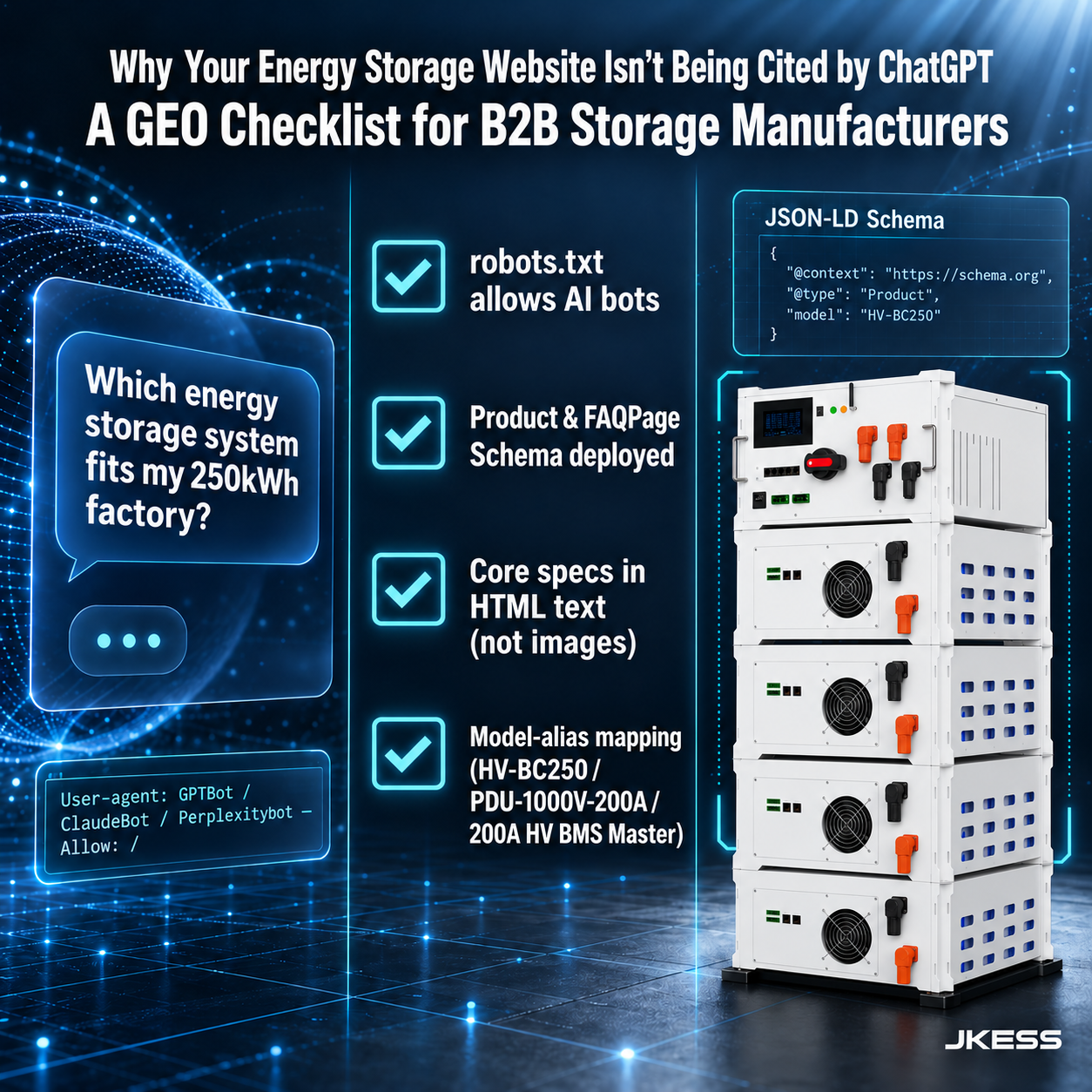
Teie ostja võib küsida ChatGPT-lt enne tarnijate veebisaitide võrdlemist. Kui teie toote tehnilised andmed on esitatud ainult piltidena, teie veebisait takistab otsingumootorite krawlereid või teie mudelinumbreid kasutatakse ebakohaselt, siis teie teave võib vastusest puudu olla.
Peamised märkused
- Ostuprotsess hõlmab nüüd ka AI-abil teostatavat uuringut. Ostja saab küsida: „Milline süsteem sobib minu 250 kWh tööstuslikku vajadust?“ enne üksikute tarnijate lehtede avamist.
- Tehke oma faktid lihtsasti leitavaks ja kontrollitavaks. Avaldage tehnilised spetsifikatsioonid nähtavana HTML-tekstina koos ühikutega, töötingimustega, allikatega ja selgete tooteidentifikaatoritega.
- Kontrollige seitsme AI-nähtavuse punkti: käru ligipääs, sobiv Schema, tegelike andmete tihedus, mudeli aliasi kooskõla, HTML-specifikatsioonid, küsimuste ja vastuste struktuur ning valikuline juhend llms.txt failis. Need hõlmavad praktilisi ligipääsu- ja sisuriske, mitte seitsme kohustuslikku rangelt määratletud positsioonimisnõuet.
- Ühele tootele vajalik ühtne identiteet. Sobitage nimed nagu HV-BC250 (sisemine PDU-tähis) ja „200A HV BMS Master“ ainult pärast seda, kui on kinnitatud, et need viitavad samale versioonile.
- GEO on jätkuv sisuhaldus. Hoidke säilinud tõendusmaterjali, jälgige viiteid ja parandage ebatäpsed vastused. Ükski kontrollloend ei taga eelispositsiooni ChatGPT’is, Perplexitys või Google AI Ülevaadetes.
01 / Ostjareis
B2B-tellimisprotsess on juba muutunud
Tavapärane ostuprotsess algab otsinguga, jätkub mitme tarnija veebisaidil ja lõpeb lühikese nimekirjaga või päringuvormiga. AI-assistentide lisamine loob veel ühe sissepääsu: ostja saab tehnilise selgituse või võrdluse küsida juba enne tootja veebisaidile minemist. See teeb teie avalehele väljaspool oleva informatsiooni kvaliteedi üha olulisemaks.
Mõelge küsimustele, mida võivad esitada energiamahtude integraatorid või EPC-täiturid: „Milline kõrgpinge BESS toetab 4–16 alistatud aku kasti?“ „Mis on 2A aktiivse tasakaalustamisega BMS tehnilised parameetrid?“ „Millised muudatused on vajalikud C&I-energiamahtude projekteerimises nõrga võrgu korral?“ Need on näited ostjate soovist, mitte mõõdetud kasutusstatistikast. Igal küsimusel on vaja täpset vastust, mis eristab komponendi klassifikatsiooni täieliku süsteemi võimalustest.
Kui asjakohased faktid on raskesti kättesaadavad või vastuolulised, võib tehisintellekti poolt loodud vastus teie toodet välja jätta või kirjeldada seda valesti. Praktiline lahendus on avaldada selge ja allikas märgitud vastus usaldusväärsel lehel. Tehisintellekti poolt loodud vastused vajavad ikka kontrollimist ning nende nähtavus täiendab olemasolevaid otsingusid, jaotuskanaleid ja otse müügikanaleid.
02 / Otsing ja viide
Traditsiooniline SEO vs GEO: mis muutub tegelikult
Mõlemad valdkonnad ülekkuvad. See võrdlus kirjeldab nende põhialaseid rõhukohti; mõlemale on olulised kasulik sisu, tehniline ligipääsetavus ja usaldusväärne tõendusmaterjal.
| Traditsiooniline SEO | GEO (generatiivne mootori optimeerimine) |
|---|---|
| Võrk Saavutage nähtavus asjakohastes otsingutulemustes. | Võrk Kujutage end kasuliku, viidatava allikana tehisintellekti poolt loodud vastustes. |
| Optimeerimise fookus Otsinguintentsioon, asjakohane sisu, lingid ja tehniline kvaliteet. | Optimeerimise fookus Tagastatavad faktid, tõendid, selged üksused ja sobiv struktureeritud andmed. |
| Ostjate käitumine Sirvige tulemusi ja külastage tarnijate lehekülgi. | Ostjate käitumine Loe vastust, esita järgmisi küsimusi ja kontrolli toetavaid linke. |
| Sisu vorming Kasulikud toote- ja redaktsioonileheküljed, mis vastavad otsinguintentsioonile. | Sisu vorming Vastuseesmärgilised lõigud, kontrollitavad väärtused, tingimused ja selgelt märgitud erandid. |
| Krabimisligipääs Googlebot, Bingbot ja asjakohane indekseerimisinfrastruktuur. | Krabimisligipääs OAI-SearchBot, PerplexityBot, Claude-SearchBot ja Googlebot Google Search AI-omaduste jaoks. |
| Struktureeritud andmed Kirjelda sobivate lehekülgede sisu ja toeta rakendatavaid otsingufunktsioone. | Struktureeritud andmed Selgita omadusi ja seoseid seal, kus neid kasutatakse; see ei ole universaalne eeltingimus viitamiseks. |
| Kilpkonna Nähtavus ja olulisus otsingutulemuste lehel. | Kilpkonna Kas vastus valib, omistab ja esindab teie tõendeid täpselt. |
| Pildid Abiks olevad visuaalsed elemendid koos kirjeldava tekstiga ja sobivate alternatiivtekstidega. | Pildid Korda olulisi tehnilisi andmeid HTML-is; piltide lugemise võimekused erinevad teenuste kaupa. |
| Brändi ja mudeli nimed Tunnustatavad nimed pealkirjades, lehtedel ja linkides. | Brändi ja mudeli nimed Ühtsed peamised identifikaatorid, kinnitatud aliasnimed ja versioonipiirid. |
| Mõõtmed Impressioonid, positsioonid, klõpsud ja kvalifitseeritud konversioonid. | Mõõtmed URL-viited, täpsed brändimainimised, suunamised ja kvalifitseeritud päringud. |
| SEO aitab ostjaid sind leida. | GEO aitab sinu tõendusmaterjali osaks saada vastusest. |
03 / Töötav kontrollnimekiri
7-punktiline GEO kontrollnimekiri B2B-andmekogude veebisaitidele
-
Kontrolli robots.txt-faili ja luba soovitud otsinguspidajad
Eralda otsingusse juurdepääs mudeli õppimise eelistustest. OpenAI tuvastab OAI-SearchBot oma otsinguspidajana ja GPTBot õppimispidajana. PerplexityBot toetab Perplexity otsingut; Claude-SearchBot toetab Claude otsingut, samas kui ClaudeBot puudutab mudeliarendust. Googlebot reguleerib Google'i otsingu jaoks (sh selle AI-võimaluste jaoks) pärimist; Google-Extended on eraldi regulaator muudeks kasutusteks.
Kontrolli olemasolevaid kasutajanime-gruppe, sümbolitega reegleid, teepiiranguid ning CDN-i või tulemüüri seadeid. Tavalise robots.txt käitumise kohaselt ei tähenda
Allowpuudumine automaatselt juurdepääsu keelamist. Selge poliitika saavutamiseks võib olla kasulik määrata kindel grupp.# Example for a public marketing website.# Merge with the existing policy; preserve intentional path restrictions.User-agent: OAI-SearchBotAllow: /User-agent: PerplexityBotAllow: /User-agent: Claude-SearchBotAllow: /User-agent: GooglebotAllow: /Määrake GPTBot, ClaudeBot ja Google-Extendedi poliitikad eraldi vastavalt soovitud sisukasutusele. Kontrollige lõplikke ühendatud reegleid ja tegelikke kihutajate päringuid.
Viited: OpenAI kihutaja dokumentatsioon ,Perplexity kihutajad ,Anthropic kihutaja dokumentatsioon , ja Google kihutaja juhtimisvõimalused .
-
Kasutage skeemat, mis kirjeldab täpselt nähtavat lehte.
Kasutage struktureeritud andmeid, et muuta identifikaatorid ja omadused selgelt nähtavaks. Skeema peab kirjeldama seda lehte, mida külastaja tegelikult näeb, ilma toetamata väideteta ja erinevate tootevariantide segamiseta.
- Toode + additionalProperty: mudelispetsiifilised parameetrid, ühikud ja dokumenteeritud omadused.
- FAQPage: autentilised, nähtavad küsimused koos nende vastustega.
- Kuidas teha: täielik paigaldus- või käivitamisjuhend koos kõigi sammude ja ulatusega.
- Artikkel: toimetaja pealkiri, autor, avaldamise kuupäev ja kanoniline lehekülg.
- Organisatsioon: ettevõtte ühtlane nimi, URL ja kinnitatud kontaktandmed.
Kontrollige JSON-i süntaks ja väljade tähendus ning võrrelge seejärel iga märgistatud lauset renderdatud lehega. Blogipostitus, mis arutleb mitme toote üle, ei ole automaatselt tooteüksikute leht.
Sobivus ei ole lubadus. Google ütleb, et selle AI-otsingufunktsioonid ei nõua erilist Schema-d ega AI-spetsiifilisi faile. Schema.org kehtivus, platvormi tugi ja tegelik kaasamine on eraldi küsimused.
Viited: Schema.org additionalProperty ,Sagiküsimuste leht , ja Google’i tehisintellekti funktsioonide juhised .
-
Suurenda kasulike faktide tihedust
Asenda toetamata omadussõnad väitega, mille ostja saab kontrollida. Esita järeldus esimesena, säilita iga lõigu fookus ja anna mudel, ühik, töötingimus ja allikas, mida väärtuse tõlgendamiseks vajatakse.
Enne / Promotsiooniline „JKESS pakub tööstuses juhtivat aktiivset tasakaalustustehnoloogiat üleliialise jõudlusega.“Pärast / Täpne ja atribueeritav „JKESS tehnilises kirjanduses on kirjeldatud BMU-H5-16 seadet, millel on 2 A aktiivne tasakaalustus, ±0,005 V täpsusega rakupinge mõõtmine, kaheksa NTC temperatuurisensorit ja 16S LiFePO4 tugi. Kontrolli need väärtused täpselt tarnitud versiooni põhjal.“Ära ühenda vastuolus olevatest dokumentidest pärit väärtusi uueks spetsifikatsiooniks. Kui tooteleht ja andmeleht ei kattu, lahenda erinevus tooteomanikuga ja uuenda mõlemat allikat enne, kui ühtegi neist peetakse kindlaks.
Näidisallikas: JKESS tehniline arutelu BMU-H5-16 kohta avalikud lehed võivad sisaldada versioonierinevusi; kehtiv heakskiidetud andmeleht on avaldamise viide.
-
Ehita kinnitatud mudeli–aliasi vastavuste kaart
Anna igale tootele üks peamine nimi ja üks kanoniline tooteleht. Hoia kirje, mis ühendab turundusnime, inseneritähisnumbrit, tooteversiooni ja piirkondlikke nimetustega variante.
Esitatud nimetuse näide on HV-BC250 / PDU-1000V-200A-A001-NY / 200A HV BMS Master Box see on aliasi suhe, mille tõepärasust tuleb kinnitada, mitte tõend selle kohta, et identifikaatorid oleksid vahetuvad. Kui insenerid kinnitavad sobivuse, kirjuta: „HV-BC250, mida tuntakse ka kui PDU-1000V-200A-A001-NY, on 200A HV BMS Master Box.“
Kasuta peamist nime pealkirjas ja H1-s; paiguta kinnitatud aliasid avasisesse lõppu ja sobivatesse tooteväliadesse, näiteks
alternateNamevõimpnsäilita eraldi identiteet, kui versioonimuudatus muudab tehnilisi andmeid, liideseid või tarnitava komplekti ulatust. -
Hoia põhitäpsusi nähtavas HTML-is
Kirjutage võtmeväärtused lehe sisse. Pinge, vool, täpsus, mõõtmed, testitingimused ja tarnimisulatus peavad jääma kättesaadavaks tavalise tekstina ja semantiliselt
cells.
Image extraction and JavaScript rendering differ between crawlers and retrieval tools. Text inside a photograph, iframe, or canvas is therefore an unreliable sole source for a critical parameter. Alt text helps describe an image, but it does not replace a visible specification table.
Publish a dated datasheet alongside the HTML table. Distinguish nominal voltage from the operating envelope, continuous current from peak current, and empty-kit weight from the weight of an assembled module.
Answer real buyer questions directly
Build a useful set of questions around the buying decision: “How many slave boxes can one master box support?” “Does the kit include battery cells?” “Which communication protocols are provided?” Answer first, then give the limits and source.
Five to ten FAQs can be a practical editorial target when the topic warrants them; there is no universal minimum. Native
When adding FAQPage markup, use the same question and answer wording as the visible page. Do not add invisible FAQ claims just to target search queries. This article includes ten visible FAQs and marks up five of them.
Consider an optional llms.txt reading guide
llms.txtis a proposed Markdown convention for guiding agents to useful website content. A concise guide can list the company, core products, application pages, and maintained technical documents. It is useful only to consumers that choose to read it.# JKESS Electronic Technology BMS and active balancing solutions for energy storage.## Core Products- [HV-BC250 200A Master Box](https://www.jkess.com/200a-hv-bms-master)- [HV-B6U Slave Battery Box Kits](https://www.jkess.com/hv-slave-6u-kits)- [261kWh Liquid-Cooled BESS Kits](https://www.jkess.com/commercial--industrial-energy-storage-system-kits)## Application Guides- [Modular HV Energy Storage Kits](https://www.jkess.com/home-energy-storage-system-kits)## Technical DocumentsUse the current specifications and scope-of-supply notes on the product pages.Add approved, versioned datasheet links when those documents are published.Illustrative content, not a report of the live site’s configuration. Use verified links and clean Markdown versions where available. Maintaining this file does not deploy robots.txt rules or create search eligibility.
References: the llms.txt proposal and Google’s generative AI optimization guidance. Google Search does not use llms.txt as a special visibility or ranking input.
04 / Content in practice
Before and After: Rewriting a Storage Product Page for AI Citation
The following five examples replace broad promotion with a more useful answer. Numerical illustrations include their assumptions; commercial and certification statements require current, model-specific evidence.
Illustrative rewrites. Calculations are not measured performance guarantees. Before / Marketing copy After / Evidence-led copy “Our advanced active balancing BMS delivers superior performance and extends battery life.” “For an illustrative 314Ah cell with a 0.5% charge difference, ΔQ = 314 × 0.005 = 1.57Ah. At a constant 2A transfer current, the idealized duration is 1.57 ÷ 2 = 0.785 hours, or about 47 minutes. Real duration depends on current limits, control behavior, and losses.” “The system supports a wide voltage range for various applications.” “The HV-BC250 listing specifies an 80–1000V DC master range. A 4–16 slave-box configuration is described as approximately 64–256kWh when each box is approximately 16kWh. With 16 cells per box and 3.2V nominal per cell, 16 boxes yield 256S / 819.2V nominal. Verify the full charge/discharge range and selected cell capacity.” “Our battery boxes are designed for easy installation.” “Define the scope as one master plus five slave boxes: six enclosures in total. State empty-kit and assembled-module weights separately, together with the lifting and installation plan. A claimed 28.55kg kit weight or two-technician, 2–3 day schedule requires a matching product record and a defined site scope.” “We provide reliable products with international certifications.” “List the exact model and revision, applicable CE declaration, RoHS documentation, FCC evidence, and test-report identifiers. If citing GB34131-2017 or insulation resistance ≥1 MΩ at 1,000 VDC, verify the applicable standard edition, test method, and report scope rather than extending a component claim to the whole system.” “Contact us for more information.” “Send your required capacity, DC range, current, communication protocol, scope of supply, quantity, and delivery location to [email protected]. Request confirmation of available regional stock and a written dispatch estimate for that configuration.” Product references: HV-BC250 and modular storage kits. The 64–256kWh shorthand is configuration-dependent; a hardware kit without cells does not itself contain that stored energy.
05 / Access and extraction
Technical Access: Can AI Crawlers Actually Read Your Website?
Check 1 / robots.txt and access controls
Open
https://yourdomain.com/robots.txtand evaluate the user-agent group and path rules that apply to each intended crawler. Inspect firewall challenges, blocked IP ranges, redirects, and server errors as well.Absence of an explicit Allow is not a failure by itself. Use the actual response and verified crawler logs to determine what is accessible.
Check 2 / Core content in HTML
Disable JavaScript and reload the product page. Check the original HTML response for the model name, specification table, scope of supply, and answers.
If they disappear, the page depends on rendering that some tools may not perform. Prefer server-rendered or static core content, and use a search engine’s inspection tools where available. Also check
noindex, snippet restrictions, andX-Robots-Tagheaders.Check 3 / Descriptive alt text
Describe informative product photographs, diagrams, and screenshots with suitable alt text. Keep purely decorative images from adding noise.
Repeat important values in the visible body or a real HTML table. A long alt attribute is not a substitute for a readable technical specification.
Check 4 / Reliable loading and delivery
Confirm that the canonical page returns a successful response and delivers useful content promptly. Reduce unnecessary third-party scripts, oversized payloads, and client-side dependencies.
Timeouts, errors, and rendering limits can interfere with retrieval. A model’s context budget is a separate issue from network performance; there is no universal “AI loading time” threshold.
Check 5 / Canonical URLs and model identity
Identify duplicate URLs for the same item and use a consistent canonical URL, internal links, and sitemap entries. For example, reconcile two product paths that describe the same HV-BC250 revision.
A canonical URL signals a preferred page; it does not by itself resolve conflicting specifications or prove that two product names are equivalent.
Access references: robots.txt interpretation and the crawler documentation linked in checkpoint 1.
06 / Evidence of progress
How to Measure Whether GEO Is Working
Pair answer-level observations with business outcomes. Metric Traditional SEO measure GEO measure Visibility Search impressions and keyword positions. Share of sampled AI answers citing an owned URL; track brand mentions separately. Traffic Organic search clicks and visits. Identifiable AI referrals; brand-search changes as supporting, non-causal evidence. Content Engagement and landing-page performance. Which facts and pages are cited, and whether values and limitations are correct. Conversion Forms, qualified leads, and sales. Qualified inquiries with an AI discovery source or attributable referral. Competition Relative search visibility. Citation share and co-mentions within the same fixed question set. Audit Indexability, search-intent coverage, and page quality. Entity consistency, evidence freshness, extractable facts, and markup accuracy. A practical weekly baseline: run ten fixed buyer questions in ChatGPT search, Perplexity, and Google AI Overviews where an overview appears. Repeat the sample and log platform, date, locale, model or mode, exact question, cited URL, brand mention, and answer accuracy.
Citation rate = answers linking to your domain ÷ eligible sampled answers. Report the sample size and the number of queries without an AI answer. A brand mention without a source link is not a citation. Use a separate measure for citations to this specific article.
For example, six cited answers out of 30 eligible observations produce a 20% sample citation rate. This is an illustrative calculation, not a JKESS result. Keep the question set stable when comparing periods, and avoid treating a single answer or a small change as proof that one edit caused an improvement.
07 / Applying the method
How JKESS Applies GEO to Its Own Product Pages
The reviewed JKESS master-box and 261kWh application pages expose technical information in readable tables. That is a useful starting point. The following seven practices form an implementation and maintenance checklist, rather than a claim that every page has already passed a site-wide audit.
- Maintain structured specification tables. Keep each voltage, current, accuracy, dimension, and weight value in visible HTML, tied to a model, revision, and source. Separate component ratings from complete-system limits.
- Keep FAQs useful and consistent. Write five to ten relevant answers when justified by the product; align any FAQPage markup with the exact visible wording and recheck answers after product changes.
- Use model-specific Product markup. Validate Product and additionalProperty on the appropriate HV-BC250, HV-B6U, and 261kWh pages. Record evidence of the deployed markup rather than assuming site-wide coverage.
- Control aliases. Confirm any relationship between HV-BC250 and PDU-1000V-200A-A001-NY, then use one primary name with the approved aliases. Keep HV-BC150-100A as a distinct product identity.
- Reconcile quantitative claims. Check the 2A active balancing and ±0.005V sampling values against the supplied BMU revision. Keep the 4–16 slave-box and 64–256kWh statements linked to their cell and configuration assumptions.
- Maintain an optional llms.txt guide. If deployed, list current canonical product and documentation URLs, remove stale links, and treat it as documentation support rather than an indexing requirement.
- Verify search access. Review the live robots.txt policy and crawler delivery logs. Confirm intended access for search bots while managing training-related controls independently.
JKESS product and specification anchors
HV-BC250 · 200A HV BMS Master · HV-BC150-100A · 100A master configuration · HV-B6U · 6U slave battery box kits · BMU-H5-16 · technical reference · 261kWh liquid-cooled system
Values to keep in context: 2A active balancing · ±0.005V sampling accuracy · 4–16 slave battery boxes · approximately 64–256kWh · 80–1000V DC master range. These refer to different components or configurations, not a single universal specification. Kits are offered without battery cells; confirm the final scope of supply.
08 / Questions buyers ask
Frequently Asked Questions
What is GEO and how does it differ from traditional SEO?
GEO (Generative Engine Optimization) is the practice of making useful content easier to retrieve, understand, and cite in AI-generated answers. Traditional SEO emphasizes visibility in search results, while GEO also tracks how accurately a brand and its facts appear in generated responses. Both benefit from accessible pages, clear product identities, and reliable evidence; neither guarantees inclusion.
Why is my energy storage website not being cited by ChatGPT?
Possible causes include blocked search crawlers, unindexed pages, specifications that are difficult to extract, inconsistent model names, or weak evidence for the question being asked. For ChatGPT search, review OAI-SearchBot access rather than assuming GPTBot controls search visibility. Missing Schema or llms.txt alone does not prove why a page was omitted; compare crawl evidence, content relevance, and repeated query results.
What is llms.txt and why does it matter for B2B storage websites?
llms.txt is a proposed Markdown-based guide to a website’s useful content, which can point agents to product documentation and application guides. It can help tools that choose to use it, but adoption and behavior differ between services. Treat it as optional documentation infrastructure, not a requirement for AI citation or a replacement for HTML pages and sitemaps.
How do I check if AI crawlers can access my website?
Inspect the robots.txt groups and path rules that apply to OAI-SearchBot, PerplexityBot, Claude-SearchBot, and Googlebot, then review server and firewall logs. A missing explicit Allow rule does not by itself mean access is denied. Also check HTTP responses, indexing and snippet controls, and whether product specifications are available without JavaScript; a browser-only test does not confirm a crawler’s actual access.
What Schema markup should a B2B storage website prioritize?
Use Product with additionalProperty on product pages, Article on editorial pages, and Organization for the company identity. FAQPage can describe visible questions and answers, and HowTo can describe a genuine procedural guide. Keep markup aligned with the visible content and applicable platform documentation; valid Schema does not guarantee a rich result or an AI citation.
How does inconsistent product naming affect AI visibility?
Different names for the same item can make it harder for readers and retrieval systems to connect the information. Select one primary model name and record verified aliases, product revisions, and one canonical URL. Publish an “also known as” relationship only after the model owner confirms that the labels identify the same product and configuration.
What is fact density and why does it matter for GEO?
Fact density is an editorial measure of how much useful, verifiable information a passage contains relative to general promotional language. A model-specific value with units, operating conditions, and a dated source is more useful than an unsupported adjective. Values such as 2A active balancing, ±0.005V sampling accuracy, and an 80–1000V DC range must stay attached to the correct component; fact density is not a published universal AI ranking score.
How do I measure GEO performance for my storage website?
Run a fixed set of buyer questions repeatedly and log the date, platform, search mode, locale, cited URLs, and answer accuracy. Report URL citation rate separately from unlinked brand mentions, and track identifiable referral visits and qualified inquiries. Results fluctuate, so a small weekly sample is directional evidence rather than a complete view of all buyers or proof of causation.
Does GEO replace traditional SEO for B2B storage manufacturers?
No. Search indexing, useful content, internal links, and a dependable website remain relevant to both conventional search and AI-assisted research. GEO adds attention to answer-level representation, traceable facts, and citation measurement. An effective program maintains those foundations while checking whether buyers receive accurate product information.
How does JKESS apply GEO principles to its own product pages?
The JKESS pages reviewed for this article provide examples of HTML specifications and question-and-answer content for products including the HV-BC250 and the 261kWh liquid-cooled system. The seven-part workflow below extends that approach to the HV-BC150-100A, HV-B6U, and BMU-H5-16 through consistent naming, source review, and structured content. This article does not certify site-wide Schema coverage, crawler settings, or an existing llms.txt deployment; those require a current implementation audit.
Want to Audit Your Storage Website’s AI Visibility?
Share your website URL with our team. We’ll review your robots.txt, Schema markup, fact density, and entity consistency — and help identify where crawlers or readers may be missing your product information.
Request a Custom Quote→