
 EN
جکس / بینشهای مهندسی
دریافت نقلقول →چرا وبسایت ذخیرهسازی انرژی شما توسط چتجیپیتی نقلقول نمیشود: فهرست بازرسی جغرافیایی (گِئو) برای سازندگان حرفهای ذخیرهسازی
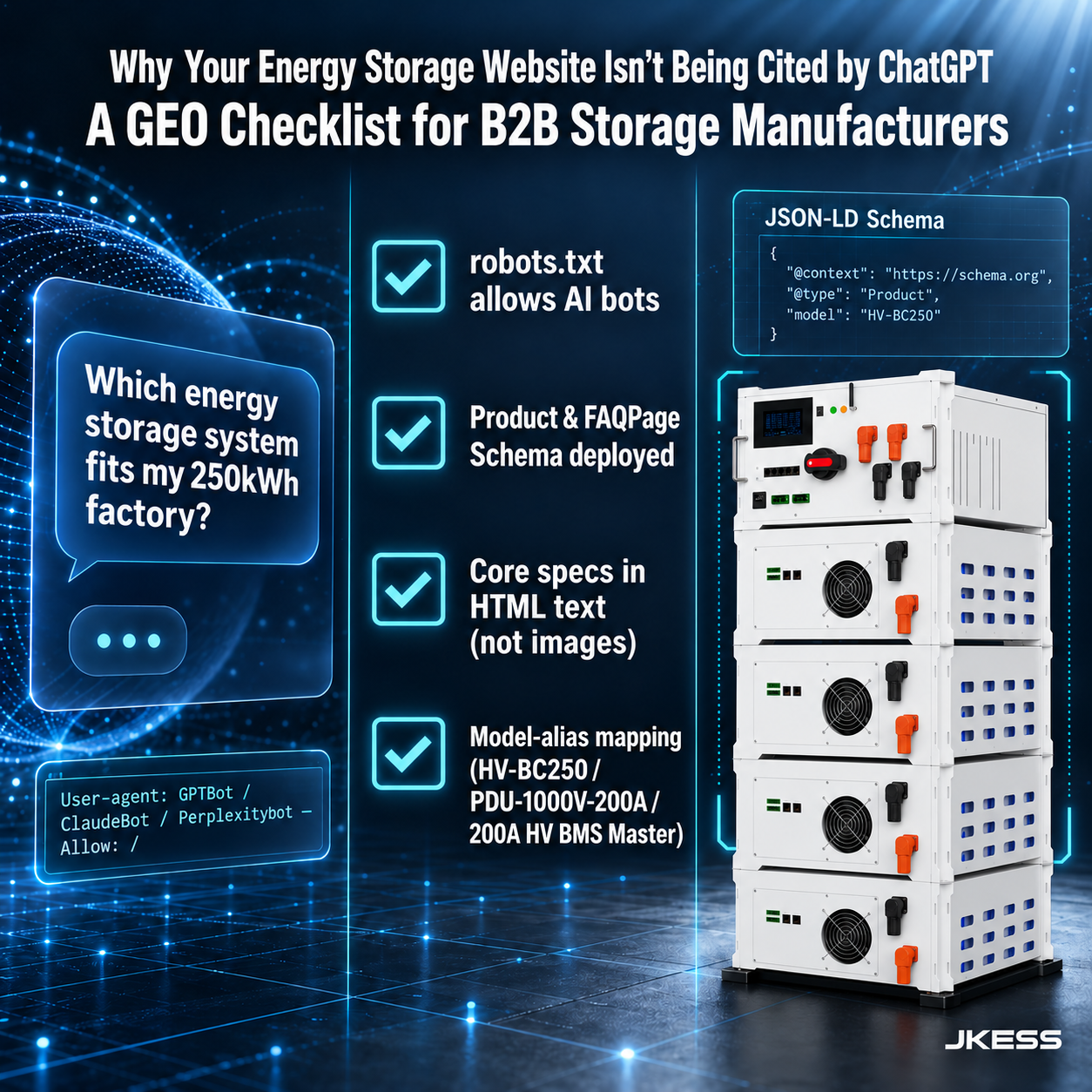
خریدار شما ممکن است پیش از مقایسهٔ وبسایتهای تأمینکنندگان، از چتجیپیتی سؤال کند. اگر مشخصات محصول شما تنها در تصاویر موجود باشد، وبسایت شما برای رباتهای جستجو غیرقابل دسترس باشد یا شمارههای مدل شما ناسازگان باشند، اطلاعات شما ممکن است در پاسخ حذف شوند.
نکات کلیدی
- مسیر خرید اکنون شامل تحقیق کمکشده توسط هوش مصنوعی است. خریدار میتواند پیش از باز کردن صفحات جداگانهٔ تأمینکنندگان، بپرسد: «کدام سیستم برای نیاز کارخانهٔ من به ظرفیت ۲۵۰ کیلوواتساعت مناسب است؟»
- حقایق خود را برای بازیابی و بررسی آسان کنید. مشخصات فنی را بهصورت متن اچتیامال قابلمشاهده منتشر کنید، همراه با واحدها، شرایط کاری، منابع و شناسههای روشن محصول.
- هفت نقطهٔ بازرسی قابلیت دید هوش مصنوعی را بررسی کنید: دسترسی کrawler، طرحبندی مناسب Schema، تراکم واقعیتها، سازگانی نامهای مدل، مشخصات HTML، ساختار پرسش و پاسخ و راهنمای اختیاری llms.txt. این موارد خطرات عملی دسترسی و محتوا را پوشش میدهند؛ اما هفت شرط اجباری رتبهبندی نیستند.
- هر محصول نیازمند یک هویت سازگانی است. نامهایی مانند HV-BC250، که شناسه داخلی PDU است، و «200A HV BMS Master» را تنها پس از تأیید اینکه به یک نسخه واحد اشاره دارند، همسانسازی کنید.
- GEO مدیریت مداوم محتوا است. شواهد را حفظ کنید، استنادات را زیر نظر بگیرید و پاسخهای نادرست را اصلاح نمایید. هیچ فهرست بازرسیای نمیتواند جایگاه اولویت در ChatGPT، Perplexity یا مرورهای هوش مصنوعی گوگل را تضمین کند.
۰۱ / سفر خریدار
جریان خرید B2B از پیش تغییر کرده است.
سفر آشنا و مرسوم خرید با جستجویی آغاز میشود، از چندین وبسایت تأمینکننده عبور میکند و با انتخاب لیست کوتاه یا پر کردن فرم استعلام به پایان میرسد. دستیارهای هوشمند مصنوعی نقطهٔ ورودی دیگری را ایجاد میکنند: خریدار میتواند پیش از بازدید از وبسایت سازنده، درخواست توضیح فنی یا مقایسهای را ارائه دهد. این امر کیفیت اطلاعات موجود خارج از صفحهٔ اصلی شما را بهطور فزایندهای مهم میسازد.
سوالاتی را که یک ادغامکنندهٔ سیستمهای ذخیرهسازی یا پیمانکار EPC ممکن است مطرح کند در نظر بگیرید: «کدام سیستم ذخیرهسازی انرژی با ولتاژ بالا (BESS) از ۴ تا ۱۶ جعبهٔ باتری فرعی پشتیبانی میکند؟» «پارامترهای فنی سیستم مدیریت باتری (BMS) با قابلیت موازنهٔ فعال ۲ آمپری چیست؟» «در طراحی سیستمهای ذخیرهسازی برای صنعت و تجارت (C&I)، در شبکههای ضعیف چه تغییراتی ایجاد میشود؟» اینها نمونههایی از قصد خریدار هستند، نه آمارهای اندازهگیریشدهٔ پذیرش. هر یک نیازمند پاسخ دقیقی است که توانایی یک مؤلفه را از توانایی یک سیستم کامل متمایز کند.
اگر حقایق مربوطه دستیافتنی نباشند یا با یکدیگر در تضاد باشند، پاسخ تولیدشده ممکن است محصول شما را نادیده بگیرد یا بهصورت نادرست توصیف کند. راهحل عملی این است که پاسخی روشن و قابلنسبتکردن را بر صفحهای مطمئن منتشر کنید. پاسخهای تولیدشده توسط هوش مصنوعی نیز همچنان نیازمند تأیید هستند و حضور در این پاسخها، کانالهای رایج جستجو، توزیعکنندگان و فروش مستقیم را تقویت میکند.
۰۲ / جستجو و استناد
سئوی سنتی در مقابل جیاو (بهینهسازی موتورهای تولیدکننده): در واقع چه چیزی تغییر میکند؟
این دو رشته همپوشانی دارند. این مقایسه بر روی حوزههای اصلی تأکید آنها تمرکز دارد؛ محتوای مفید، دسترسی فنی و شواهد معتبر برای هر دو اهمیت دارند.
| سئوی سنتی | جیاو (بهینهسازی موتورهای تولیدکننده) |
|---|---|
| هدف دستیابی به قابلیت مشاهدهشدن در نتایج جستجوی مرتبط. | هدف تبدیلشدن به منبعی مفید و مورداستناد در پاسخهای تولیدشده توسط هوش مصنوعی. |
| تمرکز بهینهسازی قصد جستجو، محتوای مرتبط، پیوندها و کیفیت فنی. | تمرکز بهینهسازی حقایق قابل بازیابی، شواهد، موجودیتهای روشن و دادههای ساختاریافته مناسب. |
| رفتار خریداران مرور نتایج و بازدید از صفحات تأمینکنندگان. | رفتار خریداران خواندن پاسخ، پرسیدن سؤالات تکمیلی و بررسی پیوندهای پشتیبان. |
| فرمت محتوا صفحات مفید محصول و ویراستاری که با هدف جستجو همسو هستند. | فرمت محتوا پاراگرافهایی با رویکرد «پاسخ اول»، مقادیر قابل تأیید، شرایط و استثناهای صریح. |
| دسترسی خزندهها گوگلبوت، بینگبوت و زیرساخت فهرستبندی مربوطه. | دسترسی خزندهها اوآیآی-سرچبوت، پرپلکسیتیبوت، کلود-سرچبوت و گوگلبوت برای ویژگیهای هوش مصنوعی جستجوی گوگل. |
| دادههای ساختاریافته توصیف محتوای صفحات واجد شرایط و پشتیبانی از ویژگیهای جستجوی قابل اعمال. | دادههای ساختاریافته روشنسازی ویژگیها و روابط در جایی که مصرف میشوند؛ نه یک پیشنیاز عمومی برای ارجاع. |
| رقیب قابلمشاهدهبودن و ارتباط با صفحهٔ نتایج جستجو. | رقیب اینکه آیا پاسخ منابع شما را انتخاب میکند، به آنها نسبت میدهد و بهدرستی نمایش میدهد. |
| تصاویر تصاویر مفید همراه با متن توصیفی و ویژگیهای «alt» مناسب. | تصاویر تکرار مشخصات حیاتی در HTML؛ قابلیتهای خواندن تصویر بسته به سرویس متفاوت است. |
| نامهای برند و مدل نامهای قابل تشخیص در عناوین، صفحات و پیوندها. | نامهای برند و مدل شناسههای اصلی سازگانیافته، نامهای جایگزین تأییدشده و مرزهای بازنگری. |
| اندازهگیری تعداد نمایشها، رتبهبندیها، کلیکها و تبدیلهای واجدشرایط. | اندازهگیری ارجاع به URLها، ذکر دقیق نام برند، ارجاعدهیها و استعلامات واجدشرایط. |
| سئو به خریداران کمک میکند تا شما را پیدا کنند. | جئو باعث میشود شواهد شما بخشی از پاسخ شوند. |
۰۳ / چکلیست عملیاتی
چکلیست هفتگانهٔ جئو برای وبسایتهای ذخیرهسازی B2B
-
فایل robots.txt را بررسی کنید و به خزندههای جستجوی مورد نظر دسترسی بدهید.
دسترسی جستجو را از ترجیحات آموزش مدل جدا کنید. اوپنایآی خزندهٔ جستجوی خود را OAI-SearchBot و خزندهٔ آموزشی خود را GPTBot مینامد. PerplexityBot برای جستجوی Perplexity طراحی شده است؛ Claude-SearchBot برای جستجوی Claude و ClaudeBot مربوط به توسعهٔ مدل است. Googlebot کنترلکنندهٔ خزندهبرداری برای جستجوی گوگل، از جمله ویژگیهای هوش مصنوعی آن است؛ Google-Extended کنترلکنندهٔ جداگانهای برای سایر کاربردها است.
گروههای موجود کاربر-عامل، قوانین واگذاری با الگوی ستارهای (*)، محدودیتهای مسیر و تنظیمات CDN یا فایروال را بررسی کنید. در رفتار استاندارد فایل robots.txt، عدم وجود یک گروه صریح
Allowبهطور خودکار دسترسی را ممنوع نمیکند. یک گروه صریح میتواند سیاست مورد نظر را شفافتر کند.# Example for a public marketing website.# Merge with the existing policy; preserve intentional path restrictions.User-agent: OAI-SearchBotAllow: /User-agent: PerplexityBotAllow: /User-agent: Claude-SearchBotAllow: /User-agent: GooglebotAllow: /سیاستهای GPTBot، ClaudeBot و Google-Extended را بهصورت جداگانه بر اساس کاربرد مورد نظر محتوا تنظیم کنید. قوانین ادغامشده نهایی و درخواستهای واقعی پیمایشگرها را تأیید کنید.
مرجع: مستندات پیمایشگر OpenAI ,پیمایشگرهای Perplexity ,مستندات پیمایشگر Anthropic و کنترلهای پیمایشگر Google .
-
اسکیما را پیادهسازی کنید که بهدرستی صفحهٔ قابلمشاهده را توصیف کند.
از دادههای ساختاریافته برای روشنسازی شناسهها و ویژگیها استفاده کنید. اسکیما باید صفحهای را که بازدیدکننده واقعاً مشاهده میکند توصیف کند، بدون افزودن ادعاهای پشتیبانینشده یا ترکیب انواع مختلف محصول.
- محصول + ویژگی اضافی: پارامترهای خاص مدل، واحدها و ویژگیهای مستندشده.
- صفحهٔ پرسشوپاسخ: سوالهای اصیل و قابل مشاهده همراه با پاسخهای مربوط به آنها.
- چگونه: راهنمای نصب یا راهاندازی واقعی با مراحل و محدودهٔ کامل.
- ماده: عنوان اصلی محتوا، نویسنده، تاریخ انتشار و آدرس ثابت صفحه.
- سازماندهی: نام ثابت شرکت، نشانی اینترنتی و اطلاعات تماس تأییدشدهٔ آن.
سینتکس جیسون و معنای فیلدها را تأیید کنید، سپس هر گزارهٔ علامتگذاریشده را با صفحهٔ نمایشدادهشده مقایسه کنید. وبلاگی که دربارهٔ چند محصول بحث میکند، بهطور خودکار صفحهٔ جزئیات محصول محسوب نمیشود.
اجراپذیری بهمعنای تعهد نیست. گوگل اعلام کرده است که ویژگیهای جستجوی هوشمند آن نیازی به اسکیماهای خاص یا فایلهای مخصوص هوشمند ندارند. اعتبار اسکیما.اورگ، پشتیبانی پلتفرم و درج واقعی موارد، سؤالاتی جداگانه هستند.
مرجع: اسکیما.اورگ additionalProperty ,FAQPage و راهنمای ویژگیهای هوش مصنوعی گوگل .
-
افزایش تراکم واقعیتهای مفید
جایگزین کردن صفات غیرپشتیبانیشده با ادعایی که خریدار بتواند آن را تأیید کند. نتیجه را در ابتدا بیاورید، هر پاراگراف را متمرکز نگه دارید و مدل، واحد، شرایط کاری و منبع لازم برای تفسیر مقدار را ارائه دهید.
قبل از / تبلیغاتی «سیستم JKESS فناوری متعادلسازی فعال پیشرو در صنعت را با عملکرد برتر ارائه میدهد.»بعد از / مشخص و قابل نسبتدهی «مستندات فنی JKESS دربارهٔ ماژول BMU-H5-16 بهصورت زیر توضیح میدهد: جریان متعادلسازی فعال ۲ آمپر، دقت نمونهبرداری از ولتاژ سلولی ±۰٫۰۰۵ ولت، هشت سنسور دمایی NTC و پشتیبانی از باتریهای ۱۶S LiFePO4. این مقادیر را در مقابل نسخهٔ دقیق ارائهشده تأیید کنید.»مقادیر موجود در اسناد متضاد را در یک مشخصات جدید ترکیب نکنید. اگر صفحهٔ محصول و برگهٔ مشخصات فنی با هم مغایرت داشتند، این تناقض را با مالک محصول حل کنید و هر دو منبع را پیش از اینکه هر یک را بهعنوان مرجع قطعی در نظر بگیرید، بهروزرسانی کنید.
منبع نمونه: بحث فنی JKESS دربارهٔ ماژول BMU-H5-16 صفحات عمومی ممکن است تفاوتهای نسخهبندی داشته باشند؛ صفحهی دادهی تأییدشدهی فعلی، مرجع انتشار باقی میماند.
-
یک نقشهی معتبر از مدل به نام مستعار بسازید
هر محصول را یک نام اصلی و یک صفحهی محصول کانونیکال در نظر بگیرید. سوابقی از نام بازاریابی، شناسهی مهندسی، نسخهی محصول و هر گونه تنوع در نامگذاری منطقهای را نگهداری کنید.
مثال ارائهشده برای نامگذاری این است: HV-BC250 / PDU-1000V-200A-A001-NY / 200A HV BMS Master Box این یک رابطهی نام مستعار برای تأیید است، نه شواهدی از قابلتبادلبودن شناسهها. اگر مهندسان تطابق را تأیید کنند، بنویسید: «HV-BC250 که همچنین به نام PDU-1000V-200A-A001-NY شناخته میشود، جعبهی اصلی سیستم مدیریت باتری ولتاژ بالا (HV BMS) ۲۰۰ آمپری است.»
از نام اصلی در عنوان و برچسب H1 استفاده کنید؛ نامهای مستعار تأییدشده را در پاراگراف اول و در فیلدهای مناسب محصول مانند ... قرار دهید.
alternateNameیاmpnهنگامی که تغییر نسخه، مشخصات فنی، رابطها یا محدودهی تأمین را تغییر دهد، هویت جداگانهای حفظ کنید. -
مشخصات اصلی را در HTML قابلمشاهده نگه دارید.
مقادیر کلیدی را مستقیماً در خود صفحه بنویسید. ولتاژ، جریان، دقت، ابعاد، شرایط آزمون و محدوده تأمین باید بهصورت متن ساده و معنایی در دسترس باشند
cells.
Image extraction and JavaScript rendering differ between crawlers and retrieval tools. Text inside a photograph, iframe, or canvas is therefore an unreliable sole source for a critical parameter. Alt text helps describe an image, but it does not replace a visible specification table.
Publish a dated datasheet alongside the HTML table. Distinguish nominal voltage from the operating envelope, continuous current from peak current, and empty-kit weight from the weight of an assembled module.
Answer real buyer questions directly
Build a useful set of questions around the buying decision: “How many slave boxes can one master box support?” “Does the kit include battery cells?” “Which communication protocols are provided?” Answer first, then give the limits and source.
Five to ten FAQs can be a practical editorial target when the topic warrants them; there is no universal minimum. Native
When adding FAQPage markup, use the same question and answer wording as the visible page. Do not add invisible FAQ claims just to target search queries. This article includes ten visible FAQs and marks up five of them.
Consider an optional llms.txt reading guide
llms.txtis a proposed Markdown convention for guiding agents to useful website content. A concise guide can list the company, core products, application pages, and maintained technical documents. It is useful only to consumers that choose to read it.# JKESS Electronic Technology BMS and active balancing solutions for energy storage.## Core Products- [HV-BC250 200A Master Box](https://www.jkess.com/200a-hv-bms-master)- [HV-B6U Slave Battery Box Kits](https://www.jkess.com/hv-slave-6u-kits)- [261kWh Liquid-Cooled BESS Kits](https://www.jkess.com/commercial--industrial-energy-storage-system-kits)## Application Guides- [Modular HV Energy Storage Kits](https://www.jkess.com/home-energy-storage-system-kits)## Technical DocumentsUse the current specifications and scope-of-supply notes on the product pages.Add approved, versioned datasheet links when those documents are published.Illustrative content, not a report of the live site’s configuration. Use verified links and clean Markdown versions where available. Maintaining this file does not deploy robots.txt rules or create search eligibility.
References: the llms.txt proposal and Google’s generative AI optimization guidance. Google Search does not use llms.txt as a special visibility or ranking input.
04 / Content in practice
Before and After: Rewriting a Storage Product Page for AI Citation
The following five examples replace broad promotion with a more useful answer. Numerical illustrations include their assumptions; commercial and certification statements require current, model-specific evidence.
Illustrative rewrites. Calculations are not measured performance guarantees. Before / Marketing copy After / Evidence-led copy “Our advanced active balancing BMS delivers superior performance and extends battery life.” “For an illustrative 314Ah cell with a 0.5% charge difference, ΔQ = 314 × 0.005 = 1.57Ah. At a constant 2A transfer current, the idealized duration is 1.57 ÷ 2 = 0.785 hours, or about 47 minutes. Real duration depends on current limits, control behavior, and losses.” “The system supports a wide voltage range for various applications.” “The HV-BC250 listing specifies an 80–1000V DC master range. A 4–16 slave-box configuration is described as approximately 64–256kWh when each box is approximately 16kWh. With 16 cells per box and 3.2V nominal per cell, 16 boxes yield 256S / 819.2V nominal. Verify the full charge/discharge range and selected cell capacity.” “Our battery boxes are designed for easy installation.” “Define the scope as one master plus five slave boxes: six enclosures in total. State empty-kit and assembled-module weights separately, together with the lifting and installation plan. A claimed 28.55kg kit weight or two-technician, 2–3 day schedule requires a matching product record and a defined site scope.” “We provide reliable products with international certifications.” “List the exact model and revision, applicable CE declaration, RoHS documentation, FCC evidence, and test-report identifiers. If citing GB34131-2017 or insulation resistance ≥1 MΩ at 1,000 VDC, verify the applicable standard edition, test method, and report scope rather than extending a component claim to the whole system.” “Contact us for more information.” “Send your required capacity, DC range, current, communication protocol, scope of supply, quantity, and delivery location to [email protected]. Request confirmation of available regional stock and a written dispatch estimate for that configuration.” Product references: HV-BC250 and modular storage kits. The 64–256kWh shorthand is configuration-dependent; a hardware kit without cells does not itself contain that stored energy.
05 / Access and extraction
Technical Access: Can AI Crawlers Actually Read Your Website?
Check 1 / robots.txt and access controls
Open
https://yourdomain.com/robots.txtand evaluate the user-agent group and path rules that apply to each intended crawler. Inspect firewall challenges, blocked IP ranges, redirects, and server errors as well.Absence of an explicit Allow is not a failure by itself. Use the actual response and verified crawler logs to determine what is accessible.
Check 2 / Core content in HTML
Disable JavaScript and reload the product page. Check the original HTML response for the model name, specification table, scope of supply, and answers.
If they disappear, the page depends on rendering that some tools may not perform. Prefer server-rendered or static core content, and use a search engine’s inspection tools where available. Also check
noindex, snippet restrictions, andX-Robots-Tagheaders.Check 3 / Descriptive alt text
Describe informative product photographs, diagrams, and screenshots with suitable alt text. Keep purely decorative images from adding noise.
Repeat important values in the visible body or a real HTML table. A long alt attribute is not a substitute for a readable technical specification.
Check 4 / Reliable loading and delivery
Confirm that the canonical page returns a successful response and delivers useful content promptly. Reduce unnecessary third-party scripts, oversized payloads, and client-side dependencies.
Timeouts, errors, and rendering limits can interfere with retrieval. A model’s context budget is a separate issue from network performance; there is no universal “AI loading time” threshold.
Check 5 / Canonical URLs and model identity
Identify duplicate URLs for the same item and use a consistent canonical URL, internal links, and sitemap entries. For example, reconcile two product paths that describe the same HV-BC250 revision.
A canonical URL signals a preferred page; it does not by itself resolve conflicting specifications or prove that two product names are equivalent.
Access references: robots.txt interpretation and the crawler documentation linked in checkpoint 1.
06 / Evidence of progress
How to Measure Whether GEO Is Working
Pair answer-level observations with business outcomes. Metric Traditional SEO measure GEO measure Visibility Search impressions and keyword positions. Share of sampled AI answers citing an owned URL; track brand mentions separately. Traffic Organic search clicks and visits. Identifiable AI referrals; brand-search changes as supporting, non-causal evidence. Content Engagement and landing-page performance. Which facts and pages are cited, and whether values and limitations are correct. Conversion Forms, qualified leads, and sales. Qualified inquiries with an AI discovery source or attributable referral. Competition Relative search visibility. Citation share and co-mentions within the same fixed question set. Audit Indexability, search-intent coverage, and page quality. Entity consistency, evidence freshness, extractable facts, and markup accuracy. A practical weekly baseline: run ten fixed buyer questions in ChatGPT search, Perplexity, and Google AI Overviews where an overview appears. Repeat the sample and log platform, date, locale, model or mode, exact question, cited URL, brand mention, and answer accuracy.
Citation rate = answers linking to your domain ÷ eligible sampled answers. Report the sample size and the number of queries without an AI answer. A brand mention without a source link is not a citation. Use a separate measure for citations to this specific article.
For example, six cited answers out of 30 eligible observations produce a 20% sample citation rate. This is an illustrative calculation, not a JKESS result. Keep the question set stable when comparing periods, and avoid treating a single answer or a small change as proof that one edit caused an improvement.
07 / Applying the method
How JKESS Applies GEO to Its Own Product Pages
The reviewed JKESS master-box and 261kWh application pages expose technical information in readable tables. That is a useful starting point. The following seven practices form an implementation and maintenance checklist, rather than a claim that every page has already passed a site-wide audit.
- Maintain structured specification tables. Keep each voltage, current, accuracy, dimension, and weight value in visible HTML, tied to a model, revision, and source. Separate component ratings from complete-system limits.
- Keep FAQs useful and consistent. Write five to ten relevant answers when justified by the product; align any FAQPage markup with the exact visible wording and recheck answers after product changes.
- Use model-specific Product markup. Validate Product and additionalProperty on the appropriate HV-BC250, HV-B6U, and 261kWh pages. Record evidence of the deployed markup rather than assuming site-wide coverage.
- Control aliases. Confirm any relationship between HV-BC250 and PDU-1000V-200A-A001-NY, then use one primary name with the approved aliases. Keep HV-BC150-100A as a distinct product identity.
- Reconcile quantitative claims. Check the 2A active balancing and ±0.005V sampling values against the supplied BMU revision. Keep the 4–16 slave-box and 64–256kWh statements linked to their cell and configuration assumptions.
- Maintain an optional llms.txt guide. If deployed, list current canonical product and documentation URLs, remove stale links, and treat it as documentation support rather than an indexing requirement.
- Verify search access. Review the live robots.txt policy and crawler delivery logs. Confirm intended access for search bots while managing training-related controls independently.
JKESS product and specification anchors
HV-BC250 · 200A HV BMS Master · HV-BC150-100A · 100A master configuration · HV-B6U · 6U slave battery box kits · BMU-H5-16 · technical reference · 261kWh liquid-cooled system
Values to keep in context: 2A active balancing · ±0.005V sampling accuracy · 4–16 slave battery boxes · approximately 64–256kWh · 80–1000V DC master range. These refer to different components or configurations, not a single universal specification. Kits are offered without battery cells; confirm the final scope of supply.
08 / Questions buyers ask
Frequently Asked Questions
What is GEO and how does it differ from traditional SEO?
GEO (Generative Engine Optimization) is the practice of making useful content easier to retrieve, understand, and cite in AI-generated answers. Traditional SEO emphasizes visibility in search results, while GEO also tracks how accurately a brand and its facts appear in generated responses. Both benefit from accessible pages, clear product identities, and reliable evidence; neither guarantees inclusion.
Why is my energy storage website not being cited by ChatGPT?
Possible causes include blocked search crawlers, unindexed pages, specifications that are difficult to extract, inconsistent model names, or weak evidence for the question being asked. For ChatGPT search, review OAI-SearchBot access rather than assuming GPTBot controls search visibility. Missing Schema or llms.txt alone does not prove why a page was omitted; compare crawl evidence, content relevance, and repeated query results.
What is llms.txt and why does it matter for B2B storage websites?
llms.txt is a proposed Markdown-based guide to a website’s useful content, which can point agents to product documentation and application guides. It can help tools that choose to use it, but adoption and behavior differ between services. Treat it as optional documentation infrastructure, not a requirement for AI citation or a replacement for HTML pages and sitemaps.
How do I check if AI crawlers can access my website?
Inspect the robots.txt groups and path rules that apply to OAI-SearchBot, PerplexityBot, Claude-SearchBot, and Googlebot, then review server and firewall logs. A missing explicit Allow rule does not by itself mean access is denied. Also check HTTP responses, indexing and snippet controls, and whether product specifications are available without JavaScript; a browser-only test does not confirm a crawler’s actual access.
What Schema markup should a B2B storage website prioritize?
Use Product with additionalProperty on product pages, Article on editorial pages, and Organization for the company identity. FAQPage can describe visible questions and answers, and HowTo can describe a genuine procedural guide. Keep markup aligned with the visible content and applicable platform documentation; valid Schema does not guarantee a rich result or an AI citation.
How does inconsistent product naming affect AI visibility?
Different names for the same item can make it harder for readers and retrieval systems to connect the information. Select one primary model name and record verified aliases, product revisions, and one canonical URL. Publish an “also known as” relationship only after the model owner confirms that the labels identify the same product and configuration.
What is fact density and why does it matter for GEO?
Fact density is an editorial measure of how much useful, verifiable information a passage contains relative to general promotional language. A model-specific value with units, operating conditions, and a dated source is more useful than an unsupported adjective. Values such as 2A active balancing, ±0.005V sampling accuracy, and an 80–1000V DC range must stay attached to the correct component; fact density is not a published universal AI ranking score.
How do I measure GEO performance for my storage website?
Run a fixed set of buyer questions repeatedly and log the date, platform, search mode, locale, cited URLs, and answer accuracy. Report URL citation rate separately from unlinked brand mentions, and track identifiable referral visits and qualified inquiries. Results fluctuate, so a small weekly sample is directional evidence rather than a complete view of all buyers or proof of causation.
Does GEO replace traditional SEO for B2B storage manufacturers?
No. Search indexing, useful content, internal links, and a dependable website remain relevant to both conventional search and AI-assisted research. GEO adds attention to answer-level representation, traceable facts, and citation measurement. An effective program maintains those foundations while checking whether buyers receive accurate product information.
How does JKESS apply GEO principles to its own product pages?
The JKESS pages reviewed for this article provide examples of HTML specifications and question-and-answer content for products including the HV-BC250 and the 261kWh liquid-cooled system. The seven-part workflow below extends that approach to the HV-BC150-100A, HV-B6U, and BMU-H5-16 through consistent naming, source review, and structured content. This article does not certify site-wide Schema coverage, crawler settings, or an existing llms.txt deployment; those require a current implementation audit.
Want to Audit Your Storage Website’s AI Visibility?
Share your website URL with our team. We’ll review your robots.txt, Schema markup, fact density, and entity consistency — and help identify where crawlers or readers may be missing your product information.
Request a Custom Quote→