
 EN
JKESS / Wawasan Teknis
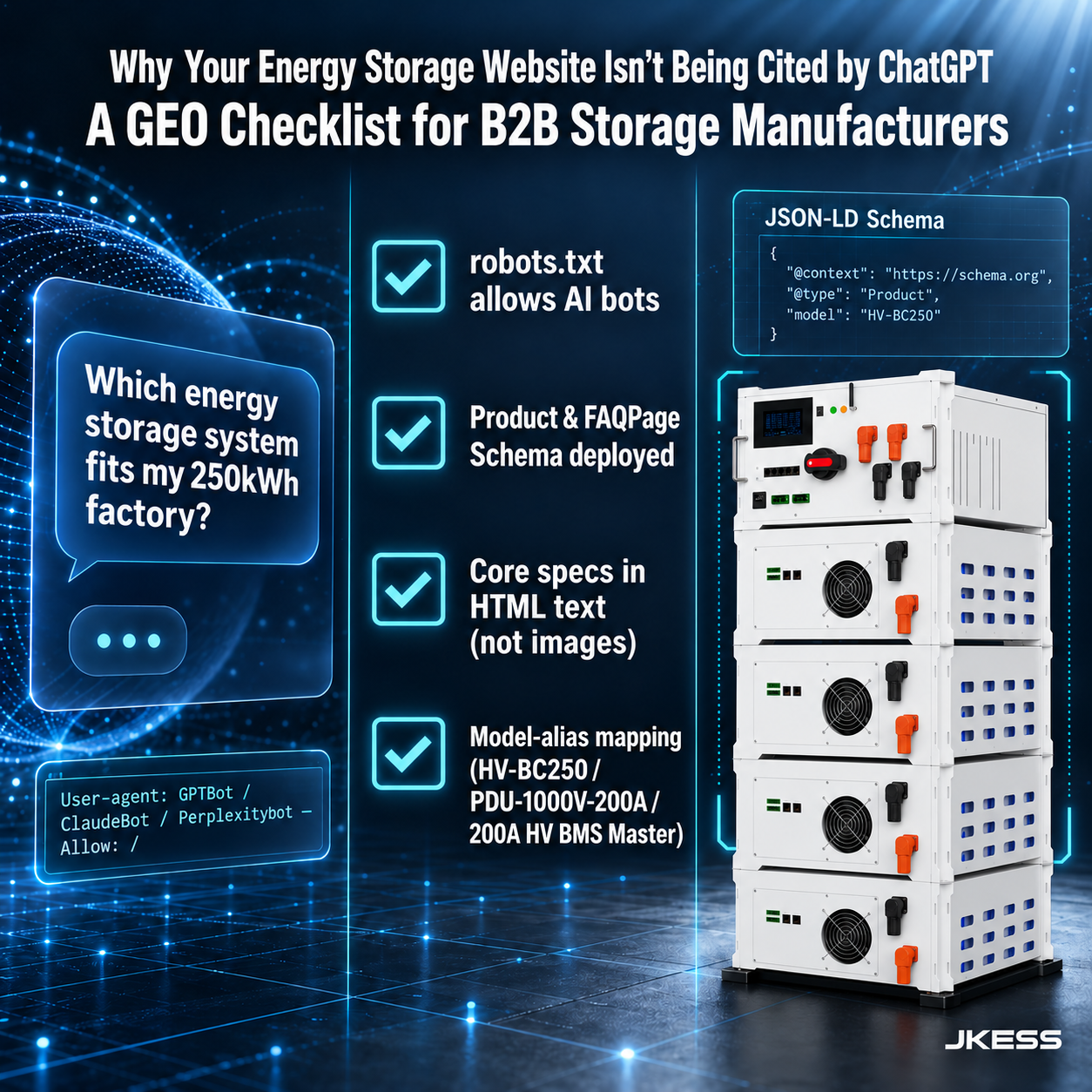
Dapatkan Penawaran→Mengapa Situs Web Penyimpanan Energi Anda Tidak Dikutip oleh ChatGPT: Daftar Periksa GEO untuk Produsen Penyimpanan B2B
Pembeli Anda mungkin bertanya pada ChatGPT sebelum membandingkan situs web pemasok. Jika spesifikasi produk Anda hanya tersedia dalam bentuk gambar, situs Anda menghalangi perayap pencarian, atau nomor model Anda tidak konsisten, informasi Anda mungkin tidak muncul dalam jawaban.
Kunci yang Harus Diperhatikan
- Perjalanan pengadaan kini mencakup riset berbantuan AI. Seorang pembeli dapat bertanya, “Sistem mana yang sesuai dengan kebutuhan pabrik saya sebesar 250 kWh?” sebelum membuka halaman pemasok secara individual.
- Jadikan fakta-fakta Anda mudah diambil dan diverifikasi. Publikasikan spesifikasi teknis sebagai teks HTML yang terlihat, lengkap dengan satuan, kondisi operasional, sumber, serta identitas produk yang jelas.
- Audit tujuh titik pemeriksaan visibilitas AI: akses crawler, Schema yang sesuai, kepadatan fakta, konsistensi alias model, spesifikasi HTML, struktur tanya-jawab, dan panduan opsional llms.txt. Semua ini mencakup risiko praktis terkait akses dan konten; bukan tujuh persyaratan peringkat wajib.
- Satu produk memerlukan satu identitas yang konsisten. Harmonisasikan nama-nama seperti HV-BC250, pengidentifikasi PDU internal, dan "200A HV BMS Master" hanya setelah memastikan bahwa semuanya merujuk pada revisi yang sama.
- GEO adalah manajemen konten yang sedang berlangsung. Jaga bukti-bukti tersebut, pantau kutipan-kutipan, serta perbaiki jawaban-jawaban yang tidak akurat. Tidak ada daftar periksa yang dapat menjamin penempatan prioritas di ChatGPT, Perplexity, atau Google AI Overviews.
01 / Perjalanan pembeli
Fungsi Pengadaan B2B telah berubah
Perjalanan pengadaan yang sudah dikenal dimulai dengan pencarian, berlanjut melalui beberapa situs web pemasok, dan berakhir dengan daftar pendek atau formulir permintaan informasi. Asisten AI memperkenalkan titik masuk tambahan: pembeli dapat mengajukan penjelasan teknis atau perbandingan sebelum mengunjungi situs web produsen. Hal ini membuat kualitas informasi yang tersedia di luar halaman utama Anda semakin relevan.
Pertimbangkan pertanyaan yang mungkin diajukan oleh integrator penyimpanan atau kontraktor EPC: “BESS tegangan tinggi mana yang mendukung 4–16 kotak baterai slave?” “Apa parameter teknis BMS dengan active balancing 2A?” “Perubahan apa saja yang diperlukan dalam desain penyimpanan C&I untuk jaringan lemah?” Ini adalah contoh maksud pembeli, bukan statistik adopsi yang terukur. Masing-masing pertanyaan memerlukan jawaban tepat yang membedakan antara rating komponen dan kemampuan sistem lengkap.
Jika fakta terkait sulit diakses atau saling bertentangan, respons yang dihasilkan kecerdasan buatan mungkin tidak menyebut produk Anda atau menggambarkannya secara keliru. Respons praktisnya adalah memublikasikan jawaban yang jelas dan dapat dikaitkan dengan sumbernya di halaman yang andal. Jawaban hasil generasi AI tetap memerlukan verifikasi, dan keterlihatan dalam jawaban tersebut melengkapi saluran pencarian tradisional, distribusi, serta penjualan langsung.
02 / Pencarian dan kutipan
SEO Tradisional versus GEO: Apa Saja Perubahan Nyatanya
Kedua disiplin ilmu ini tumpang tindih. Perbandingan ini menjelaskan area penekanan utama masing-masing; konten yang bermanfaat, akses teknis, dan bukti kredibel sama-sama penting bagi keduanya.
| SEO Tradisional | GEO (Optimisasi Mesin Generatif) |
|---|---|
| Gawang Mendapatkan keterlihatan dalam hasil pencarian yang relevan. | Gawang Menjadi sumber yang bermanfaat dan sering dikutip dalam jawaban hasil generasi AI. |
| Fokus Optimisasi Niat pencarian, konten relevan, tautan, serta kualitas teknis. | Fokus Optimisasi Fakta yang dapat diambil kembali, bukti, entitas yang jelas, dan data terstruktur yang sesuai. |
| Perilaku pembeli Menelusuri hasil dan mengunjungi halaman pemasok. | Perilaku pembeli Membaca jawaban, mengajukan pertanyaan lanjutan, serta memeriksa tautan pendukung. |
| Format Konten Halaman produk dan editorial yang bermanfaat serta selaras dengan maksud pencarian. | Format Konten Paragraf berbasis jawaban terlebih dahulu, nilai yang dapat diverifikasi, kondisi, serta pengecualian eksplisit. |
| Akses crawler Googlebot, Bingbot, dan infrastruktur pengindeksan terkait. | Akses crawler OAI-SearchBot, PerplexityBot, Claude-SearchBot, dan Googlebot untuk fitur AI Pencarian Google. |
| Data Terstruktur Menggambarkan konten halaman yang memenuhi syarat serta mendukung fitur pencarian yang berlaku. | Data Terstruktur Jelaskan sifat-sifat dan hubungan di tempat konten dikonsumsi; bukan prasyarat universal untuk kutipan. |
| Persaingan Keterlihatan dan relevansi di seluruh halaman hasil pencarian. | Persaingan Apakah jawaban memilih, mengaitkan, serta mewakili bukti Anda secara akurat. |
| Gambar Visual yang bermanfaat, didukung teks deskriptif dan atribut alt yang tepat. | Gambar Ulangi spesifikasi kritis dalam HTML; kemampuan membaca gambar berbeda-beda tergantung layanan. |
| Nama merek dan model Nama-nama yang mudah dikenali di judul, halaman, dan tautan. | Nama merek dan model Identifikasi utama yang konsisten, nama alternatif yang diverifikasi, serta batas versi. |
| Pengukuran Impresi, peringkat, klik, dan konversi berkualifikasi. | Pengukuran Kutipan URL, sebutan merek yang akurat, rujukan, dan permintaan berkualifikasi. |
| SEO membantu pembeli menemukan Anda. | GEO membantu bukti Anda menjadi bagian dari jawaban. |
03 / Daftar periksa kerja
Daftar Periksa GEO 7 Poin untuk Situs Web Penyimpanan B2B
-
Tinjau berkas robots.txt dan izinkan crawler pencarian yang dimaksud
Pisahkan akses pencarian dari preferensi pelatihan model. OpenAI mengidentifikasi OAI-SearchBot sebagai crawler pencariannya dan GPTBot sebagai crawler pelatihan. PerplexityBot mendukung pencarian Perplexity; Claude-SearchBot mendukung pencarian Claude, sedangkan ClaudeBot terkait pengembangan model. Googlebot mengatur pengambilan data untuk Google Search, termasuk fitur AI-nya; Google-Extended adalah kontrol terpisah untuk penggunaan lain.
Periksa kelompok user-agent yang ada, aturan wildcard, pembatasan jalur, serta pengaturan CDN atau firewall. Menurut perilaku standar robots.txt, ketiadaan grup eksplisit
Allowtidak secara otomatis menolak akses. Grup eksplisit dapat memperjelas kebijakan yang dimaksud.# Example for a public marketing website.# Merge with the existing policy; preserve intentional path restrictions.User-agent: OAI-SearchBotAllow: /User-agent: PerplexityBotAllow: /User-agent: Claude-SearchBotAllow: /User-agent: GooglebotAllow: /Atur kebijakan GPTBot, ClaudeBot, dan Google-Extended secara terpisah sesuai dengan tujuan penggunaan konten yang dimaksud. Verifikasi aturan gabungan akhir dan permintaan crawler aktual.
Referensi: Dokumentasi crawler OpenAI ,Crawler Perplexity ,Dokumentasi crawler Anthropic , dan Pengendali crawler Google .
-
Terapkan Schema yang secara akurat menggambarkan halaman yang terlihat
Gunakan data terstruktur untuk menjelaskan secara eksplisit pengidentifikasi dan properti. Schema harus menggambarkan halaman yang benar-benar dilihat pengunjung, tanpa menambahkan klaim yang tidak didukung atau mencampur varian produk berbeda.
- Produk + additionalProperty: parameter khusus model, satuan, dan karakteristik yang terdokumentasi.
- FAQPage: pertanyaan asli dan jelas beserta jawaban yang sesuai.
- Cara Melakukan: panduan pemasangan atau pengoperasian aktual yang mencakup seluruh langkah dan ruang lingkupnya.
- Artikel: judul editorial, nama penulis, tanggal terbit, serta tautan halaman utama.
- Organisasi: nama perusahaan yang konsisten, URL, dan informasi kontak yang telah diverifikasi.
Validasi sintaks JSON dan makna tiap bidang, lalu bandingkan setiap pernyataan yang telah diberi markup dengan tampilan halaman akhir. Sebuah blog yang membahas beberapa produk tidak otomatis dianggap sebagai halaman detail produk.
Kelayakan bukanlah jaminan. Google menyatakan fitur pencarian berbasis AI-nya tidak memerlukan Schema khusus atau berkas khusus AI. Validitas Schema.org, dukungan platform, dan inklusi aktual merupakan pertanyaan terpisah.
Referensi: AdditionalProperty Schema.org ,FAQPage , dan Panduan fitur kecerdasan buatan Google .
-
Tingkatkan kepadatan fakta yang berguna
Ganti kata sifat yang tidak didukung dengan pernyataan yang dapat diverifikasi pembeli. Nyatakan kesimpulan terlebih dahulu, pertahankan fokus setiap paragraf, serta cantumkan model, satuan, kondisi pengoperasian, dan sumber yang diperlukan untuk menafsirkan nilai tersebut.
Sebelum / Promosional “JKESS menyediakan teknologi penyeimbangan aktif terkemuka di industri dengan kinerja unggul.”Setelah / Spesifik dan dapat dikaitkan “Dokumentasi teknis JKESS menjelaskan BMU-H5-16 dengan penyeimbangan aktif 2A, akurasi pengambilan sampel tegangan sel ±0,005 V, delapan sensor suhu NTC, serta dukungan untuk konfigurasi 16S LiFePO4. Verifikasi nilai-nilai ini terhadap revisi tepat yang disuplai.”Jangan menggabungkan nilai dari dokumen-dokumen yang saling bertentangan menjadi spesifikasi baru. Jika halaman produk dan lembar spesifikasi teknis (datasheet) berbeda, selesaikan ketidaksesuaian tersebut bersama pemilik produk dan perbarui kedua sumber sebelum menganggap salah satunya sebagai acuan definitif.
Contoh sumber: Diskusi teknis JKESS mengenai BMU-H5-16 . Halaman publik dapat memuat perbedaan revisi; lembar data yang disetujui terkini tetap menjadi acuan publikasi.
-
Bangun peta model-ke-alias yang terverifikasi
Berikan setiap produk satu nama utama dan satu halaman produk kanonik. Simpan catatan yang menghubungkan nama pemasaran, identifikasi teknis, revisi produk, serta varian penamaan regional.
Contoh penamaan yang diberikan adalah HV-BC250 / PDU-1000V-200A-A001-NY / 200A HV BMS Master Box . Ini merupakan hubungan alias yang perlu diverifikasi, bukan bukti bahwa identifikasi tersebut saling dipertukarkan. Jika tim teknis mengonfirmasi kecocokan, tulis: “HV-BC250, juga dikenal sebagai PDU-1000V-200A-A001-NY, adalah 200A HV BMS Master Box.”
Gunakan nama utama dalam judul dan elemen H1; tempatkan alias yang telah dikonfirmasi di paragraf pembuka serta kolom Produk yang relevan, seperti
alternateNameataumpn. Pertahankan identitas terpisah apabila suatu revisi mengubah nilai nominal, antarmuka, atau ruang lingkup pasokan. -
Simpan spesifikasi inti dalam HTML yang terlihat
Tuliskan nilai-nilai kunci langsung ke dalam halaman itu sendiri. Tegangan, arus, akurasi, dimensi, kondisi pengujian, dan ruang lingkup pasokan harus tetap tersedia sebagai teks biasa dan semantik
cells.
Image extraction and JavaScript rendering differ between crawlers and retrieval tools. Text inside a photograph, iframe, or canvas is therefore an unreliable sole source for a critical parameter. Alt text helps describe an image, but it does not replace a visible specification table.
Publish a dated datasheet alongside the HTML table. Distinguish nominal voltage from the operating envelope, continuous current from peak current, and empty-kit weight from the weight of an assembled module.
Answer real buyer questions directly
Build a useful set of questions around the buying decision: “How many slave boxes can one master box support?” “Does the kit include battery cells?” “Which communication protocols are provided?” Answer first, then give the limits and source.
Five to ten FAQs can be a practical editorial target when the topic warrants them; there is no universal minimum. Native
When adding FAQPage markup, use the same question and answer wording as the visible page. Do not add invisible FAQ claims just to target search queries. This article includes ten visible FAQs and marks up five of them.
Consider an optional llms.txt reading guide
llms.txtis a proposed Markdown convention for guiding agents to useful website content. A concise guide can list the company, core products, application pages, and maintained technical documents. It is useful only to consumers that choose to read it.# JKESS Electronic Technology BMS and active balancing solutions for energy storage.## Core Products- [HV-BC250 200A Master Box](https://www.jkess.com/200a-hv-bms-master)- [HV-B6U Slave Battery Box Kits](https://www.jkess.com/hv-slave-6u-kits)- [261kWh Liquid-Cooled BESS Kits](https://www.jkess.com/commercial--industrial-energy-storage-system-kits)## Application Guides- [Modular HV Energy Storage Kits](https://www.jkess.com/home-energy-storage-system-kits)## Technical DocumentsUse the current specifications and scope-of-supply notes on the product pages.Add approved, versioned datasheet links when those documents are published.Illustrative content, not a report of the live site’s configuration. Use verified links and clean Markdown versions where available. Maintaining this file does not deploy robots.txt rules or create search eligibility.
References: the llms.txt proposal and Google’s generative AI optimization guidance. Google Search does not use llms.txt as a special visibility or ranking input.
04 / Content in practice
Before and After: Rewriting a Storage Product Page for AI Citation
The following five examples replace broad promotion with a more useful answer. Numerical illustrations include their assumptions; commercial and certification statements require current, model-specific evidence.
Illustrative rewrites. Calculations are not measured performance guarantees. Before / Marketing copy After / Evidence-led copy “Our advanced active balancing BMS delivers superior performance and extends battery life.” “For an illustrative 314Ah cell with a 0.5% charge difference, ΔQ = 314 × 0.005 = 1.57Ah. At a constant 2A transfer current, the idealized duration is 1.57 ÷ 2 = 0.785 hours, or about 47 minutes. Real duration depends on current limits, control behavior, and losses.” “The system supports a wide voltage range for various applications.” “The HV-BC250 listing specifies an 80–1000V DC master range. A 4–16 slave-box configuration is described as approximately 64–256kWh when each box is approximately 16kWh. With 16 cells per box and 3.2V nominal per cell, 16 boxes yield 256S / 819.2V nominal. Verify the full charge/discharge range and selected cell capacity.” “Our battery boxes are designed for easy installation.” “Define the scope as one master plus five slave boxes: six enclosures in total. State empty-kit and assembled-module weights separately, together with the lifting and installation plan. A claimed 28.55kg kit weight or two-technician, 2–3 day schedule requires a matching product record and a defined site scope.” “We provide reliable products with international certifications.” “List the exact model and revision, applicable CE declaration, RoHS documentation, FCC evidence, and test-report identifiers. If citing GB34131-2017 or insulation resistance ≥1 MΩ at 1,000 VDC, verify the applicable standard edition, test method, and report scope rather than extending a component claim to the whole system.” “Contact us for more information.” “Send your required capacity, DC range, current, communication protocol, scope of supply, quantity, and delivery location to [email protected]. Request confirmation of available regional stock and a written dispatch estimate for that configuration.” Product references: HV-BC250 and modular storage kits. The 64–256kWh shorthand is configuration-dependent; a hardware kit without cells does not itself contain that stored energy.
05 / Access and extraction
Technical Access: Can AI Crawlers Actually Read Your Website?
Check 1 / robots.txt and access controls
Open
https://yourdomain.com/robots.txtand evaluate the user-agent group and path rules that apply to each intended crawler. Inspect firewall challenges, blocked IP ranges, redirects, and server errors as well.Absence of an explicit Allow is not a failure by itself. Use the actual response and verified crawler logs to determine what is accessible.
Check 2 / Core content in HTML
Disable JavaScript and reload the product page. Check the original HTML response for the model name, specification table, scope of supply, and answers.
If they disappear, the page depends on rendering that some tools may not perform. Prefer server-rendered or static core content, and use a search engine’s inspection tools where available. Also check
noindex, snippet restrictions, andX-Robots-Tagheaders.Check 3 / Descriptive alt text
Describe informative product photographs, diagrams, and screenshots with suitable alt text. Keep purely decorative images from adding noise.
Repeat important values in the visible body or a real HTML table. A long alt attribute is not a substitute for a readable technical specification.
Check 4 / Reliable loading and delivery
Confirm that the canonical page returns a successful response and delivers useful content promptly. Reduce unnecessary third-party scripts, oversized payloads, and client-side dependencies.
Timeouts, errors, and rendering limits can interfere with retrieval. A model’s context budget is a separate issue from network performance; there is no universal “AI loading time” threshold.
Check 5 / Canonical URLs and model identity
Identify duplicate URLs for the same item and use a consistent canonical URL, internal links, and sitemap entries. For example, reconcile two product paths that describe the same HV-BC250 revision.
A canonical URL signals a preferred page; it does not by itself resolve conflicting specifications or prove that two product names are equivalent.
Access references: robots.txt interpretation and the crawler documentation linked in checkpoint 1.
06 / Evidence of progress
How to Measure Whether GEO Is Working
Pair answer-level observations with business outcomes. Metric Traditional SEO measure GEO measure Visibility Search impressions and keyword positions. Share of sampled AI answers citing an owned URL; track brand mentions separately. Traffic Organic search clicks and visits. Identifiable AI referrals; brand-search changes as supporting, non-causal evidence. Content Engagement and landing-page performance. Which facts and pages are cited, and whether values and limitations are correct. Conversion Forms, qualified leads, and sales. Qualified inquiries with an AI discovery source or attributable referral. Competition Relative search visibility. Citation share and co-mentions within the same fixed question set. Audit Indexability, search-intent coverage, and page quality. Entity consistency, evidence freshness, extractable facts, and markup accuracy. A practical weekly baseline: run ten fixed buyer questions in ChatGPT search, Perplexity, and Google AI Overviews where an overview appears. Repeat the sample and log platform, date, locale, model or mode, exact question, cited URL, brand mention, and answer accuracy.
Citation rate = answers linking to your domain ÷ eligible sampled answers. Report the sample size and the number of queries without an AI answer. A brand mention without a source link is not a citation. Use a separate measure for citations to this specific article.
For example, six cited answers out of 30 eligible observations produce a 20% sample citation rate. This is an illustrative calculation, not a JKESS result. Keep the question set stable when comparing periods, and avoid treating a single answer or a small change as proof that one edit caused an improvement.
07 / Applying the method
How JKESS Applies GEO to Its Own Product Pages
The reviewed JKESS master-box and 261kWh application pages expose technical information in readable tables. That is a useful starting point. The following seven practices form an implementation and maintenance checklist, rather than a claim that every page has already passed a site-wide audit.
- Maintain structured specification tables. Keep each voltage, current, accuracy, dimension, and weight value in visible HTML, tied to a model, revision, and source. Separate component ratings from complete-system limits.
- Keep FAQs useful and consistent. Write five to ten relevant answers when justified by the product; align any FAQPage markup with the exact visible wording and recheck answers after product changes.
- Use model-specific Product markup. Validate Product and additionalProperty on the appropriate HV-BC250, HV-B6U, and 261kWh pages. Record evidence of the deployed markup rather than assuming site-wide coverage.
- Control aliases. Confirm any relationship between HV-BC250 and PDU-1000V-200A-A001-NY, then use one primary name with the approved aliases. Keep HV-BC150-100A as a distinct product identity.
- Reconcile quantitative claims. Check the 2A active balancing and ±0.005V sampling values against the supplied BMU revision. Keep the 4–16 slave-box and 64–256kWh statements linked to their cell and configuration assumptions.
- Maintain an optional llms.txt guide. If deployed, list current canonical product and documentation URLs, remove stale links, and treat it as documentation support rather than an indexing requirement.
- Verify search access. Review the live robots.txt policy and crawler delivery logs. Confirm intended access for search bots while managing training-related controls independently.
JKESS product and specification anchors
HV-BC250 · 200A HV BMS Master · HV-BC150-100A · 100A master configuration · HV-B6U · 6U slave battery box kits · BMU-H5-16 · technical reference · 261kWh liquid-cooled system
Values to keep in context: 2A active balancing · ±0.005V sampling accuracy · 4–16 slave battery boxes · approximately 64–256kWh · 80–1000V DC master range. These refer to different components or configurations, not a single universal specification. Kits are offered without battery cells; confirm the final scope of supply.
08 / Questions buyers ask
Frequently Asked Questions
What is GEO and how does it differ from traditional SEO?
GEO (Generative Engine Optimization) is the practice of making useful content easier to retrieve, understand, and cite in AI-generated answers. Traditional SEO emphasizes visibility in search results, while GEO also tracks how accurately a brand and its facts appear in generated responses. Both benefit from accessible pages, clear product identities, and reliable evidence; neither guarantees inclusion.
Why is my energy storage website not being cited by ChatGPT?
Possible causes include blocked search crawlers, unindexed pages, specifications that are difficult to extract, inconsistent model names, or weak evidence for the question being asked. For ChatGPT search, review OAI-SearchBot access rather than assuming GPTBot controls search visibility. Missing Schema or llms.txt alone does not prove why a page was omitted; compare crawl evidence, content relevance, and repeated query results.
What is llms.txt and why does it matter for B2B storage websites?
llms.txt is a proposed Markdown-based guide to a website’s useful content, which can point agents to product documentation and application guides. It can help tools that choose to use it, but adoption and behavior differ between services. Treat it as optional documentation infrastructure, not a requirement for AI citation or a replacement for HTML pages and sitemaps.
How do I check if AI crawlers can access my website?
Inspect the robots.txt groups and path rules that apply to OAI-SearchBot, PerplexityBot, Claude-SearchBot, and Googlebot, then review server and firewall logs. A missing explicit Allow rule does not by itself mean access is denied. Also check HTTP responses, indexing and snippet controls, and whether product specifications are available without JavaScript; a browser-only test does not confirm a crawler’s actual access.
What Schema markup should a B2B storage website prioritize?
Use Product with additionalProperty on product pages, Article on editorial pages, and Organization for the company identity. FAQPage can describe visible questions and answers, and HowTo can describe a genuine procedural guide. Keep markup aligned with the visible content and applicable platform documentation; valid Schema does not guarantee a rich result or an AI citation.
How does inconsistent product naming affect AI visibility?
Different names for the same item can make it harder for readers and retrieval systems to connect the information. Select one primary model name and record verified aliases, product revisions, and one canonical URL. Publish an “also known as” relationship only after the model owner confirms that the labels identify the same product and configuration.
What is fact density and why does it matter for GEO?
Fact density is an editorial measure of how much useful, verifiable information a passage contains relative to general promotional language. A model-specific value with units, operating conditions, and a dated source is more useful than an unsupported adjective. Values such as 2A active balancing, ±0.005V sampling accuracy, and an 80–1000V DC range must stay attached to the correct component; fact density is not a published universal AI ranking score.
How do I measure GEO performance for my storage website?
Run a fixed set of buyer questions repeatedly and log the date, platform, search mode, locale, cited URLs, and answer accuracy. Report URL citation rate separately from unlinked brand mentions, and track identifiable referral visits and qualified inquiries. Results fluctuate, so a small weekly sample is directional evidence rather than a complete view of all buyers or proof of causation.
Does GEO replace traditional SEO for B2B storage manufacturers?
No. Search indexing, useful content, internal links, and a dependable website remain relevant to both conventional search and AI-assisted research. GEO adds attention to answer-level representation, traceable facts, and citation measurement. An effective program maintains those foundations while checking whether buyers receive accurate product information.
How does JKESS apply GEO principles to its own product pages?
The JKESS pages reviewed for this article provide examples of HTML specifications and question-and-answer content for products including the HV-BC250 and the 261kWh liquid-cooled system. The seven-part workflow below extends that approach to the HV-BC150-100A, HV-B6U, and BMU-H5-16 through consistent naming, source review, and structured content. This article does not certify site-wide Schema coverage, crawler settings, or an existing llms.txt deployment; those require a current implementation audit.
Want to Audit Your Storage Website’s AI Visibility?
Share your website URL with our team. We’ll review your robots.txt, Schema markup, fact density, and entity consistency — and help identify where crawlers or readers may be missing your product information.
Request a Custom Quote→