
 EN
JKESS/エンジニアリング・インサイト
お問い合わせはこちら→なぜあなたのエネルギー貯蔵システムのウェブサイトがChatGPTで引用されないのか:B2B蓄電池メーカー向けGEOチェックリスト
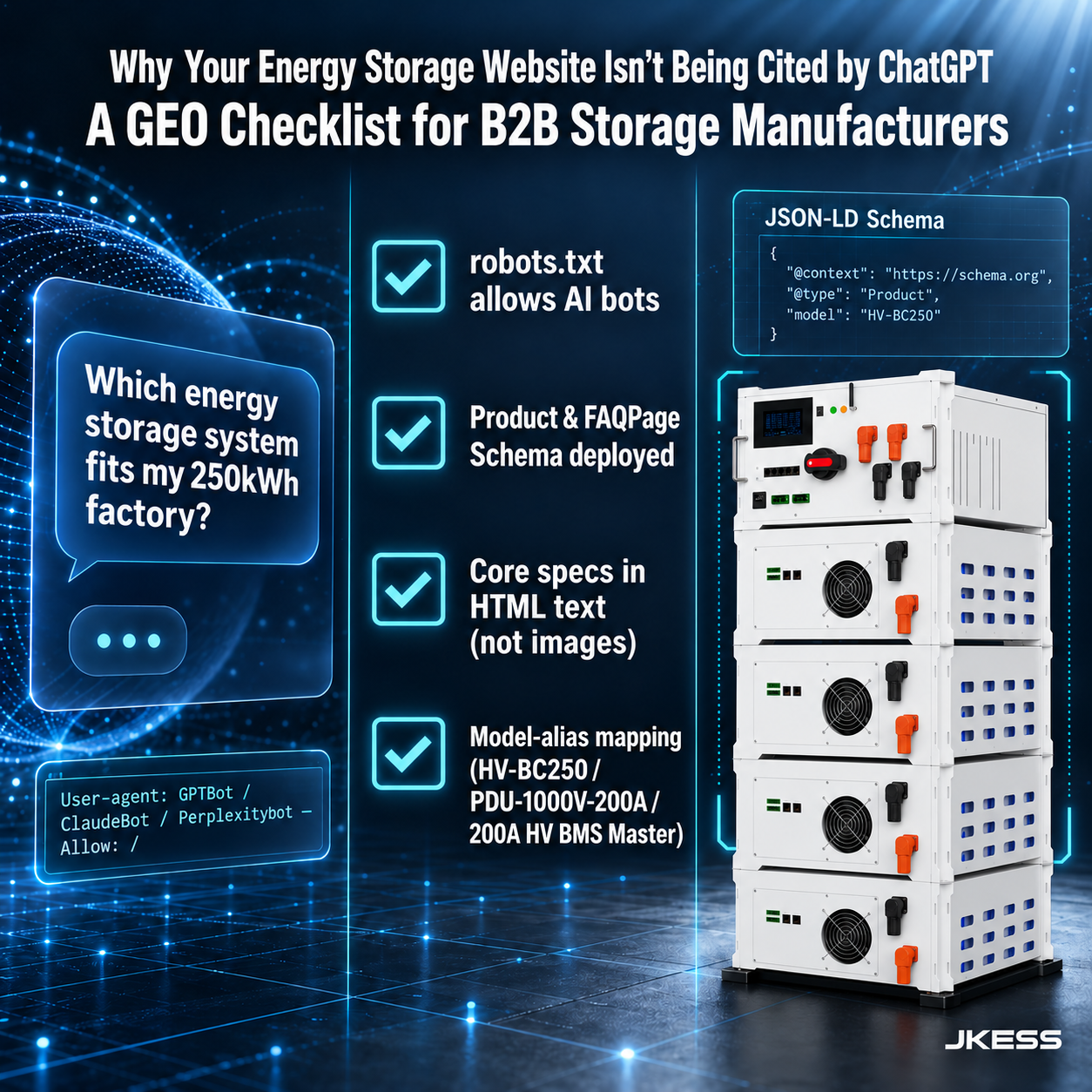
購入担当者は、サプライヤーのウェブサイトを比較する前に、まずChatGPTに質問するかもしれません。もし製品仕様が画像内にしか記載されていない、検索クローラーがサイトを読み取れない、あるいは型番表記が統一されていない場合、あなたの情報はAIの回答から抜け落ちてしまう可能性があります。
重要な 教訓
- 調達プロセスには、すでにAIを活用したリサーチが含まれています。 購入担当者は、「250kWhの工場要件に合うシステムはどれか?」と質問してから、個別のサプライヤーのページを開くこともあります。
- 事実情報を、誰でも簡単に取得・確認できる状態にしてください。 技術仕様は、単位、動作条件、出典、明確な製品識別子とともに、HTMLテキストとして可視化して公開してください。
- AIによる可視性を確認する7つのチェックポイントを点検しましょう: クローラーによるアクセス、適切なSchemaマークアップ、事実の密度、モデル別名の一貫性、HTML仕様、質問と回答の構造、およびオプションのllms.txtガイド。これらは実用的なアクセスおよびコンテンツリスクをカバーするものであり、7つの必須ランキング要件ではありません。
- 1つの製品には、一貫した識別情報が必要です。 HV-BC250(内部PDU識別子)や「200A HV BMSマスター」などの名称は、同一のリビジョンであることを確認したうえで統一してください。
- GEOは継続的なコンテンツ管理を行っています。 根拠となる情報を保存し、引用状況を監視し、不正確な回答を修正してください。チェックリストを作成しても、ChatGPTやPerplexity、Google AI Overviewにおける優先表示が保証されるわけではありません。
01/購入者のジャーニー
B2B調達ファネルはすでに変化しています
見慣れた調達プロセスは、検索から始まり、複数のサプライヤーWebサイトを経て、最終的に候補リストの作成や問い合わせフォームの送信で終わります。AIアシスタントの登場により、新たな入り口が加わりました。つまり、バイヤーはメーカーのWebサイトを訪問する前に、技術的な説明や比較を直接尋ねることができるようになったのです。これにより、自社ホームページ以外で提供される情報の質が、これまで以上に重要になっています。
ストレージ・インテグレーターまたはEPC請負業者が抱える可能性のある疑問を考えてみてください。「4~16台のスレーブバッテリーボックスに対応する高電圧BESSはどれですか?」「2Aアクティブバランス機能付きBMSの技術仕様はどのようなものですか?」「弱電力グリッド向けC&I(商用・産業用)ストレージ設計では、どのような設計変更が必要になりますか?」これらは、実際の採用率といった統計データではなく、あくまでバイヤーの意図を示す具体例です。それぞれの問いには、単一コンポーネントの性能評価と、システム全体としての機能を明確に区別した、正確な回答が求められます。
関連する事実にアクセスしにくかったり、矛盾している場合、AIが生成した回答では、お客様の製品が全く言及されなかったり、誤って説明されたりする可能性があります。実践的な対応策は、信頼できるウェブページ上で、明確で出典が明記された情報を公開することです。AIが生成した回答も依然として検証が必要であり、そのような回答内での可視性は、既存の検索・販売代理店・直販チャネルを補完するものです。
02/検索と引用
従来のSEOとGEO(生成型エンジン最適化):実際に変化するのは何か?
両分野には重なる部分があります。本比較では、それぞれの主な焦点領域——有用なコンテンツ、技術的なアクセス性、信頼できる根拠——について説明します。これらはいずれも両方の分野で重要です。
| 従来のSEO | GEO(生成型エンジン最適化) |
|---|---|
| 目標 関連性の高い検索結果に表示されるようになる。 | 目標 AIが生成する回答において、有用で引用される情報源となる。 |
| 最適化の重点 検索意図、関連性の高いコンテンツ、リンク、技術的品質。 | 最適化の重点 取得可能な事実、証拠、明確なエンティティ、および適切な構造化データ。 |
| 購入者の行動 検索結果を閲覧し、サプライヤーのページにアクセスする。 | 購入者の行動 回答を読み、追加の質問をし、関連する参照リンクを確認する。 |
| コンテンツ形式 検索意図に合致した有用な製品ページおよび編集コンテンツページ。 | コンテンツ形式 回答を優先した文章、検証可能な数値・条件・明示的な除外事項。 |
| クローラーによるアクセス Googlebot、Bingbot、および関連するインデックス作成インフラストラクチャ。 | クローラーによるアクセス OAI-SearchBot、PerplexityBot、Claude-SearchBot、およびGoogle検索AI機能向けGooglebot。 |
| 構造化データ 対象となるページコンテンツを説明し、該当する検索機能をサポートすること。 | 構造化データ 利用される際に、その性質や関係性を明確にすること。引用のための普遍的な前提条件ではない。 |
| 競争 検索結果ページ全体における可視性と関連性。 | 競争 回答が、提示された根拠を適切に選択・帰属し、正確に表現しているかどうか。 |
| 画像 有用なビジュアルと、それを補足する説明文および適切な代替テキスト(alt属性)。 | 画像 重要な仕様はHTML内でも繰り返し記述すること。画像読み取り機能はサービスによって異なる。 |
| ブランド名および車種名 タイトル・ページ・リンクなど、あらゆる場所で一貫して認識可能な名称。 | ブランド名および車種名 一貫した主な識別子、確認済みの別称、および改訂の境界線。 |
| 計量 インプレッション数、順位、クリック数、および条件付きのコンバージョン数。 | 計量 URLによる出典明記、正確なブランド表記、紹介(リファラル)、および条件付きの問い合わせ。 |
| SEOは、購入者が貴社を見つけるのを支援します。 | GEOは、貴社の証拠情報を検索結果の「回答」に組み込むことを可能にします。 |
03/作業チェックリスト
B2B向けストレージ系Webサイトのための7項目GEOチェックリスト
-
Robots.txtを確認し、意図する検索クローラーのアクセスを許可します。
検索へのアクセス制御と、モデル学習用の設定を明確に分離します。 OpenAIは、OAI-SearchBotを自社の検索クローラー、GPTBotを学習用クローラーとして識別しています。PerplexityBotはPerplexity社の検索に対応し、Claude-SearchBotはClaude社の検索に対応しています。一方、ClaudeBotはモデル開発に関係するクローラーです。GooglebotはGoogle検索(およびそのAI機能を含む)向けのクロールを制御しており、Google-Extendedはその他の用途向けに別途設定される制御です。
既存のUser-Agentグループ、ワイルドカードルール、パス制限、CDNやファイアウォールの設定を確認してください。標準的なrobots.txtの動作では、「Disallow」ディレクティブが明示的に記述されていない場合でも、自動的にアクセスが拒否されるわけではありません。
Allowただし、明示的なUser-Agentグループを設定することで、意図したポリシーをより明確に伝えることができます。# Example for a public marketing website.# Merge with the existing policy; preserve intentional path restrictions.User-agent: OAI-SearchBotAllow: /User-agent: PerplexityBotAllow: /User-agent: Claude-SearchBotAllow: /User-agent: GooglebotAllow: /GPTBot、ClaudeBot、Google-Extended の各ポリシーを、対象となるコンテンツの用途に応じて個別に設定してください。最終的に統合されたルールと実際のクローラーによるリクエストを検証します。
参考文献: OpenAI クローラーに関するドキュメンテーション ,Perplexity のクローラー ,Anthropic クローラーに関するドキュメンテーション 、および Google クローラーの制御機能 .
-
ユーザーが実際に閲覧するページ内容を正確に記述する Schema を導入します。
構造化データを用いて、識別子や属性を明示的に定義します。Schema は、訪問者が実際に見るページを記述するものであり、根拠のない主張を追加したり、異なる製品バリエーションを混在させたりしてはなりません。
- 製品 + additionalProperty: モデル固有のパラメーター、単位、および公式に文書化された特性。
- FAQPage: 実際の質問とその対応する回答が明確に示されていること。
- 使い方: 実際の設置または据付手順を、すべてのステップと範囲を含めて詳細に記載したもの。
- 規定 編集部による見出し、著者名、掲載日、および公式ページURL。
- 整理機能: 企業の正式名称、URL、および確認済みの連絡先情報。
JSONの構文と各フィールドの意味を検証したうえで、マークアップされた各文をレンダリング後のページと照合してください。複数の製品について述べたブログ記事が、自動的に製品詳細ページとなるわけではありません。
対象資格は保証を意味しません。 Googleによると、AI検索機能は特別なSchemaやAI専用ファイルを必要としていません。Schema.orgの妥当性、プラットフォーム対応状況、および実際に検索結果に含まれるかどうかは、それぞれ別個の問題です。
参考文献: Schema.org additionalProperty ,FAQPage 、および GoogleのAI機能に関するガイドライン .
-
有用な事実の密度を高める
サポートされていない形容詞は、購入者が検証可能な主張に置き換える。結論を先頭に示し、各段落は1つの要点に集中させ、数値を解釈するために必要なモデル名、単位、動作条件、および出典を明記する。
修正前/宣伝的表現 「JKESSは業界トップクラスのアクティブ・バランス技術を提供し、優れた性能を実現します。」修正後/具体的かつ根拠のある表現 「JKESSの技術資料によると、BMU-H5-16は2Aのアクティブ・バランス機能、±0.005Vのセル電圧測定精度、8個のNTC温度センサー、および16S LiFePO4対応を備えています。これらの数値は、実際に納入された仕様書の正確なリビジョンと照合してください。」矛盾する複数の資料から数値を混ぜて新たな仕様を作成しない。製品ページとデータシートの記載が異なる場合は、製品責任者と調整し、両方の資料を更新した上で、いずれかを確定的な情報源として扱う。
出典例: JKESSによるBMU-H5-16の技術解説 公開ページには改訂の差異が含まれる場合があります。現在承認済みのデータシートが、正式な出版物としての参照元となります。
-
検証済みの「モデル名→別名」対応表を作成する
各製品に1つの主名称と1つの公式製品ページを割り当てます。マーケティング名称、エンジニアリング識別子、製品改訂番号、および地域ごとの名称変種を結びつける記録を維持してください。
提供された命名例は HV-BC250/PDU-1000V-200A-A001-NY/200A HV BMSマスターボックス です。これは確認すべき別名関係であり、これらの識別子が互換可能であるという根拠ではありません。エンジニアリング部門が一致を確認した場合は、「HV-BC250は、別名PDU-1000V-200A-A001-NYとも呼ばれ、200A HV BMSマスターボックスです」と記述します。
タイトルおよびH1見出しには主名称を用い、確認済みの別名は冒頭段落および「製品」欄(例:)などの適切なフィールドに記載します。
alternateNameまたはmpn仕様値、インターフェース、または納入範囲が改訂により変更された場合には、個別の製品として独立した識別を維持します。 -
主要な仕様は、HTML上で視認可能な位置に記載する
重要な数値は、ページ本文内に直接記述します。 電圧、電流、精度、外形寸法、試験条件、および納入範囲は、通常のテキストおよび意味論として引き続き提供されるものとする
cells.
Image extraction and JavaScript rendering differ between crawlers and retrieval tools. Text inside a photograph, iframe, or canvas is therefore an unreliable sole source for a critical parameter. Alt text helps describe an image, but it does not replace a visible specification table.
Publish a dated datasheet alongside the HTML table. Distinguish nominal voltage from the operating envelope, continuous current from peak current, and empty-kit weight from the weight of an assembled module.
Answer real buyer questions directly
Build a useful set of questions around the buying decision: “How many slave boxes can one master box support?” “Does the kit include battery cells?” “Which communication protocols are provided?” Answer first, then give the limits and source.
Five to ten FAQs can be a practical editorial target when the topic warrants them; there is no universal minimum. Native
When adding FAQPage markup, use the same question and answer wording as the visible page. Do not add invisible FAQ claims just to target search queries. This article includes ten visible FAQs and marks up five of them.
Consider an optional llms.txt reading guide
llms.txtis a proposed Markdown convention for guiding agents to useful website content. A concise guide can list the company, core products, application pages, and maintained technical documents. It is useful only to consumers that choose to read it.# JKESS Electronic Technology BMS and active balancing solutions for energy storage.## Core Products- [HV-BC250 200A Master Box](https://www.jkess.com/200a-hv-bms-master)- [HV-B6U Slave Battery Box Kits](https://www.jkess.com/hv-slave-6u-kits)- [261kWh Liquid-Cooled BESS Kits](https://www.jkess.com/commercial--industrial-energy-storage-system-kits)## Application Guides- [Modular HV Energy Storage Kits](https://www.jkess.com/home-energy-storage-system-kits)## Technical DocumentsUse the current specifications and scope-of-supply notes on the product pages.Add approved, versioned datasheet links when those documents are published.Illustrative content, not a report of the live site’s configuration. Use verified links and clean Markdown versions where available. Maintaining this file does not deploy robots.txt rules or create search eligibility.
References: the llms.txt proposal and Google’s generative AI optimization guidance. Google Search does not use llms.txt as a special visibility or ranking input.
04 / Content in practice
Before and After: Rewriting a Storage Product Page for AI Citation
The following five examples replace broad promotion with a more useful answer. Numerical illustrations include their assumptions; commercial and certification statements require current, model-specific evidence.
Illustrative rewrites. Calculations are not measured performance guarantees. Before / Marketing copy After / Evidence-led copy “Our advanced active balancing BMS delivers superior performance and extends battery life.” “For an illustrative 314Ah cell with a 0.5% charge difference, ΔQ = 314 × 0.005 = 1.57Ah. At a constant 2A transfer current, the idealized duration is 1.57 ÷ 2 = 0.785 hours, or about 47 minutes. Real duration depends on current limits, control behavior, and losses.” “The system supports a wide voltage range for various applications.” “The HV-BC250 listing specifies an 80–1000V DC master range. A 4–16 slave-box configuration is described as approximately 64–256kWh when each box is approximately 16kWh. With 16 cells per box and 3.2V nominal per cell, 16 boxes yield 256S / 819.2V nominal. Verify the full charge/discharge range and selected cell capacity.” “Our battery boxes are designed for easy installation.” “Define the scope as one master plus five slave boxes: six enclosures in total. State empty-kit and assembled-module weights separately, together with the lifting and installation plan. A claimed 28.55kg kit weight or two-technician, 2–3 day schedule requires a matching product record and a defined site scope.” “We provide reliable products with international certifications.” “List the exact model and revision, applicable CE declaration, RoHS documentation, FCC evidence, and test-report identifiers. If citing GB34131-2017 or insulation resistance ≥1 MΩ at 1,000 VDC, verify the applicable standard edition, test method, and report scope rather than extending a component claim to the whole system.” “Contact us for more information.” “Send your required capacity, DC range, current, communication protocol, scope of supply, quantity, and delivery location to [email protected]. Request confirmation of available regional stock and a written dispatch estimate for that configuration.” Product references: HV-BC250 and modular storage kits. The 64–256kWh shorthand is configuration-dependent; a hardware kit without cells does not itself contain that stored energy.
05 / Access and extraction
Technical Access: Can AI Crawlers Actually Read Your Website?
Check 1 / robots.txt and access controls
Open
https://yourdomain.com/robots.txtand evaluate the user-agent group and path rules that apply to each intended crawler. Inspect firewall challenges, blocked IP ranges, redirects, and server errors as well.Absence of an explicit Allow is not a failure by itself. Use the actual response and verified crawler logs to determine what is accessible.
Check 2 / Core content in HTML
Disable JavaScript and reload the product page. Check the original HTML response for the model name, specification table, scope of supply, and answers.
If they disappear, the page depends on rendering that some tools may not perform. Prefer server-rendered or static core content, and use a search engine’s inspection tools where available. Also check
noindex, snippet restrictions, andX-Robots-Tagheaders.Check 3 / Descriptive alt text
Describe informative product photographs, diagrams, and screenshots with suitable alt text. Keep purely decorative images from adding noise.
Repeat important values in the visible body or a real HTML table. A long alt attribute is not a substitute for a readable technical specification.
Check 4 / Reliable loading and delivery
Confirm that the canonical page returns a successful response and delivers useful content promptly. Reduce unnecessary third-party scripts, oversized payloads, and client-side dependencies.
Timeouts, errors, and rendering limits can interfere with retrieval. A model’s context budget is a separate issue from network performance; there is no universal “AI loading time” threshold.
Check 5 / Canonical URLs and model identity
Identify duplicate URLs for the same item and use a consistent canonical URL, internal links, and sitemap entries. For example, reconcile two product paths that describe the same HV-BC250 revision.
A canonical URL signals a preferred page; it does not by itself resolve conflicting specifications or prove that two product names are equivalent.
Access references: robots.txt interpretation and the crawler documentation linked in checkpoint 1.
06 / Evidence of progress
How to Measure Whether GEO Is Working
Pair answer-level observations with business outcomes. Metric Traditional SEO measure GEO measure Visibility Search impressions and keyword positions. Share of sampled AI answers citing an owned URL; track brand mentions separately. Traffic Organic search clicks and visits. Identifiable AI referrals; brand-search changes as supporting, non-causal evidence. Content Engagement and landing-page performance. Which facts and pages are cited, and whether values and limitations are correct. Conversion Forms, qualified leads, and sales. Qualified inquiries with an AI discovery source or attributable referral. Competition Relative search visibility. Citation share and co-mentions within the same fixed question set. Audit Indexability, search-intent coverage, and page quality. Entity consistency, evidence freshness, extractable facts, and markup accuracy. A practical weekly baseline: run ten fixed buyer questions in ChatGPT search, Perplexity, and Google AI Overviews where an overview appears. Repeat the sample and log platform, date, locale, model or mode, exact question, cited URL, brand mention, and answer accuracy.
Citation rate = answers linking to your domain ÷ eligible sampled answers. Report the sample size and the number of queries without an AI answer. A brand mention without a source link is not a citation. Use a separate measure for citations to this specific article.
For example, six cited answers out of 30 eligible observations produce a 20% sample citation rate. This is an illustrative calculation, not a JKESS result. Keep the question set stable when comparing periods, and avoid treating a single answer or a small change as proof that one edit caused an improvement.
07 / Applying the method
How JKESS Applies GEO to Its Own Product Pages
The reviewed JKESS master-box and 261kWh application pages expose technical information in readable tables. That is a useful starting point. The following seven practices form an implementation and maintenance checklist, rather than a claim that every page has already passed a site-wide audit.
- Maintain structured specification tables. Keep each voltage, current, accuracy, dimension, and weight value in visible HTML, tied to a model, revision, and source. Separate component ratings from complete-system limits.
- Keep FAQs useful and consistent. Write five to ten relevant answers when justified by the product; align any FAQPage markup with the exact visible wording and recheck answers after product changes.
- Use model-specific Product markup. Validate Product and additionalProperty on the appropriate HV-BC250, HV-B6U, and 261kWh pages. Record evidence of the deployed markup rather than assuming site-wide coverage.
- Control aliases. Confirm any relationship between HV-BC250 and PDU-1000V-200A-A001-NY, then use one primary name with the approved aliases. Keep HV-BC150-100A as a distinct product identity.
- Reconcile quantitative claims. Check the 2A active balancing and ±0.005V sampling values against the supplied BMU revision. Keep the 4–16 slave-box and 64–256kWh statements linked to their cell and configuration assumptions.
- Maintain an optional llms.txt guide. If deployed, list current canonical product and documentation URLs, remove stale links, and treat it as documentation support rather than an indexing requirement.
- Verify search access. Review the live robots.txt policy and crawler delivery logs. Confirm intended access for search bots while managing training-related controls independently.
JKESS product and specification anchors
HV-BC250 · 200A HV BMS Master · HV-BC150-100A · 100A master configuration · HV-B6U · 6U slave battery box kits · BMU-H5-16 · technical reference · 261kWh liquid-cooled system
Values to keep in context: 2A active balancing · ±0.005V sampling accuracy · 4–16 slave battery boxes · approximately 64–256kWh · 80–1000V DC master range. These refer to different components or configurations, not a single universal specification. Kits are offered without battery cells; confirm the final scope of supply.
08 / Questions buyers ask
Frequently Asked Questions
What is GEO and how does it differ from traditional SEO?
GEO (Generative Engine Optimization) is the practice of making useful content easier to retrieve, understand, and cite in AI-generated answers. Traditional SEO emphasizes visibility in search results, while GEO also tracks how accurately a brand and its facts appear in generated responses. Both benefit from accessible pages, clear product identities, and reliable evidence; neither guarantees inclusion.
Why is my energy storage website not being cited by ChatGPT?
Possible causes include blocked search crawlers, unindexed pages, specifications that are difficult to extract, inconsistent model names, or weak evidence for the question being asked. For ChatGPT search, review OAI-SearchBot access rather than assuming GPTBot controls search visibility. Missing Schema or llms.txt alone does not prove why a page was omitted; compare crawl evidence, content relevance, and repeated query results.
What is llms.txt and why does it matter for B2B storage websites?
llms.txt is a proposed Markdown-based guide to a website’s useful content, which can point agents to product documentation and application guides. It can help tools that choose to use it, but adoption and behavior differ between services. Treat it as optional documentation infrastructure, not a requirement for AI citation or a replacement for HTML pages and sitemaps.
How do I check if AI crawlers can access my website?
Inspect the robots.txt groups and path rules that apply to OAI-SearchBot, PerplexityBot, Claude-SearchBot, and Googlebot, then review server and firewall logs. A missing explicit Allow rule does not by itself mean access is denied. Also check HTTP responses, indexing and snippet controls, and whether product specifications are available without JavaScript; a browser-only test does not confirm a crawler’s actual access.
What Schema markup should a B2B storage website prioritize?
Use Product with additionalProperty on product pages, Article on editorial pages, and Organization for the company identity. FAQPage can describe visible questions and answers, and HowTo can describe a genuine procedural guide. Keep markup aligned with the visible content and applicable platform documentation; valid Schema does not guarantee a rich result or an AI citation.
How does inconsistent product naming affect AI visibility?
Different names for the same item can make it harder for readers and retrieval systems to connect the information. Select one primary model name and record verified aliases, product revisions, and one canonical URL. Publish an “also known as” relationship only after the model owner confirms that the labels identify the same product and configuration.
What is fact density and why does it matter for GEO?
Fact density is an editorial measure of how much useful, verifiable information a passage contains relative to general promotional language. A model-specific value with units, operating conditions, and a dated source is more useful than an unsupported adjective. Values such as 2A active balancing, ±0.005V sampling accuracy, and an 80–1000V DC range must stay attached to the correct component; fact density is not a published universal AI ranking score.
How do I measure GEO performance for my storage website?
Run a fixed set of buyer questions repeatedly and log the date, platform, search mode, locale, cited URLs, and answer accuracy. Report URL citation rate separately from unlinked brand mentions, and track identifiable referral visits and qualified inquiries. Results fluctuate, so a small weekly sample is directional evidence rather than a complete view of all buyers or proof of causation.
Does GEO replace traditional SEO for B2B storage manufacturers?
No. Search indexing, useful content, internal links, and a dependable website remain relevant to both conventional search and AI-assisted research. GEO adds attention to answer-level representation, traceable facts, and citation measurement. An effective program maintains those foundations while checking whether buyers receive accurate product information.
How does JKESS apply GEO principles to its own product pages?
The JKESS pages reviewed for this article provide examples of HTML specifications and question-and-answer content for products including the HV-BC250 and the 261kWh liquid-cooled system. The seven-part workflow below extends that approach to the HV-BC150-100A, HV-B6U, and BMU-H5-16 through consistent naming, source review, and structured content. This article does not certify site-wide Schema coverage, crawler settings, or an existing llms.txt deployment; those require a current implementation audit.
Want to Audit Your Storage Website’s AI Visibility?
Share your website URL with our team. We’ll review your robots.txt, Schema markup, fact density, and entity consistency — and help identify where crawlers or readers may be missing your product information.
Request a Custom Quote→