
 EN
JKESS / 엔지니어링 인사이트
문의하기 →왜 귀사의 에너지 저장 웹사이트가 챗GPT에 의해 인용되지 않을까: B2B 저장 장치 제조사를 위한 GEO 체크리스트
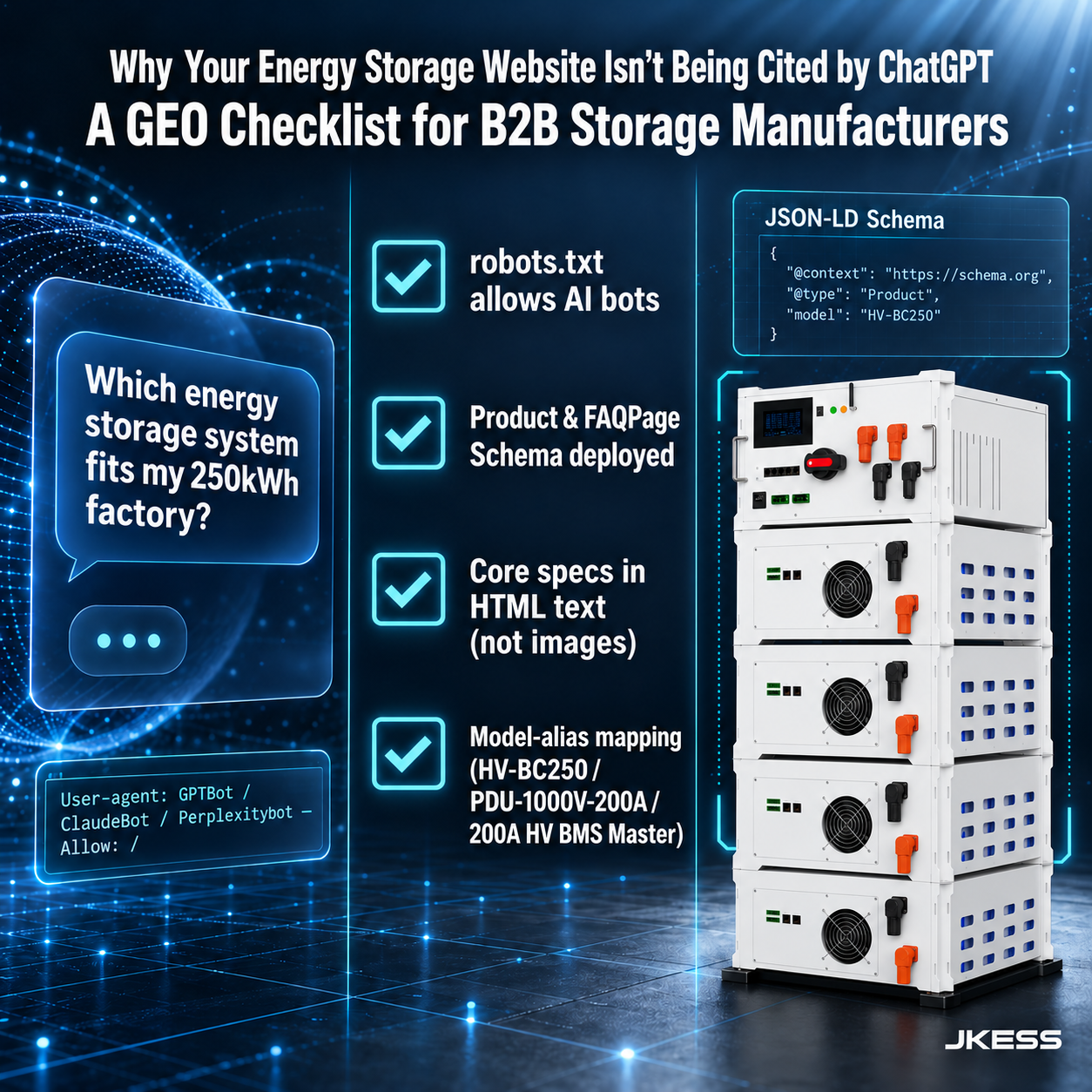
구매자는 공급업체 웹사이트를 비교하기 전에 챗GPT에 문의할 수 있다. 제품 사양이 이미지 내에만 존재하거나, 검색 크롤러가 사이트를 탐색하지 못하거나, 모델 번호가 일관되지 않으면, 해당 정보는 응답에서 누락될 수 있다.
핵심 내용
- 조달 여정에는 이제 AI 기반 조사가 포함된다. 구매자는 개별 공급업체 페이지를 열기 전에 ‘내 공장 요구사항인 250kWh에 맞는 시스템은 무엇인가?’라고 물을 수 있다.
- 사실을 쉽게 검색하고 확인할 수 있도록 하라. 기술 사양을 가시적인 HTML 텍스트로 게시하되, 단위, 작동 조건, 출처 및 명확한 제품 식별 정보를 포함시켜야 한다.
- AI 가시성 점검 항목 7가지를 감사하라: 크롤러 접근성, 적절한 스키마, 사실 밀도, 모델 별칭 일관성, HTML 사양, 질문-답변 구조, 그리고 선택적 llms.txt 가이드. 이 요소들은 실용적인 접근성 및 콘텐츠 리스크를 다루며, 일곱 가지 필수 순위 지정 요구사항은 아니다.
- 하나의 제품에는 하나의 일관된 정체성이 필요하다. HV-BC250처럼 내부 PDU 식별자와 '200A HV BMS Master' 같은 명칭은 동일한 개정판을 가리키는지 확인한 후에만 통합해야 한다.
- GEO는 지속적인 콘텐츠 관리 중이다. 근거 자료를 보관하고, 인용 출처를 모니터링하며, 부정확한 답변을 수정해야 한다. 어떤 체크리스트도 ChatGPT, Perplexity 또는 Google AI 개요에서 우선 노출을 보장하지 않는다.
01 / 구매자 여정
B2B 조달 펀넬은 이미 변화하였다.
익숙한 조달 여정은 검색으로 시작하여 여러 공급업체 웹사이트를 거쳐 최종적으로 후보 목록 작성 또는 문의 양식 제출로 끝난다. 인공지능 어시스턴트는 또 다른 진입점을 제공한다. 구매자는 제조사 웹사이트를 방문하기 전에 기술적 설명이나 비교 자료를 직접 요청할 수 있다. 따라서 홈페이지 외부에서 제공되는 정보의 품질이 점차 더 중요해지고 있다.
에너지 저장 시스템 통합업체나 EPC 계약업체가 던질 수 있는 질문들을 고려해 보라. 예를 들어, ‘어떤 고전압 BESS가 4~16개의 슬레이브 배터리 박스를 지원하나요?’ ‘2A 능동형 균형 관리 BMS의 기술 사양은 무엇인가요?’ ‘그리드가 약한 환경에서 C&I 저장 시스템 설계에는 어떤 변경이 필요한가요?’ 이들은 구매자의 의도를 보여주는 사례일 뿐, 측정된 도입 통계가 아니다. 각 질문에는 부품의 등급과 전체 시스템의 기능을 명확히 구분하는 정확한 답변이 필요하다.
관련 사실에 접근하기 어려운 경우나 모순된 경우, 생성된 응답에서 귀사의 제품을 누락시키거나 부정확하게 설명할 수 있습니다. 실용적인 대응은 신뢰할 수 있는 페이지에 명확하고 귀속 가능한 답변을 게시하는 것입니다. AI가 생성한 응답도 여전히 검증이 필요하며, 그러한 응답 내 가시성은 기존의 검색 채널, 유통 채널, 직접 판매 채널을 보완합니다.
02 / 검색 및 인용
기존 SEO와 GEO: 실제로 달라지는 점
두 분야는 중첩됩니다. 이 비교는 각각의 주요 초점 영역을 설명합니다. 유용한 콘텐츠, 기술적 접근성, 신뢰할 수 있는 근거는 모두에게 중요합니다.
| 기존 SEO | GEO(Generative Engine Optimization) |
|---|---|
| 목표 관련 검색 결과에서 가시성을 확보하세요. | 목표 AI가 생성한 응답에서 유용하고 인용되는 출처가 되세요. |
| 최적화 초점 검색 의도, 관련 콘텐츠, 링크, 기술적 품질. | 최적화 초점 검색 가능한 사실, 증거, 명확한 개체 및 적절한 구조화된 데이터. |
| 구매자 행동 검색 결과를 탐색하고 공급업체 페이지를 방문함. | 구매자 행동 답변을 읽고 추가 질문을 하며 관련 링크를 확인함. |
| 콘텐츠 형식 검색 의도와 일치하는 유용한 제품 및 편집 페이지. | 콘텐츠 형식 답변 중심의 문단, 검증 가능한 수치, 조건 및 명시적 제외 사항. |
| 크롤러 접근 Googlebot, Bingbot 및 관련 색인 생성 인프라. | 크롤러 접근 OAI-SearchBot, PerplexityBot, Claude-SearchBot 및 Google 검색 AI 기능용 Googlebot. |
| 구조화된 데이터 적격 페이지 콘텐츠를 설명하고 적용 가능한 검색 기능을 지원함. | 구조화된 데이터 소비 시 속성과 관계를 명확히 하기; 인용을 위한 보편적인 전제 조건은 아님. |
| 경쟁 검색 결과 페이지 전반에 걸친 가시성과 관련성. | 경쟁 답변이 귀하의 근거를 정확히 선정하고, 귀속하며, 사실대로 표현하는지 여부. |
| 이미지 설명적 텍스트와 적절한 대체 텍스트(alt 속성)로 뒷받침되는 유용한 시각 자료. | 이미지 중요 사양을 HTML 내에 반복 기재; 이미지 인식 기능은 서비스별로 상이함. |
| 브랜드 및 모델명 제목, 페이지, 링크 전반에서 식별 가능한 이름. | 브랜드 및 모델명 일관된 주요 식별자, 검증된 별칭, 개정 경계. |
| 측정 노출 수, 순위, 클릭 수, 자격 있는 전환 수. | 측정 URL 인용, 정확한 브랜드 언급, 추천, 자격 있는 문의. |
| SEO는 구매자가 귀사를 찾을 수 있도록 돕습니다. | GEO는 귀사의 자료가 답변의 일부가 되도록 지원합니다. |
03 / 실무 체크리스트
B2B 스토리지 웹사이트를 위한 7단계 GEO 체크리스트
-
Robots.txt 파일을 점검하고 의도한 검색 크롤러의 접근을 허용합니다.
검색 접근 설정과 모델 학습 선호 설정을 분리합니다. OpenAI는 OAI-SearchBot을 자체 검색 크롤러로, GPTBot을 학습용 크롤러로 식별합니다. PerplexityBot은 Perplexity 검색을 지원하며, Claude-SearchBot은 Claude 검색을 지원합니다. 반면 ClaudeBot은 모델 개발 관련 크롤러입니다. Googlebot은 Google 검색(그리고 그 AI 기능 포함)을 위한 크롤링을 제어하며, Google-Extended는 다른 용도에 대한 별도 제어 수단입니다.
기존 사용자 에이전트 그룹, 와일드카드 규칙, 경로 제한, CDN 또는 방화벽 설정을 점검합니다. 표준 robots.txt 동작에 따르면, 명시적인
Allow설정이 없더라도 자동으로 접근이 거부되는 것은 아닙니다. 명시적인 그룹 설정을 통해 의도한 정책을 보다 명확히 할 수 있습니다.# Example for a public marketing website.# Merge with the existing policy; preserve intentional path restrictions.User-agent: OAI-SearchBotAllow: /User-agent: PerplexityBotAllow: /User-agent: Claude-SearchBotAllow: /User-agent: GooglebotAllow: /의도한 콘텐츠 사용에 따라 GPTBot, ClaudeBot, Google-Extended 정책을 각각 별도로 설정하세요. 최종 병합된 규칙과 실제 크롤러 요청을 검증하세요.
참고 문헌: OpenAI 크롤러 설명서 ,Perplexity 크롤러 ,Anthropic 크롤러 설명서 그리고 Google 크롤러 제어 기능 .
-
사용자가 실제로 보는 페이지를 정확히 설명하는 스키마를 배포하세요.
구조화된 데이터를 사용하여 식별자와 속성을 명시적으로 표시하세요. 스키마는 방문자가 실제로 보는 페이지를 설명해야 하며, 근거 없는 주장이나 서로 다른 제품 변형을 혼합해서는 안 됩니다.
- 제품 + 추가 속성: 모델별 매개변수, 단위 및 문서화된 특성.
- FAQPage: 진정성 있고 시각적으로 확인 가능한 질문과 해당 답변.
- 방법 안내: 완전한 단계와 범위를 포함하는 실제 설치 또는 운용 가이드.
- 제1항 편집 제목, 저자, 출판일, 그리고 공식 페이지 주소.
- 정리 기능: 기업의 일관된 이름, URL, 그리고 검증된 연락처 정보.
JSON 구문과 필드 의미를 검증한 후, 모든 마크업 문장을 렌더링된 페이지와 하나하나 비교하세요. 여러 제품을 논의하는 블로그 글이 자동으로 제품 상세 페이지가 되는 것은 아닙니다.
자격 요건은 약속이 아닙니다. 구글은 AI 검색 기능에 특별한 스키마나 AI 전용 파일이 필요하지 않다고 밝혔습니다. 스키마.오르그의 유효성, 플랫폼 지원 여부, 그리고 실제로 포함되는지는 별개의 문제입니다.
참고 문헌: 스키마.오르그 추가 속성 ,FAQ 페이지 그리고 구글의 인공지능 기능 안내 .
-
유용한 사실 밀도 높이기
지원되지 않는 형용사를 구매자가 검증 가능한 주장으로 대체하세요. 결론을 먼저 제시하고, 각 문단은 하나의 주제에 집중하며, 값을 해석하기 위해 필요한 모델, 단위, 작동 조건, 출처를 모두 명시하세요.
이전 / 프로모션용 “JKESS는 우수한 성능을 갖춘 업계 최고 수준의 액티브 밸런싱 기술을 제공합니다.”이후 / 구체적이고 근거 있는 표현 “JKESS 기술 자료에 따르면 BMU-H5-16은 2A 액티브 밸런싱, ±0.005V 셀 전압 측정 정확도, 8개 NTC 온도 센서, 16S 리튬철인산염(LiFePO4) 지원 사양을 갖추고 있습니다. 공급된 정확한 리비전 버전과 이 값들을 반드시 확인하세요.”서로 모순되는 문서에서 값을 합쳐 새로운 사양을 만들지 마세요. 제품 페이지와 데이터시트가 서로 다를 경우, 제품 담당자와 협의하여 차이를 해결하고 두 출처 모두 업데이트한 후에야 어느 한쪽을 확정된 정보로 간주할 수 있습니다.
예시 출처: JKESS의 BMU-H5-16 기술 논의 공개 페이지에는 개정 차이가 포함될 수 있습니다. 현재 승인된 데이터시트는 출판 기준으로 유지됩니다.
-
검증된 모델-별명 매핑을 구축합니다
각 제품에 하나의 주요 이름과 하나의 공식 제품 페이지를 부여합니다. 마케팅 이름, 엔지니어링 식별자, 제품 개정 버전, 지역별 명명 변형을 연결하는 기록을 유지합니다.
제공된 명명 예시는 HV-BC250 / PDU-1000V-200A-A001-NY / 200A HV BMS Master Box 입니다. 이는 확인해야 할 별명 관계일 뿐, 해당 식별자가 상호 교환 가능하다는 증거가 아닙니다. 엔지니어링 측에서 일치를 확인하면 다음과 같이 기재합니다. “HV-BC250는 PDU-1000V-200A-A001-NY로도 알려져 있으며, 200A HV BMS Master Box입니다.”
제목 및 H1 태그에는 주요 이름을 사용하고, 확인된 별명은 개요 문단과 제품 필드(예:
alternateName또는mpn) 등 적절한 위치에 배치합니다. 사양, 인터페이스 또는 공급 범위가 변경되는 경우 개정 버전 간 별도의 정체성을 유지합니다. -
핵심 사양은 가시성 있는 HTML 내에 유지합니다
주요 값을 페이지 자체에 직접 기재합니다. 전압, 전류, 정확도, 치수, 시험 조건 및 공급 범위는 일반 텍스트 및 의미론으로 계속 제공되어야 함
cells.
Image extraction and JavaScript rendering differ between crawlers and retrieval tools. Text inside a photograph, iframe, or canvas is therefore an unreliable sole source for a critical parameter. Alt text helps describe an image, but it does not replace a visible specification table.
Publish a dated datasheet alongside the HTML table. Distinguish nominal voltage from the operating envelope, continuous current from peak current, and empty-kit weight from the weight of an assembled module.
Answer real buyer questions directly
Build a useful set of questions around the buying decision: “How many slave boxes can one master box support?” “Does the kit include battery cells?” “Which communication protocols are provided?” Answer first, then give the limits and source.
Five to ten FAQs can be a practical editorial target when the topic warrants them; there is no universal minimum. Native
When adding FAQPage markup, use the same question and answer wording as the visible page. Do not add invisible FAQ claims just to target search queries. This article includes ten visible FAQs and marks up five of them.
Consider an optional llms.txt reading guide
llms.txtis a proposed Markdown convention for guiding agents to useful website content. A concise guide can list the company, core products, application pages, and maintained technical documents. It is useful only to consumers that choose to read it.# JKESS Electronic Technology BMS and active balancing solutions for energy storage.## Core Products- [HV-BC250 200A Master Box](https://www.jkess.com/200a-hv-bms-master)- [HV-B6U Slave Battery Box Kits](https://www.jkess.com/hv-slave-6u-kits)- [261kWh Liquid-Cooled BESS Kits](https://www.jkess.com/commercial--industrial-energy-storage-system-kits)## Application Guides- [Modular HV Energy Storage Kits](https://www.jkess.com/home-energy-storage-system-kits)## Technical DocumentsUse the current specifications and scope-of-supply notes on the product pages.Add approved, versioned datasheet links when those documents are published.Illustrative content, not a report of the live site’s configuration. Use verified links and clean Markdown versions where available. Maintaining this file does not deploy robots.txt rules or create search eligibility.
References: the llms.txt proposal and Google’s generative AI optimization guidance. Google Search does not use llms.txt as a special visibility or ranking input.
04 / Content in practice
Before and After: Rewriting a Storage Product Page for AI Citation
The following five examples replace broad promotion with a more useful answer. Numerical illustrations include their assumptions; commercial and certification statements require current, model-specific evidence.
Illustrative rewrites. Calculations are not measured performance guarantees. Before / Marketing copy After / Evidence-led copy “Our advanced active balancing BMS delivers superior performance and extends battery life.” “For an illustrative 314Ah cell with a 0.5% charge difference, ΔQ = 314 × 0.005 = 1.57Ah. At a constant 2A transfer current, the idealized duration is 1.57 ÷ 2 = 0.785 hours, or about 47 minutes. Real duration depends on current limits, control behavior, and losses.” “The system supports a wide voltage range for various applications.” “The HV-BC250 listing specifies an 80–1000V DC master range. A 4–16 slave-box configuration is described as approximately 64–256kWh when each box is approximately 16kWh. With 16 cells per box and 3.2V nominal per cell, 16 boxes yield 256S / 819.2V nominal. Verify the full charge/discharge range and selected cell capacity.” “Our battery boxes are designed for easy installation.” “Define the scope as one master plus five slave boxes: six enclosures in total. State empty-kit and assembled-module weights separately, together with the lifting and installation plan. A claimed 28.55kg kit weight or two-technician, 2–3 day schedule requires a matching product record and a defined site scope.” “We provide reliable products with international certifications.” “List the exact model and revision, applicable CE declaration, RoHS documentation, FCC evidence, and test-report identifiers. If citing GB34131-2017 or insulation resistance ≥1 MΩ at 1,000 VDC, verify the applicable standard edition, test method, and report scope rather than extending a component claim to the whole system.” “Contact us for more information.” “Send your required capacity, DC range, current, communication protocol, scope of supply, quantity, and delivery location to [email protected]. Request confirmation of available regional stock and a written dispatch estimate for that configuration.” Product references: HV-BC250 and modular storage kits. The 64–256kWh shorthand is configuration-dependent; a hardware kit without cells does not itself contain that stored energy.
05 / Access and extraction
Technical Access: Can AI Crawlers Actually Read Your Website?
Check 1 / robots.txt and access controls
Open
https://yourdomain.com/robots.txtand evaluate the user-agent group and path rules that apply to each intended crawler. Inspect firewall challenges, blocked IP ranges, redirects, and server errors as well.Absence of an explicit Allow is not a failure by itself. Use the actual response and verified crawler logs to determine what is accessible.
Check 2 / Core content in HTML
Disable JavaScript and reload the product page. Check the original HTML response for the model name, specification table, scope of supply, and answers.
If they disappear, the page depends on rendering that some tools may not perform. Prefer server-rendered or static core content, and use a search engine’s inspection tools where available. Also check
noindex, snippet restrictions, andX-Robots-Tagheaders.Check 3 / Descriptive alt text
Describe informative product photographs, diagrams, and screenshots with suitable alt text. Keep purely decorative images from adding noise.
Repeat important values in the visible body or a real HTML table. A long alt attribute is not a substitute for a readable technical specification.
Check 4 / Reliable loading and delivery
Confirm that the canonical page returns a successful response and delivers useful content promptly. Reduce unnecessary third-party scripts, oversized payloads, and client-side dependencies.
Timeouts, errors, and rendering limits can interfere with retrieval. A model’s context budget is a separate issue from network performance; there is no universal “AI loading time” threshold.
Check 5 / Canonical URLs and model identity
Identify duplicate URLs for the same item and use a consistent canonical URL, internal links, and sitemap entries. For example, reconcile two product paths that describe the same HV-BC250 revision.
A canonical URL signals a preferred page; it does not by itself resolve conflicting specifications or prove that two product names are equivalent.
Access references: robots.txt interpretation and the crawler documentation linked in checkpoint 1.
06 / Evidence of progress
How to Measure Whether GEO Is Working
Pair answer-level observations with business outcomes. Metric Traditional SEO measure GEO measure Visibility Search impressions and keyword positions. Share of sampled AI answers citing an owned URL; track brand mentions separately. Traffic Organic search clicks and visits. Identifiable AI referrals; brand-search changes as supporting, non-causal evidence. Content Engagement and landing-page performance. Which facts and pages are cited, and whether values and limitations are correct. Conversion Forms, qualified leads, and sales. Qualified inquiries with an AI discovery source or attributable referral. Competition Relative search visibility. Citation share and co-mentions within the same fixed question set. Audit Indexability, search-intent coverage, and page quality. Entity consistency, evidence freshness, extractable facts, and markup accuracy. A practical weekly baseline: run ten fixed buyer questions in ChatGPT search, Perplexity, and Google AI Overviews where an overview appears. Repeat the sample and log platform, date, locale, model or mode, exact question, cited URL, brand mention, and answer accuracy.
Citation rate = answers linking to your domain ÷ eligible sampled answers. Report the sample size and the number of queries without an AI answer. A brand mention without a source link is not a citation. Use a separate measure for citations to this specific article.
For example, six cited answers out of 30 eligible observations produce a 20% sample citation rate. This is an illustrative calculation, not a JKESS result. Keep the question set stable when comparing periods, and avoid treating a single answer or a small change as proof that one edit caused an improvement.
07 / Applying the method
How JKESS Applies GEO to Its Own Product Pages
The reviewed JKESS master-box and 261kWh application pages expose technical information in readable tables. That is a useful starting point. The following seven practices form an implementation and maintenance checklist, rather than a claim that every page has already passed a site-wide audit.
- Maintain structured specification tables. Keep each voltage, current, accuracy, dimension, and weight value in visible HTML, tied to a model, revision, and source. Separate component ratings from complete-system limits.
- Keep FAQs useful and consistent. Write five to ten relevant answers when justified by the product; align any FAQPage markup with the exact visible wording and recheck answers after product changes.
- Use model-specific Product markup. Validate Product and additionalProperty on the appropriate HV-BC250, HV-B6U, and 261kWh pages. Record evidence of the deployed markup rather than assuming site-wide coverage.
- Control aliases. Confirm any relationship between HV-BC250 and PDU-1000V-200A-A001-NY, then use one primary name with the approved aliases. Keep HV-BC150-100A as a distinct product identity.
- Reconcile quantitative claims. Check the 2A active balancing and ±0.005V sampling values against the supplied BMU revision. Keep the 4–16 slave-box and 64–256kWh statements linked to their cell and configuration assumptions.
- Maintain an optional llms.txt guide. If deployed, list current canonical product and documentation URLs, remove stale links, and treat it as documentation support rather than an indexing requirement.
- Verify search access. Review the live robots.txt policy and crawler delivery logs. Confirm intended access for search bots while managing training-related controls independently.
JKESS product and specification anchors
HV-BC250 · 200A HV BMS Master · HV-BC150-100A · 100A master configuration · HV-B6U · 6U slave battery box kits · BMU-H5-16 · technical reference · 261kWh liquid-cooled system
Values to keep in context: 2A active balancing · ±0.005V sampling accuracy · 4–16 slave battery boxes · approximately 64–256kWh · 80–1000V DC master range. These refer to different components or configurations, not a single universal specification. Kits are offered without battery cells; confirm the final scope of supply.
08 / Questions buyers ask
Frequently Asked Questions
What is GEO and how does it differ from traditional SEO?
GEO (Generative Engine Optimization) is the practice of making useful content easier to retrieve, understand, and cite in AI-generated answers. Traditional SEO emphasizes visibility in search results, while GEO also tracks how accurately a brand and its facts appear in generated responses. Both benefit from accessible pages, clear product identities, and reliable evidence; neither guarantees inclusion.
Why is my energy storage website not being cited by ChatGPT?
Possible causes include blocked search crawlers, unindexed pages, specifications that are difficult to extract, inconsistent model names, or weak evidence for the question being asked. For ChatGPT search, review OAI-SearchBot access rather than assuming GPTBot controls search visibility. Missing Schema or llms.txt alone does not prove why a page was omitted; compare crawl evidence, content relevance, and repeated query results.
What is llms.txt and why does it matter for B2B storage websites?
llms.txt is a proposed Markdown-based guide to a website’s useful content, which can point agents to product documentation and application guides. It can help tools that choose to use it, but adoption and behavior differ between services. Treat it as optional documentation infrastructure, not a requirement for AI citation or a replacement for HTML pages and sitemaps.
How do I check if AI crawlers can access my website?
Inspect the robots.txt groups and path rules that apply to OAI-SearchBot, PerplexityBot, Claude-SearchBot, and Googlebot, then review server and firewall logs. A missing explicit Allow rule does not by itself mean access is denied. Also check HTTP responses, indexing and snippet controls, and whether product specifications are available without JavaScript; a browser-only test does not confirm a crawler’s actual access.
What Schema markup should a B2B storage website prioritize?
Use Product with additionalProperty on product pages, Article on editorial pages, and Organization for the company identity. FAQPage can describe visible questions and answers, and HowTo can describe a genuine procedural guide. Keep markup aligned with the visible content and applicable platform documentation; valid Schema does not guarantee a rich result or an AI citation.
How does inconsistent product naming affect AI visibility?
Different names for the same item can make it harder for readers and retrieval systems to connect the information. Select one primary model name and record verified aliases, product revisions, and one canonical URL. Publish an “also known as” relationship only after the model owner confirms that the labels identify the same product and configuration.
What is fact density and why does it matter for GEO?
Fact density is an editorial measure of how much useful, verifiable information a passage contains relative to general promotional language. A model-specific value with units, operating conditions, and a dated source is more useful than an unsupported adjective. Values such as 2A active balancing, ±0.005V sampling accuracy, and an 80–1000V DC range must stay attached to the correct component; fact density is not a published universal AI ranking score.
How do I measure GEO performance for my storage website?
Run a fixed set of buyer questions repeatedly and log the date, platform, search mode, locale, cited URLs, and answer accuracy. Report URL citation rate separately from unlinked brand mentions, and track identifiable referral visits and qualified inquiries. Results fluctuate, so a small weekly sample is directional evidence rather than a complete view of all buyers or proof of causation.
Does GEO replace traditional SEO for B2B storage manufacturers?
No. Search indexing, useful content, internal links, and a dependable website remain relevant to both conventional search and AI-assisted research. GEO adds attention to answer-level representation, traceable facts, and citation measurement. An effective program maintains those foundations while checking whether buyers receive accurate product information.
How does JKESS apply GEO principles to its own product pages?
The JKESS pages reviewed for this article provide examples of HTML specifications and question-and-answer content for products including the HV-BC250 and the 261kWh liquid-cooled system. The seven-part workflow below extends that approach to the HV-BC150-100A, HV-B6U, and BMU-H5-16 through consistent naming, source review, and structured content. This article does not certify site-wide Schema coverage, crawler settings, or an existing llms.txt deployment; those require a current implementation audit.
Want to Audit Your Storage Website’s AI Visibility?
Share your website URL with our team. We’ll review your robots.txt, Schema markup, fact density, and entity consistency — and help identify where crawlers or readers may be missing your product information.
Request a Custom Quote→