
 EN
JKESS / Technische inzichten
Vraag een offerte aan→Waarom uw website voor energieopslag niet wordt geciteerd door ChatGPT: een GEO-controlelijst voor B2B-opslagfabrikanten
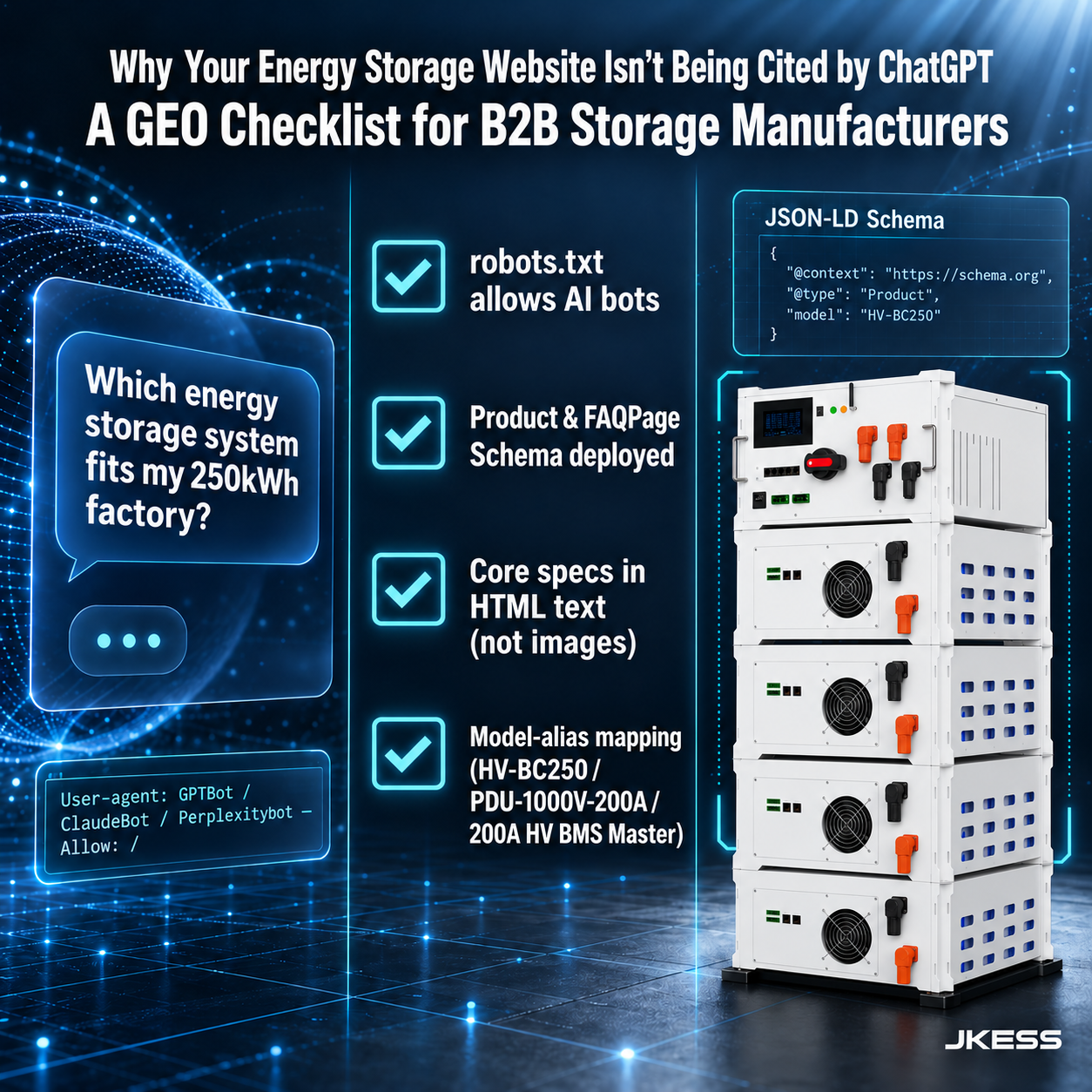
Uw koper kan ChatGPT raadplegen voordat hij of zij websites van leveranciers vergelijkt. Als uw productspecificaties alleen in afbeeldingen staan, als uw website zoekmachines blokkeert of als uw modelnummers inconsistent zijn, dan ontbreekt uw informatie mogelijk in het antwoord.
Belangrijkste lessen
- De inkoopreis omvat nu AI-ondersteund onderzoek. Een koper kan vragen: “Welk systeem voldoet aan mijn vereiste van 250 kWh voor de fabriek?”, nog voordat hij of zij individuele leverancierspagina’s opent.
- Maak uw feiten eenvoudig op te halen en te verifiëren. Publiceer technische specificaties als zichtbare HTML-tekst, inclusief eenheden, bedrijfsomstandigheden, bronnen en duidelijke productidentiteiten.
- Controleer zeven AI-zichtbaarheidscontrolepunten: toegang voor crawlers, passende Schema’s, feitendichtheid, consistentie van model-aliassen, HTML-specificaties, vraag-en-antwoordstructuur en een optionele llms.txt-gids. Deze punten dekken praktische toegangs- en inhoudsrisico’s; het zijn geen zeven verplichte rangschikkingsvereisten.
- Een product heeft één consistente identiteit. Stem namen zoals HV-BC250, een interne PDU-identificatie, en ‘200A HV BMS Master’ pas af nadat is bevestigd dat ze verwijzen naar dezelfde revisie.
- GEO is voortdurend inhoudsbeheer. Bewaar het bewijs, houd citaten in de gaten en verbeter onjuiste antwoorden. Geen checklist kan prioritaire plaatsing garanderen in ChatGPT, Perplexity of Google AI Overviews.
01 / De kooptrechter
De B2B-aankoopfunnel is al gewijzigd
De vertrouwde inkoopreis begint met een zoekopdracht, loopt door verschillende leverancierswebsites heen en eindigt met een kortelijst of een aanvraagformulier. KI-assistenten introduceren een extra toegangspunt: een koper kan alvast om een technische uitleg of vergelijking vragen, nog voordat hij of zij de website van een fabrikant bezoekt. Daardoor wordt de kwaliteit van de informatie die buiten uw startpagina beschikbaar is, steeds relevanter.
Denk na over de vragen die een opslagintegrator of EPC-aannemer zou kunnen stellen: ‘Welke hoogspannings-BESS ondersteunt 4–16 slave-batterijdozen?’ ‘Wat zijn de technische parameters van een 2A actief balancerend BMS?’ ‘Welke wijzigingen zijn nodig in een C&I-opslagontwerp voor een zwak elektriciteitsnet?’ Dit zijn voorbeelden van koperintentie, niet van gemeten adoptiestatistieken. Elke vraag vereist een precies antwoord dat onderscheid maakt tussen een componentenspecificatie en een volledig-systeemcapaciteit.
Als de relevante feiten moeilijk toegankelijk zijn of tegenstrijdig, kan een gegenereerd antwoord uw product missen of het onjuist beschrijven. De praktische oplossing is om een duidelijk, herleidbaar antwoord te publiceren op een betrouwbare pagina. AI-gegenereerde antwoorden moeten nog steeds worden geverifieerd, en zichtbaarheid in die antwoorden vormt een aanvulling op de bestaande zoek-, distributeur- en directe-verkoopkanalen.
02 / Zoeken en citatie
Traditionele SEO versus GEO: Wat verandert er echt?
De twee disciplines overlappen. Deze vergelijking beschrijft hun voornaamste nadrukgebieden; nuttige inhoud, technische toegankelijkheid en geloofwaardig bewijs zijn voor beide van belang.
| Traditionele SEO | GEO (Generative Engine Optimization) |
|---|---|
| Doel Verwerven van zichtbaarheid in relevante zoekresultaten. | Doel Een nuttige, geciteerde bron worden in AI-gegenereerde antwoorden. |
| Optimalisatie Focus Zoekintentie, relevante inhoud, koppelingen en technische kwaliteit. | Optimalisatie Focus Herstelbare feiten, bewijsmateriaal, duidelijke entiteiten en geschikte gestructureerde gegevens. |
| Koopgedrag Blader door de resultaten en bezoek de leverancierspagina's. | Koopgedrag Lees een antwoord, stel vervolgvragen en controleer ondersteunende links. |
| Inhoudsformaat Nuttige product- en redactionele pagina's die aansluiten bij de zoekintentie. | Inhoudsformaat Antwoord-eerste alinea's, verifieerbare waarden, voorwaarden en expliciete uitsluitingen. |
| Toegang voor crawlers Googlebot, Bingbot en de relevante indexeerinfrastructuur. | Toegang voor crawlers OAI-SearchBot, PerplexityBot, Claude-SearchBot en Googlebot voor Google Search AI-functies. |
| Gestructureerde data Beschrijf in aanmerking komende pagina-inhoud en ondersteun toepasselijke zoekfuncties. | Gestructureerde data Verduidelijk eigenschappen en relaties waar ze worden gebruikt; dit is geen universele vereiste voor een verwijzing. |
| Concurrentie Zichtbaarheid en relevantie over de hele zoekresultatenpagina. | Concurrentie Of het antwoord uw bewijsmateriaal selecteert, toekent en nauwkeurig weergeeft. |
| Afbeeldingen Nuttige visuele elementen, ondersteund door beschrijvende tekst en geschikte ‘alt’-attributen. | Afbeeldingen Herhaal essentiële specificaties in HTML; de mogelijkheden om afbeeldingen te lezen variëren per service. |
| Merk- en modelnamen Herkenbare namen in titels, pagina’s en links. | Merk- en modelnamen Consistente primaire identificatoren, geverifieerde aliassen en duidelijke revisiegrenzen. |
| Meten Impressies, posities, klikken en gekwalificeerde conversies. | Meten URL-verwijzingen, accurate merkvermeldingen, doorverwijzingen en gekwalificeerde aanvragen. |
| SEO helpt kopers u te vinden. | GEO zorgt ervoor dat uw bewijs onderdeel wordt van het antwoord. |
03 / De werklijst
De 7-punts GEO-werklijst voor B2B-opslagwebsites
-
Controleer robots.txt en sta de bedoelde zoekcrawlers toe
Scheid zoektoegang van voorkeuren voor modeltraining. OpenAI identificeert OAI-SearchBot als zijn zoekcrawler en GPTBot als een trainingcrawler. PerplexityBot ondersteunt Perplexity-zoekopdrachten; Claude-SearchBot ondersteunt Claude-zoekopdrachten, terwijl ClaudeBot betrekking heeft op modelontwikkeling. Googlebot regelt het crawlen voor Google Zoeken, inclusief zijn AI-functies; Google-Extended is een afzonderlijke instelling voor andere doeleinden.
Controleer bestaande user-agentgroepen, wildcardregels, padbeperkingen en CDN- of firewallinstellingen. Volgens het standaardgedrag van robots.txt leidt het ontbreken van een expliciete
Allowniet automatisch tot weigering van toegang. Een expliciete groep kan het bedoelde beleid duidelijker maken.# Example for a public marketing website.# Merge with the existing policy; preserve intentional path restrictions.User-agent: OAI-SearchBotAllow: /User-agent: PerplexityBotAllow: /User-agent: Claude-SearchBotAllow: /User-agent: GooglebotAllow: /Stel de GPTBot-, ClaudeBot- en Google-Extended-beleidsregels afzonderlijk in op basis van het beoogde gebruik van de inhoud. Valideer de uiteindelijke samengevoegde regels en de daadwerkelijke crawlerverzoeken.
Referenties: OpenAI-crawlerdocumentatie ,Perplexity-crawlers ,Anthropic-crawlerdocumentatie en de Google-crawlerbesturing .
-
Implementeer Schema dat de zichtbare pagina nauwkeurig beschrijft
Gebruik gestructureerde gegevens om identificatoren en eigenschappen expliciet te maken. Het Schema moet de pagina beschrijven die een bezoeker daadwerkelijk ziet, zonder ongesteunde beweringen toe te voegen of verschillende productvarianten te mengen.
- Product+ additionalProperty: modelspecifieke parameters, eenheden en gedocumenteerde kenmerken.
- FAQPage: echte, zichtbare vragen met hun bijbehorende antwoorden.
- Hoe te doen: een daadwerkelijke installatie- of inbedrijfstellinggids met volledige stappen en omvang.
- Artikel: de redactionele kop, auteur, publicatiedatum en canonieke pagina.
- Organisatie: de consistente naam van het bedrijf, URL en geverifieerde contactgegevens.
Valideer de JSON-syntaxis en de betekenis van de velden, en vergelijk vervolgens elke gemarkeerde verklaring met de weergegeven pagina. Een blog die over meerdere producten gaat, is niet automatisch een productdetailpagina.
Geschiktheid is geen toezegging. Google zegt dat zijn AI-zoekfuncties geen speciale Schema- of AI-specifieke bestanden vereisen. De geldigheid van Schema.org, platformondersteuning en daadwerkelijke opname zijn afzonderlijke vraagstukken.
Referenties: Schema.org additionalProperty ,FAQPage en de Richtlijnen voor AI-functies van Google .
-
Verhoog de dichtheid van nuttige feiten
Vervang niet-ondersteunde bijvoeglijke naamwoorden door een bewering die een koper kan verifiëren. Plaats de conclusie eerst, houd elke alinea gefocust, en vermeld het model, de eenheid, de bedrijfsomstandigheden en de bron die nodig zijn om de waarde te interpreteren.
Voor / Promotie "JKESS levert actieve balansertechnologie op industrieniveau met superieure prestaties."Na / Specifiek en toewijsbaar "In de technische documentatie van JKESS wordt de BMU-H5-16 beschreven met 2 A actieve balansering, een nauwkeurigheid van ±0,005 V bij het meten van celspanning, acht NTC-temperatuursensoren en ondersteuning voor 16S LiFePO4. Controleer deze waarden tegen de exacte revisie die is geleverd."Combineer geen waarden uit tegenstrijdige documenten tot een nieuwe specificatie. Als een productpagina en een datasheet van elkaar afwijken, los dan de discrepantie op met de producteigenaar en werk beide bronnen bij voordat u een van beide als definitief beschouwt.
Voorbeeldbron: Technische bespreking van JKESS over de BMU-H5-16 . Openbare pagina’s kunnen revisieverschillen bevatten; een momenteel goedgekeurd datasheet blijft de referentie voor publicatie.
-
Bouw een geverifieerde afbeelding van model-naar-alias
Geef elk product één primaire naam en één canonieke productpagina. Houd een register bij dat de marketingnaam, technische identificatie, productrevisie en eventuele regionale naamvarianten met elkaar verbindt.
Het meegeleverde naamgevingsvoorbeeld is HV-BC250 / PDU-1000V-200A-A001-NY / 200A HV BMS Master Box . Dit is een aliasrelatie die moet worden geverifieerd, niet een bewijs dat de identificatoren onderling uitwisselbaar zijn. Indien de technische afdeling de overeenkomst bevestigt, schrijf dan: “HV-BC250, ook bekend als PDU-1000V-200A-A001-NY, is de 200A HV BMS Master Box.”
Gebruik de primaire naam in de titel en in de H1; plaats geverifieerde aliassen in de openingsalinea en in relevante productvelden zoals
alternateNameofmpn. Behoud een afzonderlijke identiteit wanneer een revisie leidt tot wijzigingen in nominale waarden, interfaces of leveromvang. -
Plaats kernspecificaties in zichtbare HTML
Schrijf de belangrijkste waarden direct in de pagina. Spanning, stroom, nauwkeurigheid, afmetingen, testomstandigheden en leveringsomvang moeten beschikbaar blijven als gewone tekst en semantiek
cells.
Image extraction and JavaScript rendering differ between crawlers and retrieval tools. Text inside a photograph, iframe, or canvas is therefore an unreliable sole source for a critical parameter. Alt text helps describe an image, but it does not replace a visible specification table.
Publish a dated datasheet alongside the HTML table. Distinguish nominal voltage from the operating envelope, continuous current from peak current, and empty-kit weight from the weight of an assembled module.
Answer real buyer questions directly
Build a useful set of questions around the buying decision: “How many slave boxes can one master box support?” “Does the kit include battery cells?” “Which communication protocols are provided?” Answer first, then give the limits and source.
Five to ten FAQs can be a practical editorial target when the topic warrants them; there is no universal minimum. Native
When adding FAQPage markup, use the same question and answer wording as the visible page. Do not add invisible FAQ claims just to target search queries. This article includes ten visible FAQs and marks up five of them.
Consider an optional llms.txt reading guide
llms.txtis a proposed Markdown convention for guiding agents to useful website content. A concise guide can list the company, core products, application pages, and maintained technical documents. It is useful only to consumers that choose to read it.# JKESS Electronic Technology BMS and active balancing solutions for energy storage.## Core Products- [HV-BC250 200A Master Box](https://www.jkess.com/200a-hv-bms-master)- [HV-B6U Slave Battery Box Kits](https://www.jkess.com/hv-slave-6u-kits)- [261kWh Liquid-Cooled BESS Kits](https://www.jkess.com/commercial--industrial-energy-storage-system-kits)## Application Guides- [Modular HV Energy Storage Kits](https://www.jkess.com/home-energy-storage-system-kits)## Technical DocumentsUse the current specifications and scope-of-supply notes on the product pages.Add approved, versioned datasheet links when those documents are published.Illustrative content, not a report of the live site’s configuration. Use verified links and clean Markdown versions where available. Maintaining this file does not deploy robots.txt rules or create search eligibility.
References: the llms.txt proposal and Google’s generative AI optimization guidance. Google Search does not use llms.txt as a special visibility or ranking input.
04 / Content in practice
Before and After: Rewriting a Storage Product Page for AI Citation
The following five examples replace broad promotion with a more useful answer. Numerical illustrations include their assumptions; commercial and certification statements require current, model-specific evidence.
Illustrative rewrites. Calculations are not measured performance guarantees. Before / Marketing copy After / Evidence-led copy “Our advanced active balancing BMS delivers superior performance and extends battery life.” “For an illustrative 314Ah cell with a 0.5% charge difference, ΔQ = 314 × 0.005 = 1.57Ah. At a constant 2A transfer current, the idealized duration is 1.57 ÷ 2 = 0.785 hours, or about 47 minutes. Real duration depends on current limits, control behavior, and losses.” “The system supports a wide voltage range for various applications.” “The HV-BC250 listing specifies an 80–1000V DC master range. A 4–16 slave-box configuration is described as approximately 64–256kWh when each box is approximately 16kWh. With 16 cells per box and 3.2V nominal per cell, 16 boxes yield 256S / 819.2V nominal. Verify the full charge/discharge range and selected cell capacity.” “Our battery boxes are designed for easy installation.” “Define the scope as one master plus five slave boxes: six enclosures in total. State empty-kit and assembled-module weights separately, together with the lifting and installation plan. A claimed 28.55kg kit weight or two-technician, 2–3 day schedule requires a matching product record and a defined site scope.” “We provide reliable products with international certifications.” “List the exact model and revision, applicable CE declaration, RoHS documentation, FCC evidence, and test-report identifiers. If citing GB34131-2017 or insulation resistance ≥1 MΩ at 1,000 VDC, verify the applicable standard edition, test method, and report scope rather than extending a component claim to the whole system.” “Contact us for more information.” “Send your required capacity, DC range, current, communication protocol, scope of supply, quantity, and delivery location to [email protected]. Request confirmation of available regional stock and a written dispatch estimate for that configuration.” Product references: HV-BC250 and modular storage kits. The 64–256kWh shorthand is configuration-dependent; a hardware kit without cells does not itself contain that stored energy.
05 / Access and extraction
Technical Access: Can AI Crawlers Actually Read Your Website?
Check 1 / robots.txt and access controls
Open
https://yourdomain.com/robots.txtand evaluate the user-agent group and path rules that apply to each intended crawler. Inspect firewall challenges, blocked IP ranges, redirects, and server errors as well.Absence of an explicit Allow is not a failure by itself. Use the actual response and verified crawler logs to determine what is accessible.
Check 2 / Core content in HTML
Disable JavaScript and reload the product page. Check the original HTML response for the model name, specification table, scope of supply, and answers.
If they disappear, the page depends on rendering that some tools may not perform. Prefer server-rendered or static core content, and use a search engine’s inspection tools where available. Also check
noindex, snippet restrictions, andX-Robots-Tagheaders.Check 3 / Descriptive alt text
Describe informative product photographs, diagrams, and screenshots with suitable alt text. Keep purely decorative images from adding noise.
Repeat important values in the visible body or a real HTML table. A long alt attribute is not a substitute for a readable technical specification.
Check 4 / Reliable loading and delivery
Confirm that the canonical page returns a successful response and delivers useful content promptly. Reduce unnecessary third-party scripts, oversized payloads, and client-side dependencies.
Timeouts, errors, and rendering limits can interfere with retrieval. A model’s context budget is a separate issue from network performance; there is no universal “AI loading time” threshold.
Check 5 / Canonical URLs and model identity
Identify duplicate URLs for the same item and use a consistent canonical URL, internal links, and sitemap entries. For example, reconcile two product paths that describe the same HV-BC250 revision.
A canonical URL signals a preferred page; it does not by itself resolve conflicting specifications or prove that two product names are equivalent.
Access references: robots.txt interpretation and the crawler documentation linked in checkpoint 1.
06 / Evidence of progress
How to Measure Whether GEO Is Working
Pair answer-level observations with business outcomes. Metric Traditional SEO measure GEO measure Visibility Search impressions and keyword positions. Share of sampled AI answers citing an owned URL; track brand mentions separately. Traffic Organic search clicks and visits. Identifiable AI referrals; brand-search changes as supporting, non-causal evidence. Content Engagement and landing-page performance. Which facts and pages are cited, and whether values and limitations are correct. Conversion Forms, qualified leads, and sales. Qualified inquiries with an AI discovery source or attributable referral. Competition Relative search visibility. Citation share and co-mentions within the same fixed question set. Audit Indexability, search-intent coverage, and page quality. Entity consistency, evidence freshness, extractable facts, and markup accuracy. A practical weekly baseline: run ten fixed buyer questions in ChatGPT search, Perplexity, and Google AI Overviews where an overview appears. Repeat the sample and log platform, date, locale, model or mode, exact question, cited URL, brand mention, and answer accuracy.
Citation rate = answers linking to your domain ÷ eligible sampled answers. Report the sample size and the number of queries without an AI answer. A brand mention without a source link is not a citation. Use a separate measure for citations to this specific article.
For example, six cited answers out of 30 eligible observations produce a 20% sample citation rate. This is an illustrative calculation, not a JKESS result. Keep the question set stable when comparing periods, and avoid treating a single answer or a small change as proof that one edit caused an improvement.
07 / Applying the method
How JKESS Applies GEO to Its Own Product Pages
The reviewed JKESS master-box and 261kWh application pages expose technical information in readable tables. That is a useful starting point. The following seven practices form an implementation and maintenance checklist, rather than a claim that every page has already passed a site-wide audit.
- Maintain structured specification tables. Keep each voltage, current, accuracy, dimension, and weight value in visible HTML, tied to a model, revision, and source. Separate component ratings from complete-system limits.
- Keep FAQs useful and consistent. Write five to ten relevant answers when justified by the product; align any FAQPage markup with the exact visible wording and recheck answers after product changes.
- Use model-specific Product markup. Validate Product and additionalProperty on the appropriate HV-BC250, HV-B6U, and 261kWh pages. Record evidence of the deployed markup rather than assuming site-wide coverage.
- Control aliases. Confirm any relationship between HV-BC250 and PDU-1000V-200A-A001-NY, then use one primary name with the approved aliases. Keep HV-BC150-100A as a distinct product identity.
- Reconcile quantitative claims. Check the 2A active balancing and ±0.005V sampling values against the supplied BMU revision. Keep the 4–16 slave-box and 64–256kWh statements linked to their cell and configuration assumptions.
- Maintain an optional llms.txt guide. If deployed, list current canonical product and documentation URLs, remove stale links, and treat it as documentation support rather than an indexing requirement.
- Verify search access. Review the live robots.txt policy and crawler delivery logs. Confirm intended access for search bots while managing training-related controls independently.
JKESS product and specification anchors
HV-BC250 · 200A HV BMS Master · HV-BC150-100A · 100A master configuration · HV-B6U · 6U slave battery box kits · BMU-H5-16 · technical reference · 261kWh liquid-cooled system
Values to keep in context: 2A active balancing · ±0.005V sampling accuracy · 4–16 slave battery boxes · approximately 64–256kWh · 80–1000V DC master range. These refer to different components or configurations, not a single universal specification. Kits are offered without battery cells; confirm the final scope of supply.
08 / Questions buyers ask
Frequently Asked Questions
What is GEO and how does it differ from traditional SEO?
GEO (Generative Engine Optimization) is the practice of making useful content easier to retrieve, understand, and cite in AI-generated answers. Traditional SEO emphasizes visibility in search results, while GEO also tracks how accurately a brand and its facts appear in generated responses. Both benefit from accessible pages, clear product identities, and reliable evidence; neither guarantees inclusion.
Why is my energy storage website not being cited by ChatGPT?
Possible causes include blocked search crawlers, unindexed pages, specifications that are difficult to extract, inconsistent model names, or weak evidence for the question being asked. For ChatGPT search, review OAI-SearchBot access rather than assuming GPTBot controls search visibility. Missing Schema or llms.txt alone does not prove why a page was omitted; compare crawl evidence, content relevance, and repeated query results.
What is llms.txt and why does it matter for B2B storage websites?
llms.txt is a proposed Markdown-based guide to a website’s useful content, which can point agents to product documentation and application guides. It can help tools that choose to use it, but adoption and behavior differ between services. Treat it as optional documentation infrastructure, not a requirement for AI citation or a replacement for HTML pages and sitemaps.
How do I check if AI crawlers can access my website?
Inspect the robots.txt groups and path rules that apply to OAI-SearchBot, PerplexityBot, Claude-SearchBot, and Googlebot, then review server and firewall logs. A missing explicit Allow rule does not by itself mean access is denied. Also check HTTP responses, indexing and snippet controls, and whether product specifications are available without JavaScript; a browser-only test does not confirm a crawler’s actual access.
What Schema markup should a B2B storage website prioritize?
Use Product with additionalProperty on product pages, Article on editorial pages, and Organization for the company identity. FAQPage can describe visible questions and answers, and HowTo can describe a genuine procedural guide. Keep markup aligned with the visible content and applicable platform documentation; valid Schema does not guarantee a rich result or an AI citation.
How does inconsistent product naming affect AI visibility?
Different names for the same item can make it harder for readers and retrieval systems to connect the information. Select one primary model name and record verified aliases, product revisions, and one canonical URL. Publish an “also known as” relationship only after the model owner confirms that the labels identify the same product and configuration.
What is fact density and why does it matter for GEO?
Fact density is an editorial measure of how much useful, verifiable information a passage contains relative to general promotional language. A model-specific value with units, operating conditions, and a dated source is more useful than an unsupported adjective. Values such as 2A active balancing, ±0.005V sampling accuracy, and an 80–1000V DC range must stay attached to the correct component; fact density is not a published universal AI ranking score.
How do I measure GEO performance for my storage website?
Run a fixed set of buyer questions repeatedly and log the date, platform, search mode, locale, cited URLs, and answer accuracy. Report URL citation rate separately from unlinked brand mentions, and track identifiable referral visits and qualified inquiries. Results fluctuate, so a small weekly sample is directional evidence rather than a complete view of all buyers or proof of causation.
Does GEO replace traditional SEO for B2B storage manufacturers?
No. Search indexing, useful content, internal links, and a dependable website remain relevant to both conventional search and AI-assisted research. GEO adds attention to answer-level representation, traceable facts, and citation measurement. An effective program maintains those foundations while checking whether buyers receive accurate product information.
How does JKESS apply GEO principles to its own product pages?
The JKESS pages reviewed for this article provide examples of HTML specifications and question-and-answer content for products including the HV-BC250 and the 261kWh liquid-cooled system. The seven-part workflow below extends that approach to the HV-BC150-100A, HV-B6U, and BMU-H5-16 through consistent naming, source review, and structured content. This article does not certify site-wide Schema coverage, crawler settings, or an existing llms.txt deployment; those require a current implementation audit.
Want to Audit Your Storage Website’s AI Visibility?
Share your website URL with our team. We’ll review your robots.txt, Schema markup, fact density, and entity consistency — and help identify where crawlers or readers may be missing your product information.
Request a Custom Quote→