
 EN
JKESS / Wnioski inżynierskie
Zażądaj oferty →Dlaczego witryna internetowa firmy produkującej systemy magazynowania energii nie jest cytowana przez ChatGPT: lista kontrolna GEO dla producentów systemów magazynowania energii w segmencie B2B
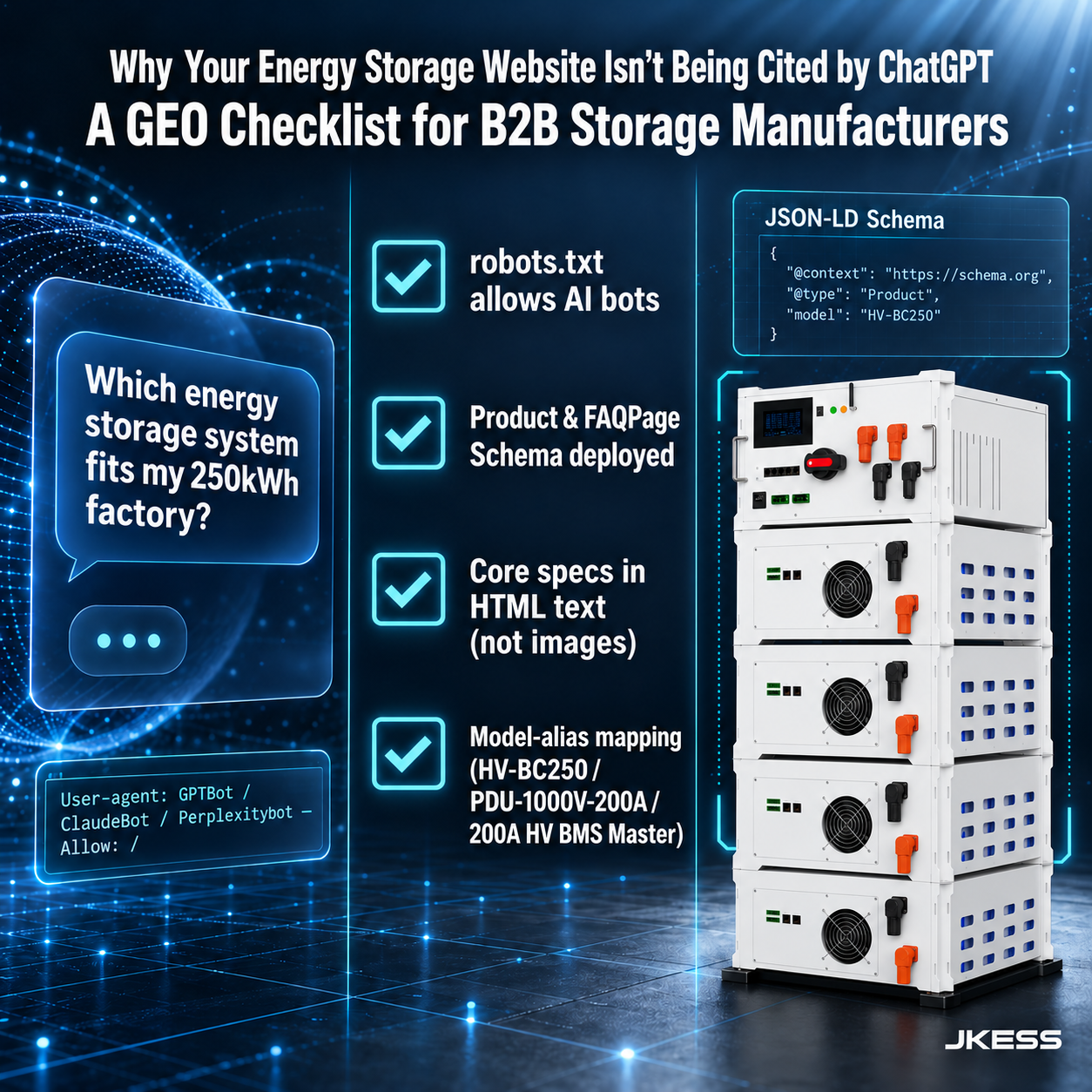
Kupujący mogą zapytać ChatGPT jeszcze przed porównaniem stron internetowych dostawców. Jeśli dane techniczne produktów są umieszczone wyłącznie na obrazach, strona blokuje roboty indeksujące lub numery modeli są niespójne, informacje o produkcie mogą nie pojawić się w odpowiedzi.
Kluczowe wnioski
- Proces zakupowy obejmuje teraz badania wspomagane sztuczną inteligencją. Kupujący może zadać pytanie: „Który system spełnia moje wymagania dotyczące magazynowania 250 kWh w zakładzie?”, zanim przejdzie do poszczególnych stron dostawców.
- Ułatw dostęp do faktów i ich weryfikację. Publikuj dane techniczne jako widoczny tekst HTML, wraz z jednostkami miary, warunkami pracy, źródłami oraz jednoznacznymi identyfikatorami produktów.
- Przeprowadź audyt siedmiu punktów kontrolnych widoczności w środowisku AI: dostęp dla robotów indeksujących, odpowiednia struktura Schema, gęstość faktów, spójność aliasów modeli, specyfikacje HTML, struktura pytań i odpowiedzi oraz opcjonalny przewodnik llms.txt. Obejmują one praktyczne ryzyka związane z dostępem i treścią; nie są to siedem obowiązkowych wymogów pozycjonowania.
- Jeden produkt wymaga jednej spójnej tożsamości. Ujednaj nazwy takie jak HV-BC250 – wewnętrzny identyfikator PDU – oraz „200A HV BMS Master” dopiero po potwierdzeniu, że odnoszą się one do tej samej wersji.
- GEO to trwające zarządzanie treścią. Zachowuj źródła dowodowe, monitoruj cytowania i koryguj błędne odpowiedzi. Żadna lista kontrolna nie gwarantuje pierwszeństwa w ChatGPT, Perplexity ani w przeglądarkach AI Google.
01 / Ścieżka zakupu klienta
Filtr zakupowy B2B już się zmienił
Znany proces zakupowy zaczyna się od wyszukiwania, przebiega przez kilka stron internetowych dostawców i kończy się na liście krótkiej lub formularzu zapytania. Asystenci oparci na sztucznej inteligencji wprowadzają kolejny punkt wejścia: kupujący może zadać pytanie o wyjaśnienie techniczne lub porównanie jeszcze przed odwiedzeniem strony internetowej producenta. Oznacza to, że jakość informacji dostępnych poza stroną główną staje się coraz bardziej istotna.
Rozważ pytania, jakie mogą zadać integrator systemów magazynowania energii lub wykonawca projektów EPC: «Które systemy magazynowania energii BESS o wysokim napięciu obsługują od 4 do 16 dodatkowych modułów baterii?», «Jakie są parametry techniczne systemu zarządzania baterią BMS z aktywnym wyważaniem prądu 2 A?», «Jakie zmiany należy wprowadzić w projekcie magazynowania energii dla obiektów przemysłowych i komercyjnych (C&I) przy słabej sieci energetycznej?». To przykłady intencji kupującego, a nie statystyk rzeczywistego wykorzystania. Każde z tych pytań wymaga precyzyjnej odpowiedzi, która wyraźnie rozróżnia parametry pojedynczego komponentu od możliwości całego systemu.
Jeśli odpowiednie fakty są trudne do uzyskania lub sprzeczne ze sobą, wygenerowana odpowiedź może pominąć Wasz produkt lub opisać go niepoprawnie. Praktycznym rozwiązaniem jest opublikowanie jasnej, przypisanej odpowiedzi na wiarygodnej stronie. Odpowiedzi generowane przez sztuczną inteligencję nadal wymagają weryfikacji, a widoczność w nich uzupełnia established kanały wyszukiwania, dystrybucji i sprzedaży bezpośredniej.
02 / Wyszukiwanie i cytowanie
Tradycyjne SEO kontra GEO: Co się naprawdę zmienia
Oba podejścia nachodzą na siebie. Niniejsze porównanie opisuje ich główne obszary nacisku; zarówno dla jednego, jak i drugiego kluczowe są użyteczna treść, techniczny dostęp oraz wiarygodne dowody.
| Tradycyjne SEO | GEO (Generative Engine Optimization) |
|---|---|
| Cel Uzyskaj widoczność w odpowiednich wynikach wyszukiwania. | Cel Zostań użytecznym, cytowanym źródłem w odpowiedziach generowanych przez sztuczną inteligencję. |
| Ognisko optymalizacji Intencja wyszukiwania, odpowiednia treść, linki oraz jakość techniczna. | Ognisko optymalizacji Odzyskiwalne fakty, dowody, jasne encje oraz odpowiednie dane strukturalne. |
| Zachowania kupujących Przeglądanie wyników i odwiedzanie stron dostawców. | Zachowania kupujących Czytanie odpowiedzi, zadawanie pytań uzupełniających oraz sprawdzanie linków wspierających. |
| Format treści Przydatne strony produktowe i redakcyjne zgodne z intencją wyszukiwania. | Format treści Fragmenty z odpowiedzią na pierwszym miejscu, weryfikowalne wartości, warunki oraz wyraźne wyłączenia. |
| Dostęp dla robotów indeksujących Googlebot, Bingbot oraz odpowiednia infrastruktura indeksowania. | Dostęp dla robotów indeksujących OAI-SearchBot, PerplexityBot, Claude-SearchBot oraz Googlebot do funkcji AI wyszukiwania Google. |
| Dane strukturalne Opis dopuszczalnej treści strony oraz wsparcie odpowiednich funkcji wyszukiwania. | Dane strukturalne Ustal właściwości i relacje tam, gdzie są wykorzystywane; nie jest to uniwersalny warunek wstępny dla cytowania. |
| Konkurencja Widoczność i istotność w całej stronie wyników wyszukiwania. | Konkurencja Czy odpowiedź wybiera, przypisuje i poprawnie reprezentuje Twoje dowody. |
| Obrazy Przydatne wizualizacje wsparte opisowym tekstem oraz odpowiednimi atrybutami alt. | Obrazy Powtórz kluczowe specyfikacje w kodzie HTML; możliwości odczytu obrazów różnią się w zależności od usługi. |
| Nazwy marek i modeli Rozpoznawalne nazwy w tytułach, na stronach i w linkach. | Nazwy marek i modeli Spójne podstawowe identyfikatory, zweryfikowane aliasy oraz granice wersji. |
| Pomiar Wrażenia, pozycje w rankingu, kliknięcia i zakwalifikowane konwersje. | Pomiar Cytowania adresów URL, dokładne wzmianki o markach, odsyłania i zakwalifikowane zapytania. |
| SEO pomaga kupującym Cię znaleźć. | GEO sprawia, że Twoje dane stają się częścią odpowiedzi. |
03 / Lista kontrolna do pracy
7-punktowa lista kontrolna GEO dla stron internetowych B2B z zakresem magazynowania
-
Przejrzyj plik robots.txt i zezwól na zamierzone roboty indeksujące.
Oddziel dostęp dla celów wyszukiwania od preferencji dotyczących uczenia modeli. OpenAI identyfikuje OAI-SearchBot jako swojego robota wyszukiwarki, a GPTBot jako robota służącego do uczenia modeli. PerplexityBot obsługuje wyszukiwanie w serwisie Perplexity; Claude-SearchBot obsługuje wyszukiwanie w serwisie Claude, natomiast ClaudeBot dotyczy rozwoju modeli. Googlebot kontroluje przeszukiwanie dla Google Search, w tym jego funkcji opartych na sztucznej inteligencji; Google-Extended to osobny mechanizm kontroli przeznaczony do innych zastosowań.
Sprawdź istniejące grupy agentów użytkownika, reguły wieloznaczne, ograniczenia ścieżek oraz ustawienia CDN lub zapory sieciowej. Zgodnie ze standardowym zachowaniem pliku robots.txt brak jawnej deklaracji
Allownie oznacza automatycznego zabronienia dostępu. Jawna grupa może uczynić zamierzona polityka bardziej czytelna.# Example for a public marketing website.# Merge with the existing policy; preserve intentional path restrictions.User-agent: OAI-SearchBotAllow: /User-agent: PerplexityBotAllow: /User-agent: Claude-SearchBotAllow: /User-agent: GooglebotAllow: /Ustaw zasady dla GPTBot, ClaudeBot i Google-Extended osobno, zgodnie z zamierzonym przeznaczeniem treści. Zweryfikuj ostateczne połączone reguły oraz rzeczywiste żądania robotów indeksujących.
Odwołania: Dokumentacja robota indeksującego OpenAI ,Roboty indeksujące Perplexity ,Dokumentacja robota indeksującego Anthropic , I Sterowanie robotem indeksującym Google .
-
Wdroż schemat (Schema), który dokładnie opisuje widoczną stronę.
Użyj danych strukturalnych, aby jawnie określić identyfikatory i właściwości. Schemat powinien opisywać stronę, którą rzeczywiście widzi odwiedzający, bez dodawania niepotwierdzonych stwierdzeń ani łączenia różnych wariantów produktu.
- Produkt + additionalProperty: parametry specyficzne dla modelu, jednostki miary oraz udokumentowane cechy.
- FAQPage: autentyczne, widoczne pytania wraz z odpowiadającymi im odpowiedziami.
- Jak to zrobić: rzeczywisty przewodnik instalacji lub uruchomienia zawierający pełne kroki i zakres.
- Artykuł: redakcyjny tytuł, autor, data publikacji oraz kanoniczny adres strony.
- Organizacja: spójna nazwa firmy, adres URL oraz zweryfikowane dane kontaktowe.
Sprawdź poprawność składni JSON i znaczenie pól, a następnie porównaj każde oznaczone stwierdzenie z wyrenderowaną stroną. Blog omawiający kilka produktów nie jest automatycznie stroną szczegółów produktu.
Zdatność nie stanowi gwarancji. Google informuje, że jego funkcje wyszukiwania oparte na sztucznej inteligencji nie wymagają specjalnego schematu Schema ani plików dedykowanych sztucznej inteligencji. Poprawność schematu Schema.org, wsparcie ze strony platformy oraz rzeczywiste uwzględnienie to osobne kwestie.
Odwołania: Schema.org additionalProperty ,FAQPage , I Wskazówki dotyczące funkcji sztucznej inteligencji Google .
-
Zwiększ gęstość użytecznych faktów
Zastąp nieobsługiwane przymiotniki stwierdzeniem, które kupujący może zweryfikować. Umieść wniosek na początku, zachowaj skupienie każdego akapitu i podaj model, jednostkę, warunki eksploatacji oraz źródło niezbędne do zinterpretowania wartości.
Przed / Promocyjnie „JKESS oferuje technologię aktywnego balansowania na poziomie lidera branży z wyższą wydajnością.”Po / Konkretnie i przypisane „W dokumentacji technicznej JKESS opisano moduł BMU-H5-16 z aktywnym balansowaniem 2 A, dokładnością pomiaru napięcia komórkowego ±0,005 V, ośmioma czujnikami temperatury NTC oraz obsługą konfiguracji 16S LiFePO4. Zweryfikuj te wartości w odniesieniu do dokładnie określonej wersji dokumentacji.”Nie łączy się wartości z sprzecznych dokumentów w nową specyfikację. Jeśli strona produktu i karta katalogowa różnią się danymi, rozstrzygnij rozbieżność we współpracy z właścicielem produktu i zaktualizuj oba źródła przed uznaniem któregoś z nich za wiarygodne.
Przykładowe źródło: Dyskusja techniczna JKESS dotycząca modułu BMU-H5-16 strony publiczne mogą zawierać różnice wersji; obecnie zatwierdzony arkusz danych pozostaje odniesieniem publikacyjnym.
-
Utwórz zweryfikowaną mapę modelu na alias.
Przypisz każdemu produktowi jedną główną nazwę i jedną kanoniczną stronę produktu. Przechowuj rekord łączący nazwę marketingową, identyfikator inżynieryjny, wersję produktu oraz wszelkie regionalne warianty nazewnictwa.
Podany przykład nazewnictwa to HV-BC250 / PDU-1000V-200A-A001-NY / 200A HV BMS Master Box jest to relacja aliasu do zweryfikowania, a nie dowód na wzajemną zamienność identyfikatorów. Jeśli inżynierowie potwierdzą dopasowanie, napisz: „HV-BC250, znany również jako PDU-1000V-200A-A001-NY, to 200A HV BMS Master Box.”
Używaj głównej nazwy w tytule i nagłówku H1; umieszczaj zweryfikowane aliasy w pierwszym akapicie oraz odpowiednich polach produktu, takich jak
alternateNamelubmpnzachowaj osobną tożsamość, gdy zmiana wersji wpływa na parametry techniczne, interfejsy lub zakres dostawy. -
Umieść kluczowe specyfikacje w widocznej treści HTML.
Wpisz kluczowe wartości bezpośrednio na stronie. Napięcie, prąd, dokładność, wymiary, warunki testowe oraz zakres dostawy powinny pozostać dostępne jako zwykły tekst i semantyka
cells.
Image extraction and JavaScript rendering differ between crawlers and retrieval tools. Text inside a photograph, iframe, or canvas is therefore an unreliable sole source for a critical parameter. Alt text helps describe an image, but it does not replace a visible specification table.
Publish a dated datasheet alongside the HTML table. Distinguish nominal voltage from the operating envelope, continuous current from peak current, and empty-kit weight from the weight of an assembled module.
Answer real buyer questions directly
Build a useful set of questions around the buying decision: “How many slave boxes can one master box support?” “Does the kit include battery cells?” “Which communication protocols are provided?” Answer first, then give the limits and source.
Five to ten FAQs can be a practical editorial target when the topic warrants them; there is no universal minimum. Native
When adding FAQPage markup, use the same question and answer wording as the visible page. Do not add invisible FAQ claims just to target search queries. This article includes ten visible FAQs and marks up five of them.
Consider an optional llms.txt reading guide
llms.txtis a proposed Markdown convention for guiding agents to useful website content. A concise guide can list the company, core products, application pages, and maintained technical documents. It is useful only to consumers that choose to read it.# JKESS Electronic Technology BMS and active balancing solutions for energy storage.## Core Products- [HV-BC250 200A Master Box](https://www.jkess.com/200a-hv-bms-master)- [HV-B6U Slave Battery Box Kits](https://www.jkess.com/hv-slave-6u-kits)- [261kWh Liquid-Cooled BESS Kits](https://www.jkess.com/commercial--industrial-energy-storage-system-kits)## Application Guides- [Modular HV Energy Storage Kits](https://www.jkess.com/home-energy-storage-system-kits)## Technical DocumentsUse the current specifications and scope-of-supply notes on the product pages.Add approved, versioned datasheet links when those documents are published.Illustrative content, not a report of the live site’s configuration. Use verified links and clean Markdown versions where available. Maintaining this file does not deploy robots.txt rules or create search eligibility.
References: the llms.txt proposal and Google’s generative AI optimization guidance. Google Search does not use llms.txt as a special visibility or ranking input.
04 / Content in practice
Before and After: Rewriting a Storage Product Page for AI Citation
The following five examples replace broad promotion with a more useful answer. Numerical illustrations include their assumptions; commercial and certification statements require current, model-specific evidence.
Illustrative rewrites. Calculations are not measured performance guarantees. Before / Marketing copy After / Evidence-led copy “Our advanced active balancing BMS delivers superior performance and extends battery life.” “For an illustrative 314Ah cell with a 0.5% charge difference, ΔQ = 314 × 0.005 = 1.57Ah. At a constant 2A transfer current, the idealized duration is 1.57 ÷ 2 = 0.785 hours, or about 47 minutes. Real duration depends on current limits, control behavior, and losses.” “The system supports a wide voltage range for various applications.” “The HV-BC250 listing specifies an 80–1000V DC master range. A 4–16 slave-box configuration is described as approximately 64–256kWh when each box is approximately 16kWh. With 16 cells per box and 3.2V nominal per cell, 16 boxes yield 256S / 819.2V nominal. Verify the full charge/discharge range and selected cell capacity.” “Our battery boxes are designed for easy installation.” “Define the scope as one master plus five slave boxes: six enclosures in total. State empty-kit and assembled-module weights separately, together with the lifting and installation plan. A claimed 28.55kg kit weight or two-technician, 2–3 day schedule requires a matching product record and a defined site scope.” “We provide reliable products with international certifications.” “List the exact model and revision, applicable CE declaration, RoHS documentation, FCC evidence, and test-report identifiers. If citing GB34131-2017 or insulation resistance ≥1 MΩ at 1,000 VDC, verify the applicable standard edition, test method, and report scope rather than extending a component claim to the whole system.” “Contact us for more information.” “Send your required capacity, DC range, current, communication protocol, scope of supply, quantity, and delivery location to [email protected]. Request confirmation of available regional stock and a written dispatch estimate for that configuration.” Product references: HV-BC250 and modular storage kits. The 64–256kWh shorthand is configuration-dependent; a hardware kit without cells does not itself contain that stored energy.
05 / Access and extraction
Technical Access: Can AI Crawlers Actually Read Your Website?
Check 1 / robots.txt and access controls
Open
https://yourdomain.com/robots.txtand evaluate the user-agent group and path rules that apply to each intended crawler. Inspect firewall challenges, blocked IP ranges, redirects, and server errors as well.Absence of an explicit Allow is not a failure by itself. Use the actual response and verified crawler logs to determine what is accessible.
Check 2 / Core content in HTML
Disable JavaScript and reload the product page. Check the original HTML response for the model name, specification table, scope of supply, and answers.
If they disappear, the page depends on rendering that some tools may not perform. Prefer server-rendered or static core content, and use a search engine’s inspection tools where available. Also check
noindex, snippet restrictions, andX-Robots-Tagheaders.Check 3 / Descriptive alt text
Describe informative product photographs, diagrams, and screenshots with suitable alt text. Keep purely decorative images from adding noise.
Repeat important values in the visible body or a real HTML table. A long alt attribute is not a substitute for a readable technical specification.
Check 4 / Reliable loading and delivery
Confirm that the canonical page returns a successful response and delivers useful content promptly. Reduce unnecessary third-party scripts, oversized payloads, and client-side dependencies.
Timeouts, errors, and rendering limits can interfere with retrieval. A model’s context budget is a separate issue from network performance; there is no universal “AI loading time” threshold.
Check 5 / Canonical URLs and model identity
Identify duplicate URLs for the same item and use a consistent canonical URL, internal links, and sitemap entries. For example, reconcile two product paths that describe the same HV-BC250 revision.
A canonical URL signals a preferred page; it does not by itself resolve conflicting specifications or prove that two product names are equivalent.
Access references: robots.txt interpretation and the crawler documentation linked in checkpoint 1.
06 / Evidence of progress
How to Measure Whether GEO Is Working
Pair answer-level observations with business outcomes. Metric Traditional SEO measure GEO measure Visibility Search impressions and keyword positions. Share of sampled AI answers citing an owned URL; track brand mentions separately. Traffic Organic search clicks and visits. Identifiable AI referrals; brand-search changes as supporting, non-causal evidence. Content Engagement and landing-page performance. Which facts and pages are cited, and whether values and limitations are correct. Conversion Forms, qualified leads, and sales. Qualified inquiries with an AI discovery source or attributable referral. Competition Relative search visibility. Citation share and co-mentions within the same fixed question set. Audit Indexability, search-intent coverage, and page quality. Entity consistency, evidence freshness, extractable facts, and markup accuracy. A practical weekly baseline: run ten fixed buyer questions in ChatGPT search, Perplexity, and Google AI Overviews where an overview appears. Repeat the sample and log platform, date, locale, model or mode, exact question, cited URL, brand mention, and answer accuracy.
Citation rate = answers linking to your domain ÷ eligible sampled answers. Report the sample size and the number of queries without an AI answer. A brand mention without a source link is not a citation. Use a separate measure for citations to this specific article.
For example, six cited answers out of 30 eligible observations produce a 20% sample citation rate. This is an illustrative calculation, not a JKESS result. Keep the question set stable when comparing periods, and avoid treating a single answer or a small change as proof that one edit caused an improvement.
07 / Applying the method
How JKESS Applies GEO to Its Own Product Pages
The reviewed JKESS master-box and 261kWh application pages expose technical information in readable tables. That is a useful starting point. The following seven practices form an implementation and maintenance checklist, rather than a claim that every page has already passed a site-wide audit.
- Maintain structured specification tables. Keep each voltage, current, accuracy, dimension, and weight value in visible HTML, tied to a model, revision, and source. Separate component ratings from complete-system limits.
- Keep FAQs useful and consistent. Write five to ten relevant answers when justified by the product; align any FAQPage markup with the exact visible wording and recheck answers after product changes.
- Use model-specific Product markup. Validate Product and additionalProperty on the appropriate HV-BC250, HV-B6U, and 261kWh pages. Record evidence of the deployed markup rather than assuming site-wide coverage.
- Control aliases. Confirm any relationship between HV-BC250 and PDU-1000V-200A-A001-NY, then use one primary name with the approved aliases. Keep HV-BC150-100A as a distinct product identity.
- Reconcile quantitative claims. Check the 2A active balancing and ±0.005V sampling values against the supplied BMU revision. Keep the 4–16 slave-box and 64–256kWh statements linked to their cell and configuration assumptions.
- Maintain an optional llms.txt guide. If deployed, list current canonical product and documentation URLs, remove stale links, and treat it as documentation support rather than an indexing requirement.
- Verify search access. Review the live robots.txt policy and crawler delivery logs. Confirm intended access for search bots while managing training-related controls independently.
JKESS product and specification anchors
HV-BC250 · 200A HV BMS Master · HV-BC150-100A · 100A master configuration · HV-B6U · 6U slave battery box kits · BMU-H5-16 · technical reference · 261kWh liquid-cooled system
Values to keep in context: 2A active balancing · ±0.005V sampling accuracy · 4–16 slave battery boxes · approximately 64–256kWh · 80–1000V DC master range. These refer to different components or configurations, not a single universal specification. Kits are offered without battery cells; confirm the final scope of supply.
08 / Questions buyers ask
Frequently Asked Questions
What is GEO and how does it differ from traditional SEO?
GEO (Generative Engine Optimization) is the practice of making useful content easier to retrieve, understand, and cite in AI-generated answers. Traditional SEO emphasizes visibility in search results, while GEO also tracks how accurately a brand and its facts appear in generated responses. Both benefit from accessible pages, clear product identities, and reliable evidence; neither guarantees inclusion.
Why is my energy storage website not being cited by ChatGPT?
Possible causes include blocked search crawlers, unindexed pages, specifications that are difficult to extract, inconsistent model names, or weak evidence for the question being asked. For ChatGPT search, review OAI-SearchBot access rather than assuming GPTBot controls search visibility. Missing Schema or llms.txt alone does not prove why a page was omitted; compare crawl evidence, content relevance, and repeated query results.
What is llms.txt and why does it matter for B2B storage websites?
llms.txt is a proposed Markdown-based guide to a website’s useful content, which can point agents to product documentation and application guides. It can help tools that choose to use it, but adoption and behavior differ between services. Treat it as optional documentation infrastructure, not a requirement for AI citation or a replacement for HTML pages and sitemaps.
How do I check if AI crawlers can access my website?
Inspect the robots.txt groups and path rules that apply to OAI-SearchBot, PerplexityBot, Claude-SearchBot, and Googlebot, then review server and firewall logs. A missing explicit Allow rule does not by itself mean access is denied. Also check HTTP responses, indexing and snippet controls, and whether product specifications are available without JavaScript; a browser-only test does not confirm a crawler’s actual access.
What Schema markup should a B2B storage website prioritize?
Use Product with additionalProperty on product pages, Article on editorial pages, and Organization for the company identity. FAQPage can describe visible questions and answers, and HowTo can describe a genuine procedural guide. Keep markup aligned with the visible content and applicable platform documentation; valid Schema does not guarantee a rich result or an AI citation.
How does inconsistent product naming affect AI visibility?
Different names for the same item can make it harder for readers and retrieval systems to connect the information. Select one primary model name and record verified aliases, product revisions, and one canonical URL. Publish an “also known as” relationship only after the model owner confirms that the labels identify the same product and configuration.
What is fact density and why does it matter for GEO?
Fact density is an editorial measure of how much useful, verifiable information a passage contains relative to general promotional language. A model-specific value with units, operating conditions, and a dated source is more useful than an unsupported adjective. Values such as 2A active balancing, ±0.005V sampling accuracy, and an 80–1000V DC range must stay attached to the correct component; fact density is not a published universal AI ranking score.
How do I measure GEO performance for my storage website?
Run a fixed set of buyer questions repeatedly and log the date, platform, search mode, locale, cited URLs, and answer accuracy. Report URL citation rate separately from unlinked brand mentions, and track identifiable referral visits and qualified inquiries. Results fluctuate, so a small weekly sample is directional evidence rather than a complete view of all buyers or proof of causation.
Does GEO replace traditional SEO for B2B storage manufacturers?
No. Search indexing, useful content, internal links, and a dependable website remain relevant to both conventional search and AI-assisted research. GEO adds attention to answer-level representation, traceable facts, and citation measurement. An effective program maintains those foundations while checking whether buyers receive accurate product information.
How does JKESS apply GEO principles to its own product pages?
The JKESS pages reviewed for this article provide examples of HTML specifications and question-and-answer content for products including the HV-BC250 and the 261kWh liquid-cooled system. The seven-part workflow below extends that approach to the HV-BC150-100A, HV-B6U, and BMU-H5-16 through consistent naming, source review, and structured content. This article does not certify site-wide Schema coverage, crawler settings, or an existing llms.txt deployment; those require a current implementation audit.
Want to Audit Your Storage Website’s AI Visibility?
Share your website URL with our team. We’ll review your robots.txt, Schema markup, fact density, and entity consistency — and help identify where crawlers or readers may be missing your product information.
Request a Custom Quote→