
 EN
JKESS / Insights de engenharia
Solicite um Orçamento →Por que seu site de armazenamento de energia não está sendo citado pelo ChatGPT: uma lista de verificação GEO para fabricantes B2B de sistemas de armazenamento
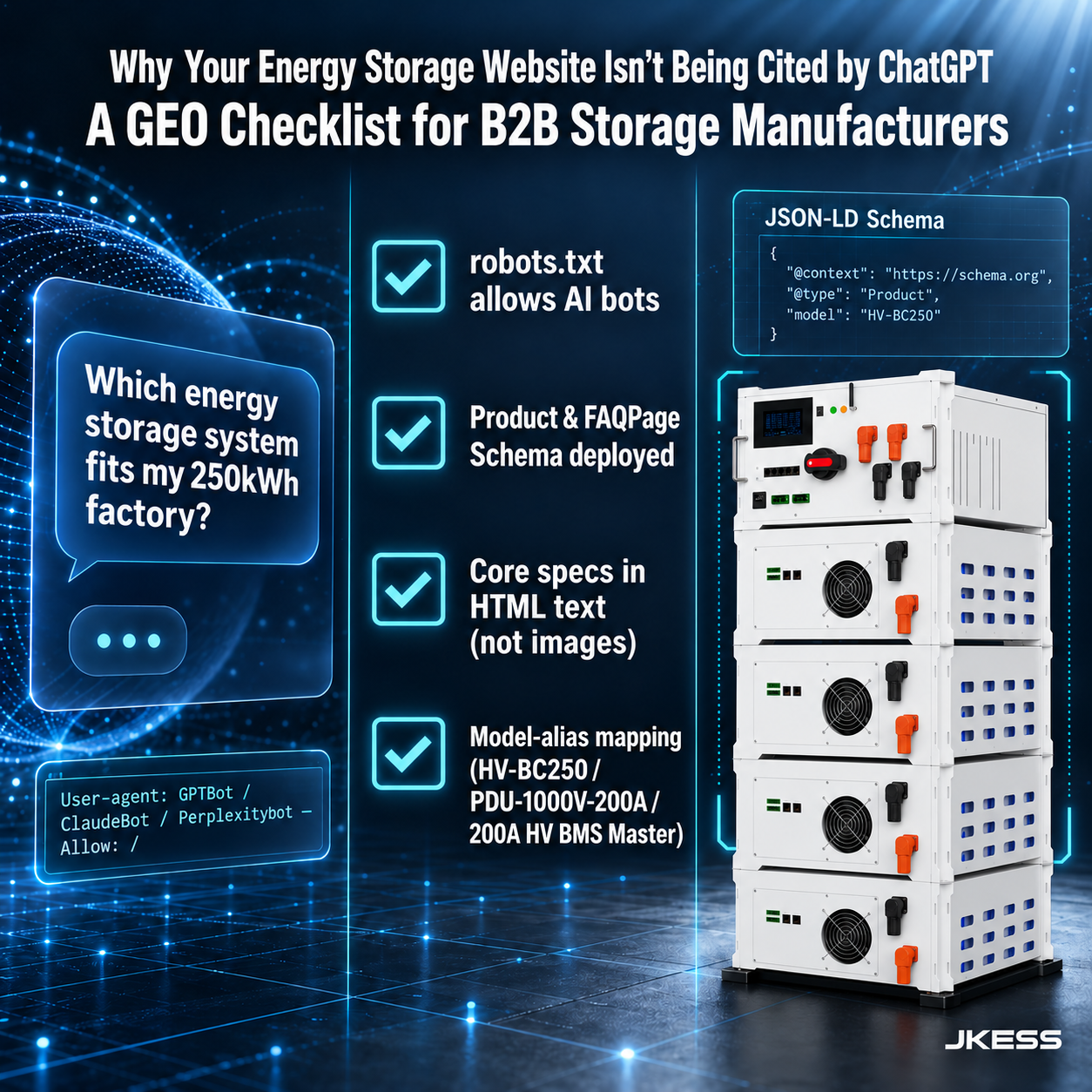
Seu comprador pode consultar o ChatGPT antes de comparar sites de fornecedores. Se suas especificações técnicas estiverem apenas em imagens, se seu site bloquear rastreadores de busca ou se seus números de modelo forem inconsistentes, suas informações podem não aparecer na resposta.
Principais conclusões
- A jornada de aquisição agora inclui pesquisa assistida por IA. Um comprador pode perguntar: “Qual sistema atende à minha necessidade de 250 kWh para fábrica?” antes mesmo de acessar páginas individuais de fornecedores.
- Torne seus dados fáceis de recuperar e verificar. Publique especificações técnicas como texto HTML visível, com unidades, condições operacionais, fontes e identidades claras dos produtos.
- Audite sete pontos de verificação para visibilidade em IA: acesso por crawler, Schema apropriado, densidade de fatos, consistência de alias de modelo, especificações HTML, estrutura de perguntas e respostas e um guia opcional llms.txt. Esses itens abrangem riscos práticos de acesso e conteúdo; não são sete requisitos obrigatórios de classificação.
- Um produto precisa de uma identidade consistente. Unifique nomes como HV-BC250, um identificador interno de PDU, e "200A HV BMS Master" somente após confirmar que eles se referem à mesma revisão.
- GEO é uma gestão contínua de conteúdo. Mantenha as evidências, monitore citações e corrija respostas imprecisas. Nenhuma lista de verificação pode garantir posicionamento prioritário no ChatGPT, Perplexity ou Google AI Overviews.
01 / A jornada do comprador
O funil de aquisição B2B já mudou
A jornada familiar de aquisição começa com uma pesquisa, prossegue em diversos sites de fornecedores e termina com uma lista restrita ou um formulário de consulta. Assistentes de IA introduzem outro ponto de entrada: um comprador pode solicitar uma explicação técnica ou uma comparação antes mesmo de visitar o site de um fabricante. Isso torna cada vez mais relevante a qualidade das informações disponíveis fora de sua página inicial.
Considere as perguntas que um integrador de armazenamento ou um empreiteiro EPC poderia fazer: “Qual BESS de alta tensão suporta de 4 a 16 caixas de baterias escravas?” “Quais são os parâmetros técnicos de um BMS com equilíbrio ativo de 2 A?” “Quais alterações ocorrem em um projeto de armazenamento C&I para uma rede fraca?” Esses são exemplos de intenção de compra, não de estatísticas mensuradas de adoção. Cada um exige uma resposta precisa que distingue a classificação de um componente da capacidade de um sistema completo.
Se os fatos relevantes forem de difícil acesso ou contraditórios, uma resposta gerada por IA pode omitir seu produto ou descrevê-lo incorretamente. A resposta prática é publicar uma resposta clara e atribuível em uma página confiável. As respostas geradas por IA ainda exigem verificação, e a visibilidade nelas complementa os canais estabelecidos de busca, distribuição e vendas diretas.
02 / Busca e citação
SEO tradicional versus GEO: o que realmente muda
As duas disciplinas se sobrepõem. Essa comparação descreve suas principais áreas de ênfase; conteúdo útil, acessibilidade técnica e evidências confiáveis são importantes para ambas.
| SEO tradicional | GEO (Otimização para Motores Generativos) |
|---|---|
| Gol Conquistar visibilidade em resultados de busca relevantes. | Gol Tornar-se uma fonte útil e citada em respostas geradas por IA. |
| Foco na Otimização Intenção de busca, conteúdo relevante, links e qualidade técnica. | Foco na Otimização Fatos recuperáveis, evidências, entidades claras e dados estruturados apropriados. |
| Comportamento do comprador Navegar pelos resultados e visitar as páginas dos fornecedores. | Comportamento do comprador Ler uma resposta, fazer perguntas complementares e examinar os links de suporte. |
| Formato de Conteúdo Páginas úteis de produtos e editoriais alinhadas à intenção de busca. | Formato de Conteúdo Trechos com respostas em primeiro lugar, valores verificáveis, condições e exclusões explícitas. |
| Acesso do rastreador Googlebot, Bingbot e a infraestrutura relevante de indexação. | Acesso do rastreador OAI-SearchBot, PerplexityBot, Claude-SearchBot e Googlebot para recursos de IA da Pesquisa Google. |
| Dados Estruturados Descrever o conteúdo de página elegível e apoiar os recursos de busca aplicáveis. | Dados Estruturados Esclarecer propriedades e relações onde consumidas; não é um pré-requisito universal para citação. |
| Concorrência Visibilidade e relevância em toda a página de resultados de pesquisa. | Concorrência Se a resposta seleciona, atribui e representa com precisão suas evidências. |
| Imagem Visuais úteis, apoiados por texto descritivo e atributos alternativos apropriados. | Imagem Repetir especificações críticas em HTML; as capacidades de leitura de imagens variam conforme o serviço. |
| Nomes da marca e do modelo Nomes reconhecíveis em títulos, páginas e links. | Nomes da marca e do modelo Identificadores principais consistentes, alcunhas verificadas e limites de revisão. |
| Medição Impressões, posições, cliques e conversões qualificadas. | Medição Citações de URL, menções precisas da marca, referências e consultas qualificadas. |
| O SEO ajuda compradores a encontrá-lo. | O GEO ajuda sua evidência a se tornar parte da resposta. |
03 / A lista de verificação em funcionamento
A Lista de Verificação GEO de 7 Pontos para Sites B2B de Armazenamento
-
Revise o arquivo robots.txt e autorize os rastreadores de busca pretendidos
Separe o acesso para busca das preferências para treinamento de modelos. A OpenAI identifica o OAI-SearchBot como seu rastreador de busca e o GPTBot como rastreador para treinamento. O PerplexityBot suporta buscas no Perplexity; o Claude-SearchBot suporta buscas no Claude, enquanto o ClaudeBot diz respeito ao desenvolvimento de modelos. O Googlebot controla o rastreamento para a Pesquisa Google, incluindo seus recursos de IA; o Google-Extended é um controle separado para outros usos.
Verifique os grupos existentes de user-agent, regras com curinga, restrições de caminho e configurações de CDN ou firewall. Sob o comportamento padrão do robots.txt, a ausência de um grupo explícito
Allownão nega automaticamente o acesso. Um grupo explícito pode deixar a política pretendida mais clara.# Example for a public marketing website.# Merge with the existing policy; preserve intentional path restrictions.User-agent: OAI-SearchBotAllow: /User-agent: PerplexityBotAllow: /User-agent: Claude-SearchBotAllow: /User-agent: GooglebotAllow: /Defina as políticas do GPTBot, do ClaudeBot e do Google-Extended separadamente, de acordo com o uso pretendido do conteúdo. Valide as regras mescladas finais e as solicitações reais dos rastreadores.
Referências: Documentação do rastreador da OpenAI ,Rastreadores da Perplexity ,Documentação do rastreador da Anthropic , e Controles de rastreamento do Google .
-
Implante um Schema que descreva com precisão a página visível
Utilize dados estruturados para deixar explícitos identificadores e propriedades. O Schema deve descrever a página que um visitante realmente vê, sem incluir afirmações não comprovadas ou misturar diferentes variantes de produto.
- Produto + additionalProperty: parâmetros específicos do modelo, unidades e características documentadas.
- FAQPage: perguntas genuínas e visíveis com suas respectivas respostas.
- Como fazer: um guia real de instalação ou colocação em operação, com etapas completas e escopo definido.
- Artigo: o título editorial, o autor, a data de publicação e a página canônica.
- Organização: o nome consistente da empresa, a URL e as informações de contato verificadas.
Valide a sintaxe JSON e o significado dos campos, depois compare cada declaração marcada com a página renderizada. Um blog que discute diversos produtos não é automaticamente uma página de detalhes de produto.
A elegibilidade não é uma promessa. O Google afirma que seus recursos de busca com IA não exigem Schema especial nem arquivos específicos para IA. A validade do Schema.org, o suporte da plataforma e a inclusão efetiva são questões separadas.
Referências: Schema.org additionalProperty ,FAQPage , e Orientações sobre os recursos de IA do Google .
-
Aumentar a densidade de fatos úteis
Substituir adjetivos não suportados por uma afirmação que um comprador possa verificar. Apresentar a conclusão em primeiro lugar, manter cada parágrafo focado e fornecer o modelo, a unidade, a condição operacional e a fonte necessários para interpretar o valor.
Antes / Promocional “A JKESS oferece tecnologia líder no setor de equilíbrio ativo com desempenho superior.”Depois / Específico e atribuível “A documentação técnica da JKESS descreve a BMU-H5-16 com equilíbrio ativo de 2 A, precisão de amostragem de tensão celular de ±0,005 V, oito sensores de temperatura NTC e suporte para 16S LiFePO4. Confirme esses valores na versão exata fornecida.”Não combinar valores provenientes de documentos conflitantes para criar uma nova especificação. Se uma página de produto e uma folha de dados divergirem, resolver a discrepância com o proprietário do produto e atualizar ambas as fontes antes de considerar qualquer uma delas como definitiva.
Exemplo de fonte: Discussão técnica da JKESS sobre a BMU-H5-16 . Páginas públicas podem conter diferenças de revisão; uma ficha técnica atual aprovada permanece como referência de publicação.
-
Construir um mapa verificado de modelo para apelido
Atribuir a cada produto um nome principal e uma página de produto canônica. Manter um registro que conecte o nome de marketing, o identificador de engenharia, a revisão do produto e quaisquer variantes regionais de nomenclatura.
O exemplo de nomenclatura fornecido é HV-BC250 / PDU-1000V-200A-A001-NY / 200A HV BMS Master Box . Trata-se de uma relação de apelido a ser verificada, não de uma prova de que os identificadores são intercambiáveis. Se a engenharia confirmar a correspondência, escrever: “HV-BC250, também conhecido como PDU-1000V-200A-A001-NY, é a caixa mestra HV BMS de 200 A.”
Usar o nome principal no título e no H1; inserir apelidos confirmados no primeiro parágrafo e nos campos de produto apropriados, tais como
alternateNameoumpn. Manter uma identidade distinta sempre que uma revisão alterar classificações, interfaces ou escopo de fornecimento. -
Manter as especificações principais em HTML visível
Inserir os valores-chave diretamente na página. Tensão, corrente, precisão, dimensões, condições de ensaio e escopo de fornecimento devem permanecer disponíveis como texto comum e semântico
cells.
Image extraction and JavaScript rendering differ between crawlers and retrieval tools. Text inside a photograph, iframe, or canvas is therefore an unreliable sole source for a critical parameter. Alt text helps describe an image, but it does not replace a visible specification table.
Publish a dated datasheet alongside the HTML table. Distinguish nominal voltage from the operating envelope, continuous current from peak current, and empty-kit weight from the weight of an assembled module.
Answer real buyer questions directly
Build a useful set of questions around the buying decision: “How many slave boxes can one master box support?” “Does the kit include battery cells?” “Which communication protocols are provided?” Answer first, then give the limits and source.
Five to ten FAQs can be a practical editorial target when the topic warrants them; there is no universal minimum. Native
When adding FAQPage markup, use the same question and answer wording as the visible page. Do not add invisible FAQ claims just to target search queries. This article includes ten visible FAQs and marks up five of them.
Consider an optional llms.txt reading guide
llms.txtis a proposed Markdown convention for guiding agents to useful website content. A concise guide can list the company, core products, application pages, and maintained technical documents. It is useful only to consumers that choose to read it.# JKESS Electronic Technology BMS and active balancing solutions for energy storage.## Core Products- [HV-BC250 200A Master Box](https://www.jkess.com/200a-hv-bms-master)- [HV-B6U Slave Battery Box Kits](https://www.jkess.com/hv-slave-6u-kits)- [261kWh Liquid-Cooled BESS Kits](https://www.jkess.com/commercial--industrial-energy-storage-system-kits)## Application Guides- [Modular HV Energy Storage Kits](https://www.jkess.com/home-energy-storage-system-kits)## Technical DocumentsUse the current specifications and scope-of-supply notes on the product pages.Add approved, versioned datasheet links when those documents are published.Illustrative content, not a report of the live site’s configuration. Use verified links and clean Markdown versions where available. Maintaining this file does not deploy robots.txt rules or create search eligibility.
References: the llms.txt proposal and Google’s generative AI optimization guidance. Google Search does not use llms.txt as a special visibility or ranking input.
04 / Content in practice
Before and After: Rewriting a Storage Product Page for AI Citation
The following five examples replace broad promotion with a more useful answer. Numerical illustrations include their assumptions; commercial and certification statements require current, model-specific evidence.
Illustrative rewrites. Calculations are not measured performance guarantees. Before / Marketing copy After / Evidence-led copy “Our advanced active balancing BMS delivers superior performance and extends battery life.” “For an illustrative 314Ah cell with a 0.5% charge difference, ΔQ = 314 × 0.005 = 1.57Ah. At a constant 2A transfer current, the idealized duration is 1.57 ÷ 2 = 0.785 hours, or about 47 minutes. Real duration depends on current limits, control behavior, and losses.” “The system supports a wide voltage range for various applications.” “The HV-BC250 listing specifies an 80–1000V DC master range. A 4–16 slave-box configuration is described as approximately 64–256kWh when each box is approximately 16kWh. With 16 cells per box and 3.2V nominal per cell, 16 boxes yield 256S / 819.2V nominal. Verify the full charge/discharge range and selected cell capacity.” “Our battery boxes are designed for easy installation.” “Define the scope as one master plus five slave boxes: six enclosures in total. State empty-kit and assembled-module weights separately, together with the lifting and installation plan. A claimed 28.55kg kit weight or two-technician, 2–3 day schedule requires a matching product record and a defined site scope.” “We provide reliable products with international certifications.” “List the exact model and revision, applicable CE declaration, RoHS documentation, FCC evidence, and test-report identifiers. If citing GB34131-2017 or insulation resistance ≥1 MΩ at 1,000 VDC, verify the applicable standard edition, test method, and report scope rather than extending a component claim to the whole system.” “Contact us for more information.” “Send your required capacity, DC range, current, communication protocol, scope of supply, quantity, and delivery location to [email protected]. Request confirmation of available regional stock and a written dispatch estimate for that configuration.” Product references: HV-BC250 and modular storage kits. The 64–256kWh shorthand is configuration-dependent; a hardware kit without cells does not itself contain that stored energy.
05 / Access and extraction
Technical Access: Can AI Crawlers Actually Read Your Website?
Check 1 / robots.txt and access controls
Open
https://yourdomain.com/robots.txtand evaluate the user-agent group and path rules that apply to each intended crawler. Inspect firewall challenges, blocked IP ranges, redirects, and server errors as well.Absence of an explicit Allow is not a failure by itself. Use the actual response and verified crawler logs to determine what is accessible.
Check 2 / Core content in HTML
Disable JavaScript and reload the product page. Check the original HTML response for the model name, specification table, scope of supply, and answers.
If they disappear, the page depends on rendering that some tools may not perform. Prefer server-rendered or static core content, and use a search engine’s inspection tools where available. Also check
noindex, snippet restrictions, andX-Robots-Tagheaders.Check 3 / Descriptive alt text
Describe informative product photographs, diagrams, and screenshots with suitable alt text. Keep purely decorative images from adding noise.
Repeat important values in the visible body or a real HTML table. A long alt attribute is not a substitute for a readable technical specification.
Check 4 / Reliable loading and delivery
Confirm that the canonical page returns a successful response and delivers useful content promptly. Reduce unnecessary third-party scripts, oversized payloads, and client-side dependencies.
Timeouts, errors, and rendering limits can interfere with retrieval. A model’s context budget is a separate issue from network performance; there is no universal “AI loading time” threshold.
Check 5 / Canonical URLs and model identity
Identify duplicate URLs for the same item and use a consistent canonical URL, internal links, and sitemap entries. For example, reconcile two product paths that describe the same HV-BC250 revision.
A canonical URL signals a preferred page; it does not by itself resolve conflicting specifications or prove that two product names are equivalent.
Access references: robots.txt interpretation and the crawler documentation linked in checkpoint 1.
06 / Evidence of progress
How to Measure Whether GEO Is Working
Pair answer-level observations with business outcomes. Metric Traditional SEO measure GEO measure Visibility Search impressions and keyword positions. Share of sampled AI answers citing an owned URL; track brand mentions separately. Traffic Organic search clicks and visits. Identifiable AI referrals; brand-search changes as supporting, non-causal evidence. Content Engagement and landing-page performance. Which facts and pages are cited, and whether values and limitations are correct. Conversion Forms, qualified leads, and sales. Qualified inquiries with an AI discovery source or attributable referral. Competition Relative search visibility. Citation share and co-mentions within the same fixed question set. Audit Indexability, search-intent coverage, and page quality. Entity consistency, evidence freshness, extractable facts, and markup accuracy. A practical weekly baseline: run ten fixed buyer questions in ChatGPT search, Perplexity, and Google AI Overviews where an overview appears. Repeat the sample and log platform, date, locale, model or mode, exact question, cited URL, brand mention, and answer accuracy.
Citation rate = answers linking to your domain ÷ eligible sampled answers. Report the sample size and the number of queries without an AI answer. A brand mention without a source link is not a citation. Use a separate measure for citations to this specific article.
For example, six cited answers out of 30 eligible observations produce a 20% sample citation rate. This is an illustrative calculation, not a JKESS result. Keep the question set stable when comparing periods, and avoid treating a single answer or a small change as proof that one edit caused an improvement.
07 / Applying the method
How JKESS Applies GEO to Its Own Product Pages
The reviewed JKESS master-box and 261kWh application pages expose technical information in readable tables. That is a useful starting point. The following seven practices form an implementation and maintenance checklist, rather than a claim that every page has already passed a site-wide audit.
- Maintain structured specification tables. Keep each voltage, current, accuracy, dimension, and weight value in visible HTML, tied to a model, revision, and source. Separate component ratings from complete-system limits.
- Keep FAQs useful and consistent. Write five to ten relevant answers when justified by the product; align any FAQPage markup with the exact visible wording and recheck answers after product changes.
- Use model-specific Product markup. Validate Product and additionalProperty on the appropriate HV-BC250, HV-B6U, and 261kWh pages. Record evidence of the deployed markup rather than assuming site-wide coverage.
- Control aliases. Confirm any relationship between HV-BC250 and PDU-1000V-200A-A001-NY, then use one primary name with the approved aliases. Keep HV-BC150-100A as a distinct product identity.
- Reconcile quantitative claims. Check the 2A active balancing and ±0.005V sampling values against the supplied BMU revision. Keep the 4–16 slave-box and 64–256kWh statements linked to their cell and configuration assumptions.
- Maintain an optional llms.txt guide. If deployed, list current canonical product and documentation URLs, remove stale links, and treat it as documentation support rather than an indexing requirement.
- Verify search access. Review the live robots.txt policy and crawler delivery logs. Confirm intended access for search bots while managing training-related controls independently.
JKESS product and specification anchors
HV-BC250 · 200A HV BMS Master · HV-BC150-100A · 100A master configuration · HV-B6U · 6U slave battery box kits · BMU-H5-16 · technical reference · 261kWh liquid-cooled system
Values to keep in context: 2A active balancing · ±0.005V sampling accuracy · 4–16 slave battery boxes · approximately 64–256kWh · 80–1000V DC master range. These refer to different components or configurations, not a single universal specification. Kits are offered without battery cells; confirm the final scope of supply.
08 / Questions buyers ask
Frequently Asked Questions
What is GEO and how does it differ from traditional SEO?
GEO (Generative Engine Optimization) is the practice of making useful content easier to retrieve, understand, and cite in AI-generated answers. Traditional SEO emphasizes visibility in search results, while GEO also tracks how accurately a brand and its facts appear in generated responses. Both benefit from accessible pages, clear product identities, and reliable evidence; neither guarantees inclusion.
Why is my energy storage website not being cited by ChatGPT?
Possible causes include blocked search crawlers, unindexed pages, specifications that are difficult to extract, inconsistent model names, or weak evidence for the question being asked. For ChatGPT search, review OAI-SearchBot access rather than assuming GPTBot controls search visibility. Missing Schema or llms.txt alone does not prove why a page was omitted; compare crawl evidence, content relevance, and repeated query results.
What is llms.txt and why does it matter for B2B storage websites?
llms.txt is a proposed Markdown-based guide to a website’s useful content, which can point agents to product documentation and application guides. It can help tools that choose to use it, but adoption and behavior differ between services. Treat it as optional documentation infrastructure, not a requirement for AI citation or a replacement for HTML pages and sitemaps.
How do I check if AI crawlers can access my website?
Inspect the robots.txt groups and path rules that apply to OAI-SearchBot, PerplexityBot, Claude-SearchBot, and Googlebot, then review server and firewall logs. A missing explicit Allow rule does not by itself mean access is denied. Also check HTTP responses, indexing and snippet controls, and whether product specifications are available without JavaScript; a browser-only test does not confirm a crawler’s actual access.
What Schema markup should a B2B storage website prioritize?
Use Product with additionalProperty on product pages, Article on editorial pages, and Organization for the company identity. FAQPage can describe visible questions and answers, and HowTo can describe a genuine procedural guide. Keep markup aligned with the visible content and applicable platform documentation; valid Schema does not guarantee a rich result or an AI citation.
How does inconsistent product naming affect AI visibility?
Different names for the same item can make it harder for readers and retrieval systems to connect the information. Select one primary model name and record verified aliases, product revisions, and one canonical URL. Publish an “also known as” relationship only after the model owner confirms that the labels identify the same product and configuration.
What is fact density and why does it matter for GEO?
Fact density is an editorial measure of how much useful, verifiable information a passage contains relative to general promotional language. A model-specific value with units, operating conditions, and a dated source is more useful than an unsupported adjective. Values such as 2A active balancing, ±0.005V sampling accuracy, and an 80–1000V DC range must stay attached to the correct component; fact density is not a published universal AI ranking score.
How do I measure GEO performance for my storage website?
Run a fixed set of buyer questions repeatedly and log the date, platform, search mode, locale, cited URLs, and answer accuracy. Report URL citation rate separately from unlinked brand mentions, and track identifiable referral visits and qualified inquiries. Results fluctuate, so a small weekly sample is directional evidence rather than a complete view of all buyers or proof of causation.
Does GEO replace traditional SEO for B2B storage manufacturers?
No. Search indexing, useful content, internal links, and a dependable website remain relevant to both conventional search and AI-assisted research. GEO adds attention to answer-level representation, traceable facts, and citation measurement. An effective program maintains those foundations while checking whether buyers receive accurate product information.
How does JKESS apply GEO principles to its own product pages?
The JKESS pages reviewed for this article provide examples of HTML specifications and question-and-answer content for products including the HV-BC250 and the 261kWh liquid-cooled system. The seven-part workflow below extends that approach to the HV-BC150-100A, HV-B6U, and BMU-H5-16 through consistent naming, source review, and structured content. This article does not certify site-wide Schema coverage, crawler settings, or an existing llms.txt deployment; those require a current implementation audit.
Want to Audit Your Storage Website’s AI Visibility?
Share your website URL with our team. We’ll review your robots.txt, Schema markup, fact density, and entity consistency — and help identify where crawlers or readers may be missing your product information.
Request a Custom Quote→