
 EN
JKESS / Mga pananaw sa inhinyerya
Kumuha ng Quote→Bakit hindi sinisipi ng ChatGPT ang iyong website para sa pag-imbak ng enerhiya: Isang GEO na checklist para sa mga tagagawa ng storage na B2B
Maaaring itanong ng iyong mamimili ang ChatGPT bago ikumpara ang mga website ng supplier. Kung ang mga teknikal na detalye ng iyong produkto ay nasa larawan lamang, kung ang iyong site ay nagbabarang sa mga search crawler, o kung ang mga numero ng modelo ay hindi pare-pareho, maaaring kulang ang impormasyon mo sa sagot.
Mga Pangunahing Batayan
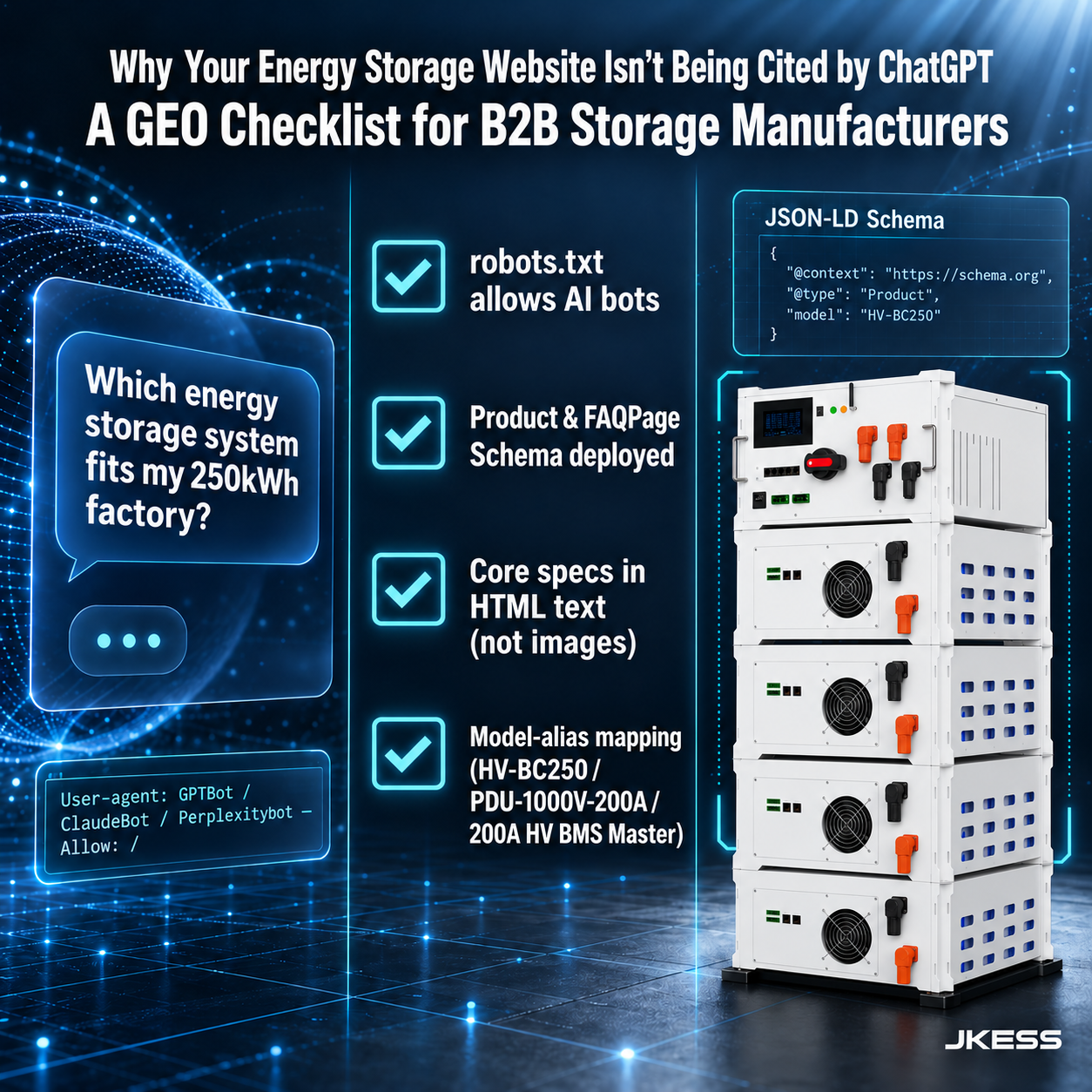
- Ang proseso ng pagbili ay kasama na ngayon ang pananaliksik na tinutulungan ng AI. Maaaring itanong ng isang mamimili, “Aling sistema ang angkop sa aking kailangan sa pabrika na 250kWh?” bago buksan ang mga indibidwal na pahina ng supplier.
- Gawin ang iyong mga katotohanan madaling kunin at suriin. I-publish ang mga teknikal na tukoy bilang nakikitang HTML na teksto, kasama ang mga yunit, mga kondisyon sa pagpapatakbo, mga pinagmulan, at malinaw na pagkakakilanlan ng produkto.
- Suriin ang pitong checkpoint sa visibility ng AI: ang pag-access ng crawler, ang naaangkop na Schema, ang kahigpit ng katotohanan, ang pagkakapareho ng model-alias, ang mga tuntunin sa HTML, ang istruktura ng tanong at sagot, at ang opsyonal na gabay na llms.txt. Ang mga ito ay sumasaklaw sa mga panganib sa praktikal na access at nilalaman; hindi ito pitong sapilitang mga kinakailangan para sa ranking.
- Ang bawat produkto ay nangangailangan ng isang pare-parehong identidad. Ipaayon ang mga pangalan tulad ng HV-BC250, isang panloob na identifier ng PDU, at ang "200A HV BMS Master" lamang matapos kumpirmahin na tumutukoy sila sa parehong bersyon.
- Ang GEO ay isang patuloy na pamamahala ng nilalaman. Panatilihin ang ebidensya, subaybayan ang mga sanggunian, at ayusin ang mga maling sagot. Walang anumang checklist ang maaaring magagarantiya ng unang posisyon sa ChatGPT, Perplexity, o Google AI Overviews.
01 / Ang biyahe ng buyer
Ang B2B Procurement Funnel ay nagbago na
Ang pamilyar na proseso ng pagbili ay nagsisimula sa isang paghahanap, nagpapatuloy sa ilang website ng mga supplier, at natatapos sa isang maikling listahan o porma ng katanungan. Ang mga AI assistant ay nagdaragdag ng isa pang daan: maaaring humingi ang isang buyer ng teknikal na paliwanag o paghahambing bago pa man bisitahin ang website ng isang tagagawa. Dahil dito, lalong tumataas ang kahalagahan ng kalidad ng impormasyon na magagamit sa labas ng iyong homepage.
Isipin ang mga katanungan na maaaring itanong ng isang storage integrator o EPC contractor: “Aling high-voltage BESS ang sumusuporta sa 4–16 na slave battery boxes?” “Ano ang mga teknikal na parameter ng isang 2A active balancing BMS?” “Ano ang mga pagbabago sa disenyo ng C&I storage para sa isang mahinang grid?” Ito ay mga halimbawa ng layunin ng buyer, hindi ng mga istatistika ng aktwal na paggamit. Bawat isa ay nangangailangan ng tiyak na sagot na naghihiwalay sa rating ng isang bahagi mula sa kakayahan ng buong sistema.
Kung ang mga kaugnay na katotohanan ay mahirap abutin o magkasalungat, maaaring hindi isama ng isang nabuong sagot ang inyong produkto o mali ang paglalarawan nito. Ang praktikal na tugon ay ilathala ang isang malinaw at maiuugnay na sagot sa isang maaasahang pahina. Kailangan pa ring patunayan ang mga sagot na nabuo ng AI, at ang pagiging nakikita sa mga ito ay nagpapalakas sa mga establisadong channel ng paghahanap, pamamahagi, at direktang benta.
02 / Paghahanap at sanggunian
Tradisyonal na SEO laban sa GEO: Ano Talaga ang Nagbabago
Ang dalawang disiplina ay nag-uugnay. Ang paghahambing na ito ay naglalarawan ng kanilang pangunahing mga sentro ng pansin; ang kapaki-pakinabang na nilalaman, teknikal na abilidad sa pag-access, at mapagkakatiwalaang ebidensya ay mahalaga sa pareho.
| Tradisyonal na SEO | GEO (Generative Engine Optimization) |
|---|---|
| Goal Kumita ng pagiging nakikita sa mga kaugnay na resulta ng paghahanap. | Goal Maging isang kapaki-pakinabang at binibihag na pinagmumulan sa mga sagot na nabuo ng AI. |
| Optimization Focus Intensyon sa paghahanap, kaugnay na nilalaman, mga link, at kalidad ng teknikal na aspeto. | Optimization Focus Mga katuturan na maaaring kunin, ebidensya, malinaw na mga entidad, at angkop na istrukturadong datos. |
| Pag-uugali ng mamimili Mag-browse ng mga resulta at bisitahin ang mga pahina ng tagapagkaloob. | Pag-uugali ng mamimili Basahin ang isang sagot, magtanong ng karagdagang tanong, at suriin ang mga suportadong link. |
| Format ng Nilalaman Mga kapaki-pakinabang na pahina ng produkto at pang-editoryal na umaayon sa layunin ng paghahanap. | Format ng Nilalaman Mga talata na may unang sagot, mga halagang maaaring patunayan, mga kondisyon, at mga tiyak na eksklusyon. |
| Access ng crawler Googlebot, Bingbot, at ang kaugnay na imprastruktura para sa indexing. | Access ng crawler OAI-SearchBot, PerplexityBot, Claude-SearchBot, at Googlebot para sa mga tampok ng AI sa Google Search. |
| Nakabalangkas na Datos Ipaunawa ang mga pahinang may karapatang i-list at suportahan ang mga kaugnay na tampok ng paghahanap. | Nakabalangkas na Datos Klaruhin ang mga katangian at ugnayan kung saan ginagamit; hindi ito pangkalahatang kinakailangan para sa pagbanggit. |
| Kompetisyon Kakikitaan at kahalagahan sa buong pahina ng mga resulta ng paghahanap. | Kompetisyon Kung ang sagot ay pumipili, nagtatalaga, at tumpak na kumakatawan sa iyong ebidensya. |
| Mga larawan Mga kapaki-pakinabang na visual na suportado ng deskriptibong teksto at angkop na mga alt attribute. | Mga larawan Ulitin ang mahahalagang teknikal na detalye sa HTML; iba-iba ang kakayahan ng mga serbisyo na basahin ang mga imahe. |
| Mga pangalan ng brand at modelo Mga kilala at madaling matukoy na pangalan sa mga pamagat, pahina, at mga link. | Mga pangalan ng brand at modelo Pansaklaw na pangunahing mga identifier, na-verify na mga alias, at hangganan ng mga bersyon. |
| Pagsukat Mga impresyon, ranggo, klik, at kwalipikadong conversion. | Pagsukat Mga pagbanggit ng URL, tumpak na mga banggit sa brand, mga referral, at kwalipikadong katanungan. |
| Tumutulong ang SEO sa mga bumibili na makakahanap sa iyo. | Tumutulong ang GEO sa iyong ebidensya na maging bahagi ng sagot. |
03 / Ang listahan ng gawain
Ang 7-Puntong GEO Checklist para sa mga B2B Storage Website
-
Suriin ang robots.txt at payagan ang mga nais na search crawler.
Hiwalayin ang access sa paghahanap mula sa mga kagustuhang pagsasanay ng modelo. Kinikilala ng OpenAI ang OAI-SearchBot bilang kanyang search crawler at ang GPTBot bilang training crawler. Sumusuporta ang PerplexityBot sa paghahanap ng Perplexity; sumusuporta ang Claude-SearchBot sa paghahanap ng Claude, samantalang may kinalaman ang ClaudeBot sa pag-unlad ng modelo. Kinokontrol ng Googlebot ang pag-crawl para sa Google Search, kasama ang mga AI feature nito; ang Google-Extended ay hiwalay na kontrol para sa iba pang gamit.
Suriin ang mga umiiral na user-agent group, wildcard rule, path restriction, at mga setting ng CDN o firewall. Ayon sa karaniwang pag-uugali ng robots.txt, ang kawalan ng explicit na
Alloway hindi awtomatikong nagpapabawal ng access. Maaaring gawing mas malinaw ang isang nais na patakaran sa pamamagitan ng explicit na grupo.# Example for a public marketing website.# Merge with the existing policy; preserve intentional path restrictions.User-agent: OAI-SearchBotAllow: /User-agent: PerplexityBotAllow: /User-agent: Claude-SearchBotAllow: /User-agent: GooglebotAllow: /Itakda ang mga patakaran para sa GPTBot, ClaudeBot, at Google-Extended nang hiwalay ayon sa ninanais na paggamit ng nilalaman. I-verify ang huling pinagsamang mga patakaran at ang aktuwal na mga kahilingan ng crawler.
Mga Sanggunian: Dokumentasyon ng OpenAI crawler ,Mga crawler ng Perplexity ,Dokumentasyon ng Anthropic crawler , at Mga kontrol sa crawler ng Google .
-
Ilunsad ang Schema na sumasaklaw nang tumpak sa nakikitang pahina
Gamitin ang structured data upang gawing malinaw ang mga identifier at properties. Dapat ilarawan ng Schema ang pahina na talagang nakikita ng bisita, nang walang idinadagdag na hindi suportadong mga pahayag o paghalo ng iba't ibang variant ng produkto.
- Produkto + karagdagang katangian: mga parameter na partikular sa modelo, mga yunit, at mga dokumentadong katangian.
- FAQPage: mga tunay at nakikitang mga katanungan kasama ang kanilang mga tugon.
- Paano Gawin: isang aktwal na gabay sa pag-install o pagsisimula na may buong mga hakbang at saklaw.
- Artikulo: pangunahing pamagat ng editoryal, may-akda, petsa ng publikasyon, at opisyal na pahina.
- Organisasyon: pangalan ng kumpanya na pare-pareho, URL, at sinuri na impormasyon sa pakikipag-ugnayan.
Suriin ang syntax ng JSON at ang kahulugan ng bawat field, pagkatapos ay ihambing ang bawat naka-markup na pahayag sa nakikita sa pahina. Ang isang blog na talakayin ang ilang produkto ay hindi agad isang pahina ng detalye ng produkto.
Ang karapat-dapat ay hindi isang pangako. Sinabi ng Google na ang mga tampok ng AI search nito ay hindi nangangailangan ng espesyal na Schema o mga file na partikular sa AI. Ang katapatan sa Schema.org, suporta ng platform, at aktwal na pagsasama ay hihiwalay na mga katanungan.
Mga Sanggunian: Schema.org additionalProperty ,FAQPage , at Gabay sa mga tampok ng AI ng Google .
-
Pataasin ang kahusayan ng pagkakaroon ng kapaki-pakinabang na mga katotohanan
Palitan ang mga hindi suportadang pang-uri gamit ang isang pahayag na maaaring patunayan ng isang bumibili. Ilagay muna ang konklusyon, panatilihin ang bawat talata na nakatuon, at bigyan ang modelo, yunit, kondisyon ng operasyon, at pinagkunan na kailangan upang maunawaan ang halaga.
Bago / Promosyonal "Ang JKESS ay nag-aalok ng nangungunang teknolohiya sa aktibong pagbabalanse sa industriya na may napakahusay na pagganap."Pagkatapos / Tiyak at maiuugnay "Ang teknikal na dokumentasyon ng JKESS ay naglalarawan sa BMU-H5-16 na may 2A aktibong pagbabalanse, ±0.005V na katiyakan sa pagkuha ng voltaheng selula, walong sensor ng temperatura na NTC, at suporta para sa 16S LiFePO4. Kumpirmahin ang mga halagang ito batay sa eksaktong bersyon na ibinigay."Huwag pagsamahin ang mga halaga mula sa magkakalabang dokumento upang lumikha ng bagong espesipikasyon. Kung may pagkakasalungatan sa pagitan ng isang pahina ng produkto at isang datasheet, lutasin ang hindi pagkakasundo kasama ang may-ari ng produkto at i-update ang parehong pinagkunan bago ituring ang alinman sa kanila bilang kapani-paniwala.
Halimbawa ng pinagkunan: Teknikal na talakayan ng JKESS tungkol sa BMU-H5-16 ang mga pampublikong pahina ay maaaring maglaman ng mga pagkakaiba sa bersyon; ang kasalukuyang naaprubahang datasheet ang nananatiling sanggunian sa publikasyon.
-
Gumawa ng isang napatunayang mapa mula sa modelo patungo sa alias
Bigyan ang bawat produkto ng isang pangunahing pangalan at isang opisyal na pahina ng produkto. Panatilihin ang talaan na nag-uugnay sa pangalan para sa marketing, engineering identifier, bersyon ng produkto, at anumang mga variant ng pangalan ayon sa rehiyon.
Ang ibinigay na halimbawa ng pangalan ay HV-BC250 / PDU-1000V-200A-A001-NY / 200A HV BMS Master Box ito ay isang ugnayan ng alias na kailangang patunayan, hindi ebidensya na ang mga identifier ay palitan ng isa't isa. Kung kinumpirma ng engineering ang tugma, isulat: “Ang HV-BC250, na kilala rin bilang PDU-1000V-200A-A001-NY, ay ang 200A HV BMS Master Box.”
Gamitin ang pangunahing pangalan sa pamagat at H1; ilagay ang mga napatunayang alias sa unang talata at sa mga angkop na field ng Produkto tulad ng
alternateNameompnpanatilihin ang hiwalay na identidad kapag ang isang bersyon ay nagbabago ng mga rating, interface, o saklaw ng suplay. -
Panatilihin ang mga pangunahing teknikal na detalye sa nakikitang HTML
Isulat ang mga pangunahing halaga nang direkta sa pahina mismo. Ang boltahe, kasalukuyang daloy, katiyakan, sukat, mga kondisyon sa pagsusulit, at saklaw ng suplay ay dapat manatiling magagamit bilang karaniwang teksto at kahulugan
cells.
Image extraction and JavaScript rendering differ between crawlers and retrieval tools. Text inside a photograph, iframe, or canvas is therefore an unreliable sole source for a critical parameter. Alt text helps describe an image, but it does not replace a visible specification table.
Publish a dated datasheet alongside the HTML table. Distinguish nominal voltage from the operating envelope, continuous current from peak current, and empty-kit weight from the weight of an assembled module.
Answer real buyer questions directly
Build a useful set of questions around the buying decision: “How many slave boxes can one master box support?” “Does the kit include battery cells?” “Which communication protocols are provided?” Answer first, then give the limits and source.
Five to ten FAQs can be a practical editorial target when the topic warrants them; there is no universal minimum. Native
When adding FAQPage markup, use the same question and answer wording as the visible page. Do not add invisible FAQ claims just to target search queries. This article includes ten visible FAQs and marks up five of them.
Consider an optional llms.txt reading guide
llms.txtis a proposed Markdown convention for guiding agents to useful website content. A concise guide can list the company, core products, application pages, and maintained technical documents. It is useful only to consumers that choose to read it.# JKESS Electronic Technology BMS and active balancing solutions for energy storage.## Core Products- [HV-BC250 200A Master Box](https://www.jkess.com/200a-hv-bms-master)- [HV-B6U Slave Battery Box Kits](https://www.jkess.com/hv-slave-6u-kits)- [261kWh Liquid-Cooled BESS Kits](https://www.jkess.com/commercial--industrial-energy-storage-system-kits)## Application Guides- [Modular HV Energy Storage Kits](https://www.jkess.com/home-energy-storage-system-kits)## Technical DocumentsUse the current specifications and scope-of-supply notes on the product pages.Add approved, versioned datasheet links when those documents are published.Illustrative content, not a report of the live site’s configuration. Use verified links and clean Markdown versions where available. Maintaining this file does not deploy robots.txt rules or create search eligibility.
References: the llms.txt proposal and Google’s generative AI optimization guidance. Google Search does not use llms.txt as a special visibility or ranking input.
04 / Content in practice
Before and After: Rewriting a Storage Product Page for AI Citation
The following five examples replace broad promotion with a more useful answer. Numerical illustrations include their assumptions; commercial and certification statements require current, model-specific evidence.
Illustrative rewrites. Calculations are not measured performance guarantees. Before / Marketing copy After / Evidence-led copy “Our advanced active balancing BMS delivers superior performance and extends battery life.” “For an illustrative 314Ah cell with a 0.5% charge difference, ΔQ = 314 × 0.005 = 1.57Ah. At a constant 2A transfer current, the idealized duration is 1.57 ÷ 2 = 0.785 hours, or about 47 minutes. Real duration depends on current limits, control behavior, and losses.” “The system supports a wide voltage range for various applications.” “The HV-BC250 listing specifies an 80–1000V DC master range. A 4–16 slave-box configuration is described as approximately 64–256kWh when each box is approximately 16kWh. With 16 cells per box and 3.2V nominal per cell, 16 boxes yield 256S / 819.2V nominal. Verify the full charge/discharge range and selected cell capacity.” “Our battery boxes are designed for easy installation.” “Define the scope as one master plus five slave boxes: six enclosures in total. State empty-kit and assembled-module weights separately, together with the lifting and installation plan. A claimed 28.55kg kit weight or two-technician, 2–3 day schedule requires a matching product record and a defined site scope.” “We provide reliable products with international certifications.” “List the exact model and revision, applicable CE declaration, RoHS documentation, FCC evidence, and test-report identifiers. If citing GB34131-2017 or insulation resistance ≥1 MΩ at 1,000 VDC, verify the applicable standard edition, test method, and report scope rather than extending a component claim to the whole system.” “Contact us for more information.” “Send your required capacity, DC range, current, communication protocol, scope of supply, quantity, and delivery location to [email protected]. Request confirmation of available regional stock and a written dispatch estimate for that configuration.” Product references: HV-BC250 and modular storage kits. The 64–256kWh shorthand is configuration-dependent; a hardware kit without cells does not itself contain that stored energy.
05 / Access and extraction
Technical Access: Can AI Crawlers Actually Read Your Website?
Check 1 / robots.txt and access controls
Open
https://yourdomain.com/robots.txtand evaluate the user-agent group and path rules that apply to each intended crawler. Inspect firewall challenges, blocked IP ranges, redirects, and server errors as well.Absence of an explicit Allow is not a failure by itself. Use the actual response and verified crawler logs to determine what is accessible.
Check 2 / Core content in HTML
Disable JavaScript and reload the product page. Check the original HTML response for the model name, specification table, scope of supply, and answers.
If they disappear, the page depends on rendering that some tools may not perform. Prefer server-rendered or static core content, and use a search engine’s inspection tools where available. Also check
noindex, snippet restrictions, andX-Robots-Tagheaders.Check 3 / Descriptive alt text
Describe informative product photographs, diagrams, and screenshots with suitable alt text. Keep purely decorative images from adding noise.
Repeat important values in the visible body or a real HTML table. A long alt attribute is not a substitute for a readable technical specification.
Check 4 / Reliable loading and delivery
Confirm that the canonical page returns a successful response and delivers useful content promptly. Reduce unnecessary third-party scripts, oversized payloads, and client-side dependencies.
Timeouts, errors, and rendering limits can interfere with retrieval. A model’s context budget is a separate issue from network performance; there is no universal “AI loading time” threshold.
Check 5 / Canonical URLs and model identity
Identify duplicate URLs for the same item and use a consistent canonical URL, internal links, and sitemap entries. For example, reconcile two product paths that describe the same HV-BC250 revision.
A canonical URL signals a preferred page; it does not by itself resolve conflicting specifications or prove that two product names are equivalent.
Access references: robots.txt interpretation and the crawler documentation linked in checkpoint 1.
06 / Evidence of progress
How to Measure Whether GEO Is Working
Pair answer-level observations with business outcomes. Metric Traditional SEO measure GEO measure Visibility Search impressions and keyword positions. Share of sampled AI answers citing an owned URL; track brand mentions separately. Traffic Organic search clicks and visits. Identifiable AI referrals; brand-search changes as supporting, non-causal evidence. Content Engagement and landing-page performance. Which facts and pages are cited, and whether values and limitations are correct. Conversion Forms, qualified leads, and sales. Qualified inquiries with an AI discovery source or attributable referral. Competition Relative search visibility. Citation share and co-mentions within the same fixed question set. Audit Indexability, search-intent coverage, and page quality. Entity consistency, evidence freshness, extractable facts, and markup accuracy. A practical weekly baseline: run ten fixed buyer questions in ChatGPT search, Perplexity, and Google AI Overviews where an overview appears. Repeat the sample and log platform, date, locale, model or mode, exact question, cited URL, brand mention, and answer accuracy.
Citation rate = answers linking to your domain ÷ eligible sampled answers. Report the sample size and the number of queries without an AI answer. A brand mention without a source link is not a citation. Use a separate measure for citations to this specific article.
For example, six cited answers out of 30 eligible observations produce a 20% sample citation rate. This is an illustrative calculation, not a JKESS result. Keep the question set stable when comparing periods, and avoid treating a single answer or a small change as proof that one edit caused an improvement.
07 / Applying the method
How JKESS Applies GEO to Its Own Product Pages
The reviewed JKESS master-box and 261kWh application pages expose technical information in readable tables. That is a useful starting point. The following seven practices form an implementation and maintenance checklist, rather than a claim that every page has already passed a site-wide audit.
- Maintain structured specification tables. Keep each voltage, current, accuracy, dimension, and weight value in visible HTML, tied to a model, revision, and source. Separate component ratings from complete-system limits.
- Keep FAQs useful and consistent. Write five to ten relevant answers when justified by the product; align any FAQPage markup with the exact visible wording and recheck answers after product changes.
- Use model-specific Product markup. Validate Product and additionalProperty on the appropriate HV-BC250, HV-B6U, and 261kWh pages. Record evidence of the deployed markup rather than assuming site-wide coverage.
- Control aliases. Confirm any relationship between HV-BC250 and PDU-1000V-200A-A001-NY, then use one primary name with the approved aliases. Keep HV-BC150-100A as a distinct product identity.
- Reconcile quantitative claims. Check the 2A active balancing and ±0.005V sampling values against the supplied BMU revision. Keep the 4–16 slave-box and 64–256kWh statements linked to their cell and configuration assumptions.
- Maintain an optional llms.txt guide. If deployed, list current canonical product and documentation URLs, remove stale links, and treat it as documentation support rather than an indexing requirement.
- Verify search access. Review the live robots.txt policy and crawler delivery logs. Confirm intended access for search bots while managing training-related controls independently.
JKESS product and specification anchors
HV-BC250 · 200A HV BMS Master · HV-BC150-100A · 100A master configuration · HV-B6U · 6U slave battery box kits · BMU-H5-16 · technical reference · 261kWh liquid-cooled system
Values to keep in context: 2A active balancing · ±0.005V sampling accuracy · 4–16 slave battery boxes · approximately 64–256kWh · 80–1000V DC master range. These refer to different components or configurations, not a single universal specification. Kits are offered without battery cells; confirm the final scope of supply.
08 / Questions buyers ask
Frequently Asked Questions
What is GEO and how does it differ from traditional SEO?
GEO (Generative Engine Optimization) is the practice of making useful content easier to retrieve, understand, and cite in AI-generated answers. Traditional SEO emphasizes visibility in search results, while GEO also tracks how accurately a brand and its facts appear in generated responses. Both benefit from accessible pages, clear product identities, and reliable evidence; neither guarantees inclusion.
Why is my energy storage website not being cited by ChatGPT?
Possible causes include blocked search crawlers, unindexed pages, specifications that are difficult to extract, inconsistent model names, or weak evidence for the question being asked. For ChatGPT search, review OAI-SearchBot access rather than assuming GPTBot controls search visibility. Missing Schema or llms.txt alone does not prove why a page was omitted; compare crawl evidence, content relevance, and repeated query results.
What is llms.txt and why does it matter for B2B storage websites?
llms.txt is a proposed Markdown-based guide to a website’s useful content, which can point agents to product documentation and application guides. It can help tools that choose to use it, but adoption and behavior differ between services. Treat it as optional documentation infrastructure, not a requirement for AI citation or a replacement for HTML pages and sitemaps.
How do I check if AI crawlers can access my website?
Inspect the robots.txt groups and path rules that apply to OAI-SearchBot, PerplexityBot, Claude-SearchBot, and Googlebot, then review server and firewall logs. A missing explicit Allow rule does not by itself mean access is denied. Also check HTTP responses, indexing and snippet controls, and whether product specifications are available without JavaScript; a browser-only test does not confirm a crawler’s actual access.
What Schema markup should a B2B storage website prioritize?
Use Product with additionalProperty on product pages, Article on editorial pages, and Organization for the company identity. FAQPage can describe visible questions and answers, and HowTo can describe a genuine procedural guide. Keep markup aligned with the visible content and applicable platform documentation; valid Schema does not guarantee a rich result or an AI citation.
How does inconsistent product naming affect AI visibility?
Different names for the same item can make it harder for readers and retrieval systems to connect the information. Select one primary model name and record verified aliases, product revisions, and one canonical URL. Publish an “also known as” relationship only after the model owner confirms that the labels identify the same product and configuration.
What is fact density and why does it matter for GEO?
Fact density is an editorial measure of how much useful, verifiable information a passage contains relative to general promotional language. A model-specific value with units, operating conditions, and a dated source is more useful than an unsupported adjective. Values such as 2A active balancing, ±0.005V sampling accuracy, and an 80–1000V DC range must stay attached to the correct component; fact density is not a published universal AI ranking score.
How do I measure GEO performance for my storage website?
Run a fixed set of buyer questions repeatedly and log the date, platform, search mode, locale, cited URLs, and answer accuracy. Report URL citation rate separately from unlinked brand mentions, and track identifiable referral visits and qualified inquiries. Results fluctuate, so a small weekly sample is directional evidence rather than a complete view of all buyers or proof of causation.
Does GEO replace traditional SEO for B2B storage manufacturers?
No. Search indexing, useful content, internal links, and a dependable website remain relevant to both conventional search and AI-assisted research. GEO adds attention to answer-level representation, traceable facts, and citation measurement. An effective program maintains those foundations while checking whether buyers receive accurate product information.
How does JKESS apply GEO principles to its own product pages?
The JKESS pages reviewed for this article provide examples of HTML specifications and question-and-answer content for products including the HV-BC250 and the 261kWh liquid-cooled system. The seven-part workflow below extends that approach to the HV-BC150-100A, HV-B6U, and BMU-H5-16 through consistent naming, source review, and structured content. This article does not certify site-wide Schema coverage, crawler settings, or an existing llms.txt deployment; those require a current implementation audit.
Want to Audit Your Storage Website’s AI Visibility?
Share your website URL with our team. We’ll review your robots.txt, Schema markup, fact density, and entity consistency — and help identify where crawlers or readers may be missing your product information.
Request a Custom Quote→