
 EN
JKESS / Mühendislik içgörüsü
Teklif Al→Enerji Depolama Web Sitelerinizin ChatGPT Tarafından Alıntılanmamasının Nedeni: B2B Depolama Üreticileri İçin Bir GEO Kontrol Listesi
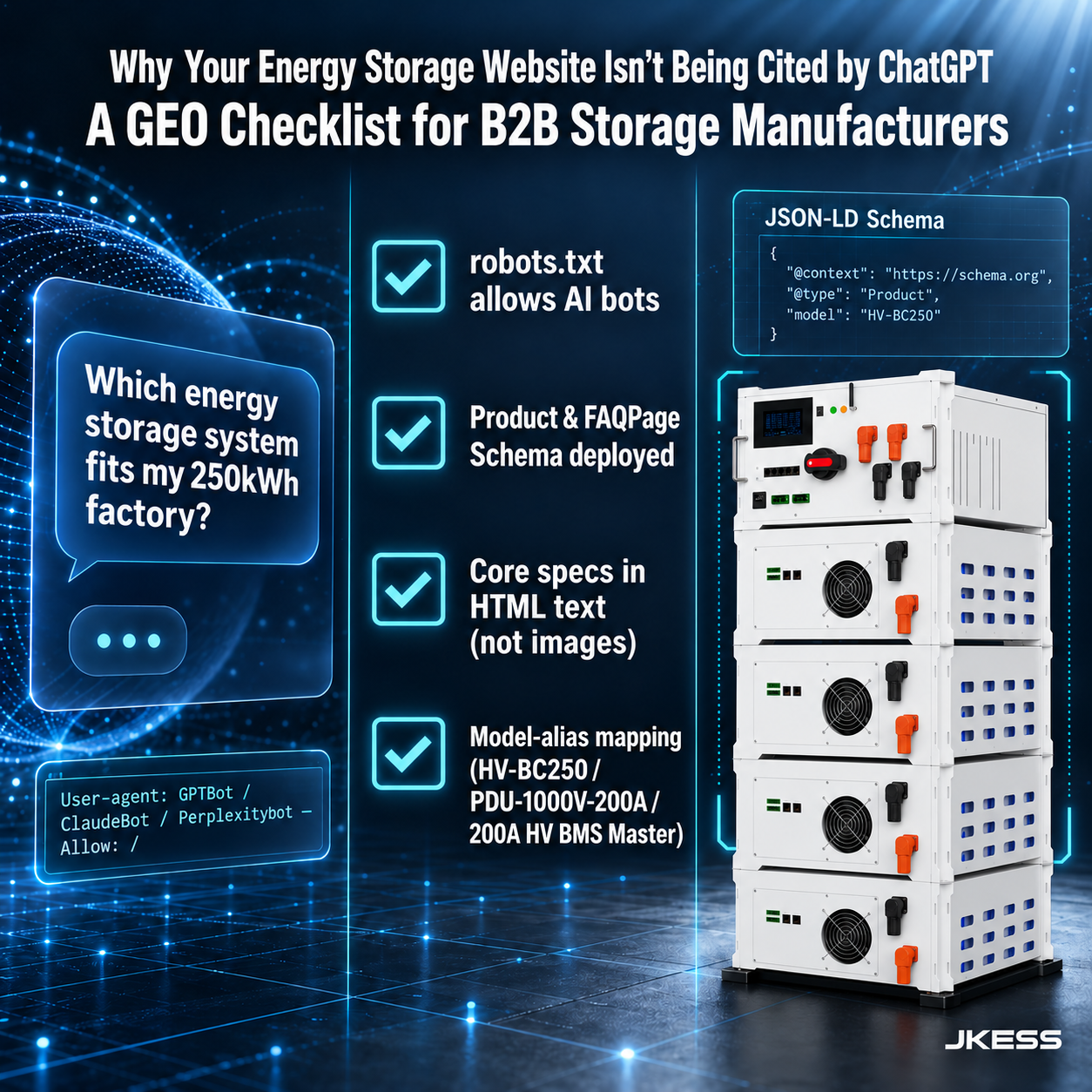
Alıcınız, tedarikçi web sitelerini karşılaştırmadan önce ChatGPT’ye soru sorabilir. Ürün teknik özellikleri yalnızca görsellerde yer alıyorsa, siteniz arama tarayıcılarını engelliyorsa veya model numaralarınız tutarsızsa, bilgileriniz cevaptan eksik kalabilir.
Önemli Öğreniler
- Satın alma süreci artık yapay zekâ destekli araştırma içeriyor. Alıcı, bireysel tedarikçi sayfalarını açmadan önce şöyle sorabilir: “Hangi sistem 250 kWh’lık fabrika ihtiyacımı karşılar?”
- Bilgilerinizi kolayca alınabilir ve doğrulanabilir hâle getirin. Teknik özellikleri, birimlerle, çalışma koşullarıyla, kaynaklarla ve açık ürün tanımlarıyla görünür HTML metni olarak yayınlayın.
- Yedi yapay zekâ görünürlüğü kontrol noktası denetimi yapın: tarayıcı erişimi, uygun Şema, gerçeklik yoğunluğu, model takma adı tutarlılığı, HTML belirtimleri, soru-cevap yapısı ve isteğe bağlı bir llms.txt kılavuzu. Bunlar pratik erişim ve içerik risklerini kapsar; yedi zorunlu sıralama gereksinimi değildir.
- Bir ürün için tek bir tutarlı kimlik gerekir. HV-BC250 gibi isimleri, iç PDU tanımlayıcısı ile '200A HV BMS Master' gibi ifadeleri yalnızca aynı revizyona ait olduklarını doğruladıktan sonra eşleştirin.
- GEO devam eden içerik yönetimidir. Kanıtları koruyun, alıntıları izleyin ve yanlış cevapları düzeltin. Hiçbir kontrol listesi, ChatGPT, Perplexity veya Google AI Özetleri’nde öncelikli yer alma garantisi vermez.
01 / Alıcı yolculuğu
B2B Satın Alma Funneli zaten değişmiştir
Tanıdık tedarik süreci, bir arama ile başlar, birkaç tedarikçi web sitesi boyunca devam eder ve bir kısa liste veya bilgi formuyla sona erer. Yapay zekâ asistanları, başka bir giriş noktası sunar: Alıcı, üreticinin web sitesini ziyaret etmeden önce teknik bir açıklama ya da karşılaştırma isteyebilir. Bu durum, ana sayfanızın dışındaki mevcut bilgilerin kalitesini giderek daha önemli hale getirir.
Bir depolama entegratörü ya da EPC müteahhidi tarafından sorulabilecek soruları düşünün: «Hangi yüksek gerilimli BESS, 4–16 adet yardımcı pil kutusu destekler?» «2A aktif dengeleme BMS’nin teknik parametreleri nelerdir?» «Zayıf bir şebeke için C&I depolama tasarımı hangi değişiklikleri gerektirir?» Bunlar, ölçülmüş benimsenme istatistikleri değil, alıcı niyeti örnekleridir. Her biri, bir bileşen derecelendirmesini tam sistem yeteneğinden ayırt eden kesin bir yanıt gerektirir.
İlgili gerçeklere erişmek zor olabilir veya çelişkili olabilir; bu durumda oluşturulan bir yanıt ürününüzü atlayabilir ya da yanlış tanımlayabilir. Pratik çözüm, güvenilir bir sayfada net ve kaynak gösterilebilir bir yanıt yayınlamaktır. Yapay zekâ tarafından oluşturulan yanıtların doğrulanmaya devam etmesi gerekir ve bu yanıtlarda görünür olmak, mevcut arama, dağıtım ve doğrudan satış kanallarını tamamlar.
02 / Arama ve alıntı
Geleneksel SEO ile GEO: Gerçekten Değişen Nedir?
Her iki disiplin de örtüşür. Bu karşılaştırma, her ikisinin de odaklandığı temel alanları açıklar; hem geleneksel SEO hem de GEO için faydalı içerik, teknik erişilebilirlik ve güvenilir kanıtlar önemlidir.
| Geleneksel SEO | GEO (Üretici Motor Optimizasyonu) |
|---|---|
| Hedef İlgili arama sonuçlarında görünürlük kazanın. | Hedef Yapay zekâ tarafından oluşturulan yanıtlarda faydalı ve alıntılanan bir kaynak haline gelin. |
| Odak Noktası Optimizasyonu Arama amacına uygunluk, ilgili içerik, bağlantılar ve teknik kalite. | Odak Noktası Optimizasyonu Erişilebilir gerçekler, kanıtlar, açık varlıklar ve uygun yapılandırılmış veriler. |
| Alıcı davranışı Sonuçları gözden geçirin ve tedarikçi sayfalarını ziyaret edin. | Alıcı davranışı Bir cevabı okuyun, takip soruları sorun ve destekleyici bağlantıları inceleyin. |
| İçerik Biçimi Arama amacına uygun faydalı ürün ve editöryel sayfalar. | İçerik Biçimi Önce cevap veren paragraflar, doğrulanabilir değerler, koşullar ve açık dışlamalar. |
| Tarama erişimi Googlebot, Bingbot ve ilgili indeksleme altyapısı. | Tarama erişimi OAI-SearchBot, PerplexityBot, Claude-SearchBot ve Google Search AI özellikleri için Googlebot. |
| Yapılandırılmış Veri Uygun sayfa içeriğini tanımlayın ve geçerli arama özelliklerini destekleyin. | Yapılandırılmış Veri Tüketildiğinde özelliklerin ve ilişkilerin netleştirilmesi; alıntı için evrensel bir ön koşul değildir. |
| Rekabet Arama sonuçları sayfası boyunca görünürlük ve ilgili olma durumu. | Rekabet Cevabın, kanıtlarınızı seçip atfetmesi ve bunları doğru şekilde temsil etmesi. |
| Resimler Açıklayıcı metinle desteklenen ve uygun alternatif (alt) özniteliklere sahip yararlı görseller. | Resimler Kritik teknik özellikleri HTML içinde tekrarlamak; hizmetlere göre görüntü okuma yetenekleri değişir. |
| Marka ve model adları Başlıklarda, sayfalarda ve bağlantılar da dahil olmak üzere tanınabilir adlar. | Marka ve model adları Tutarlı birincil tanımlayıcılar, doğrulanmış takma adlar ve sürüm sınırları. |
| Ölçüm Gösterimler, sıralamalar, tıklamalar ve nitelikli dönüşümler. | Ölçüm URL atıfları, doğru marka bahisleri, yönlendirmeler ve nitelikli sorgular. |
| SEO, alıcıların sizi bulmasına yardımcı olur. | GEO, kanıtlarınızın cevabın bir parçası haline gelmesini sağlar. |
03 / Çalışma kontrol listesi
B2B Depolama Web Siteleri İçin 7 Maddelik GEO Kontrol Listesi
-
Robots.txt dosyasını inceleyin ve amaçlanan arama tarayıcılarına izin verin.
Arama erişimini model eğitimi tercihlerinden ayırın. OpenAI, arama tarayıcısı olarak OAI-SearchBot'u ve model eğitimi için GPTBot'u tanımlar. PerplexityBot, Perplexity aramasını destekler; Claude-SearchBot, Claude aramasını desteklerken ClaudeBot, model geliştirmeyle ilgilidir. Googlebot, Google Arama dahil olmak üzere Google'ın yapay zeka özelliklerini de kapsayan tarama işlemlerini yönetir; Google-Extended ise diğer kullanım alanları için ayrı bir denetim aracıdır.
Mevcut kullanıcı ajanı gruplarını, joker karakter kurallarını, yol kısıtlamalarını ve CDN veya güvenlik duvarı ayarlarını kontrol edin. Standart robots.txt davranışı kapsamında açık bir
Allowotomatik olarak erişimi reddetmez. Açık bir grup, amaçlanan politikayı daha net hale getirebilir.# Example for a public marketing website.# Merge with the existing policy; preserve intentional path restrictions.User-agent: OAI-SearchBotAllow: /User-agent: PerplexityBotAllow: /User-agent: Claude-SearchBotAllow: /User-agent: GooglebotAllow: /Hedef içerik kullanımına göre GPTBot, ClaudeBot ve Google-Extended politikalarını ayrı ayrı ayarlayın. Son birleştirilmiş kuralları ve gerçek tarayıcı isteklerini doğrulayın.
Referanslar: OpenAI tarayıcı belgeleri ,Perplexity tarayıcıları ,Anthropic tarayıcı belgeleri , ve Google tarayıcı denetimleri .
-
Görünür sayfayı doğru şekilde açıklayan Şema’yı dağıtın
Tanımlayıcıları ve özellikleri açık hale getirmek için yapılandırılmış veriler kullanın. Şema, ziyaretçinin aslında gördüğü sayfayı tanımlamalıdır; desteklenmeyen iddialar eklememeli veya farklı ürün varyantlarını karıştırmamalıdır.
- Ürün + ek özellik: model özel parametreleri, birimleri ve belgelendirilmiş özellikler.
- SSS Sayfası: gerçek, görünür sorular ve bunlara karşılık gelen cevaplar.
- Nasıl Yapılır: tam adımları ve kapsamı içeren gerçek bir kurulum veya devreye alma kılavuzu.
- Madde: editöryel başlık, yazar, yayın tarihi ve resmi sayfa.
- Düzenleme: şirketin tutarlı adı, URL'si ve doğrulanmış iletişim bilgileri.
JSON sözdizimini ve alan anlamını doğrulayın, ardından her işaretlenmiş ifadeyi işlenen sayfa ile karşılaştırın. Birçok ürün hakkında tartışma yapan bir blog, otomatik olarak bir ürün ayrıntı sayfası değildir.
Uygunluk bir vaat değildir. Google, yapay zeka arama özelliklerinin özel Şema veya yapay zeka özel dosyaları gerektirmediğini belirtir. Schema.org geçerliliği, platform desteği ve gerçek dahil edilme ayrı sorulardır.
Referanslar: Schema.org additionalProperty ,FAQPage , ve Google’ın yapay zeka özelliklerine ilişkin kılavuzu .
-
Yararlı bilgi yoğunluğunu artırın
Desteklenmeyen sıfatları, bir alıcının doğrulayabileceği bir iddia ile değiştirin. Sonucu önce belirtin, her paragrafı tek bir konuya odaklayın ve değeri yorumlamak için gerekli olan modeli, birimi, çalışma koşullarını ve kaynağı sağlayın.
Önce / Tanıtım amaçlı "JKESS, üstün performansla sektör lideri aktif dengeleme teknolojisi sunar."Sonra / Belirgin ve kaynak gösterilmiş "JKESS teknik dokümantasyonuna göre BMU-H5-16, 2 A aktif dengeleme, ±0,005 V hücre voltajı ölçüm doğruluğu, sekiz adet NTC sıcaklık sensörü ve 16S LiFePO4 desteği sunar. Bu değerleri sağlanan tam revizyon ile karşılaştırın."Çakışan belgelerden gelen değerleri yeni bir özellik tanımı oluşturmak amacıyla birleştirmeyin. Bir ürün sayfası ile bir veri sayfası çelişiyorsa, bu uyuşmazlığı ürün sahibiyle çözün ve her iki kaynağı da güncelleyin; ardından bunlardan herhangi birini kesin kaynak olarak kabul edin.
Örnek kaynak: JKESS’in BMU-H5-16 hakkında teknik açıklaması . Genel sayfalar, revizyon farkları içerebilir; geçerli onaylı bir veri saytası yayın referansı olarak kalır.
-
Doğrulanmış bir model-alias eşleme tablosu oluşturun
Her ürün için birincil bir ad ve bir temel ürün sayfası belirleyin. Pazarlama adı, mühendislik tanımlayıcısı, ürün revizyonu ve bölgesel adlandırma varyantları gibi bilgileri bağlayan bir kayıt tutun.
Sağlanan adlandırma örneği şudur HV-BC250 / PDU-1000V-200A-A001-NY / 200A HV BMS Master Box . Bu, doğrulanacak bir takma ad ilişkisidir; tanımlayıcıların birbirleriyle değiştirilebilir olduğuna dair bir kanıt değildir. Mühendislik tarafından eşleşme onaylanırsa şu şekilde yazın: “HV-BC250, aynı zamanda PDU-1000V-200A-A001-NY olarak bilinir ve 200A HV BMS Master Box’tır.”
Başlıkta ve H1 etiketinde birincil adı kullanın; doğrulanmış takma adları giriş paragrafında ve Ürün alanlarında (örneğin
alternateNameveyampn. Bir revizyon, değerlerde, arayüzlerde veya teslim kapsamında değişiklik yaptığı takdirde ayrı bir kimlik koruyun. -
Temel teknik özellikleri görünür HTML içinde tutun
Ana değerleri sayfanın kendisine yazın. Gerilim, akım, doğruluk, boyutlar, test koşulları ve teslim kapsamı sıradan metin ve anlam bilgisi olarak mevcut kalmalıdır
cells.
Image extraction and JavaScript rendering differ between crawlers and retrieval tools. Text inside a photograph, iframe, or canvas is therefore an unreliable sole source for a critical parameter. Alt text helps describe an image, but it does not replace a visible specification table.
Publish a dated datasheet alongside the HTML table. Distinguish nominal voltage from the operating envelope, continuous current from peak current, and empty-kit weight from the weight of an assembled module.
Answer real buyer questions directly
Build a useful set of questions around the buying decision: “How many slave boxes can one master box support?” “Does the kit include battery cells?” “Which communication protocols are provided?” Answer first, then give the limits and source.
Five to ten FAQs can be a practical editorial target when the topic warrants them; there is no universal minimum. Native
When adding FAQPage markup, use the same question and answer wording as the visible page. Do not add invisible FAQ claims just to target search queries. This article includes ten visible FAQs and marks up five of them.
Consider an optional llms.txt reading guide
llms.txtis a proposed Markdown convention for guiding agents to useful website content. A concise guide can list the company, core products, application pages, and maintained technical documents. It is useful only to consumers that choose to read it.# JKESS Electronic Technology BMS and active balancing solutions for energy storage.## Core Products- [HV-BC250 200A Master Box](https://www.jkess.com/200a-hv-bms-master)- [HV-B6U Slave Battery Box Kits](https://www.jkess.com/hv-slave-6u-kits)- [261kWh Liquid-Cooled BESS Kits](https://www.jkess.com/commercial--industrial-energy-storage-system-kits)## Application Guides- [Modular HV Energy Storage Kits](https://www.jkess.com/home-energy-storage-system-kits)## Technical DocumentsUse the current specifications and scope-of-supply notes on the product pages.Add approved, versioned datasheet links when those documents are published.Illustrative content, not a report of the live site’s configuration. Use verified links and clean Markdown versions where available. Maintaining this file does not deploy robots.txt rules or create search eligibility.
References: the llms.txt proposal and Google’s generative AI optimization guidance. Google Search does not use llms.txt as a special visibility or ranking input.
04 / Content in practice
Before and After: Rewriting a Storage Product Page for AI Citation
The following five examples replace broad promotion with a more useful answer. Numerical illustrations include their assumptions; commercial and certification statements require current, model-specific evidence.
Illustrative rewrites. Calculations are not measured performance guarantees. Before / Marketing copy After / Evidence-led copy “Our advanced active balancing BMS delivers superior performance and extends battery life.” “For an illustrative 314Ah cell with a 0.5% charge difference, ΔQ = 314 × 0.005 = 1.57Ah. At a constant 2A transfer current, the idealized duration is 1.57 ÷ 2 = 0.785 hours, or about 47 minutes. Real duration depends on current limits, control behavior, and losses.” “The system supports a wide voltage range for various applications.” “The HV-BC250 listing specifies an 80–1000V DC master range. A 4–16 slave-box configuration is described as approximately 64–256kWh when each box is approximately 16kWh. With 16 cells per box and 3.2V nominal per cell, 16 boxes yield 256S / 819.2V nominal. Verify the full charge/discharge range and selected cell capacity.” “Our battery boxes are designed for easy installation.” “Define the scope as one master plus five slave boxes: six enclosures in total. State empty-kit and assembled-module weights separately, together with the lifting and installation plan. A claimed 28.55kg kit weight or two-technician, 2–3 day schedule requires a matching product record and a defined site scope.” “We provide reliable products with international certifications.” “List the exact model and revision, applicable CE declaration, RoHS documentation, FCC evidence, and test-report identifiers. If citing GB34131-2017 or insulation resistance ≥1 MΩ at 1,000 VDC, verify the applicable standard edition, test method, and report scope rather than extending a component claim to the whole system.” “Contact us for more information.” “Send your required capacity, DC range, current, communication protocol, scope of supply, quantity, and delivery location to [email protected]. Request confirmation of available regional stock and a written dispatch estimate for that configuration.” Product references: HV-BC250 and modular storage kits. The 64–256kWh shorthand is configuration-dependent; a hardware kit without cells does not itself contain that stored energy.
05 / Access and extraction
Technical Access: Can AI Crawlers Actually Read Your Website?
Check 1 / robots.txt and access controls
Open
https://yourdomain.com/robots.txtand evaluate the user-agent group and path rules that apply to each intended crawler. Inspect firewall challenges, blocked IP ranges, redirects, and server errors as well.Absence of an explicit Allow is not a failure by itself. Use the actual response and verified crawler logs to determine what is accessible.
Check 2 / Core content in HTML
Disable JavaScript and reload the product page. Check the original HTML response for the model name, specification table, scope of supply, and answers.
If they disappear, the page depends on rendering that some tools may not perform. Prefer server-rendered or static core content, and use a search engine’s inspection tools where available. Also check
noindex, snippet restrictions, andX-Robots-Tagheaders.Check 3 / Descriptive alt text
Describe informative product photographs, diagrams, and screenshots with suitable alt text. Keep purely decorative images from adding noise.
Repeat important values in the visible body or a real HTML table. A long alt attribute is not a substitute for a readable technical specification.
Check 4 / Reliable loading and delivery
Confirm that the canonical page returns a successful response and delivers useful content promptly. Reduce unnecessary third-party scripts, oversized payloads, and client-side dependencies.
Timeouts, errors, and rendering limits can interfere with retrieval. A model’s context budget is a separate issue from network performance; there is no universal “AI loading time” threshold.
Check 5 / Canonical URLs and model identity
Identify duplicate URLs for the same item and use a consistent canonical URL, internal links, and sitemap entries. For example, reconcile two product paths that describe the same HV-BC250 revision.
A canonical URL signals a preferred page; it does not by itself resolve conflicting specifications or prove that two product names are equivalent.
Access references: robots.txt interpretation and the crawler documentation linked in checkpoint 1.
06 / Evidence of progress
How to Measure Whether GEO Is Working
Pair answer-level observations with business outcomes. Metric Traditional SEO measure GEO measure Visibility Search impressions and keyword positions. Share of sampled AI answers citing an owned URL; track brand mentions separately. Traffic Organic search clicks and visits. Identifiable AI referrals; brand-search changes as supporting, non-causal evidence. Content Engagement and landing-page performance. Which facts and pages are cited, and whether values and limitations are correct. Conversion Forms, qualified leads, and sales. Qualified inquiries with an AI discovery source or attributable referral. Competition Relative search visibility. Citation share and co-mentions within the same fixed question set. Audit Indexability, search-intent coverage, and page quality. Entity consistency, evidence freshness, extractable facts, and markup accuracy. A practical weekly baseline: run ten fixed buyer questions in ChatGPT search, Perplexity, and Google AI Overviews where an overview appears. Repeat the sample and log platform, date, locale, model or mode, exact question, cited URL, brand mention, and answer accuracy.
Citation rate = answers linking to your domain ÷ eligible sampled answers. Report the sample size and the number of queries without an AI answer. A brand mention without a source link is not a citation. Use a separate measure for citations to this specific article.
For example, six cited answers out of 30 eligible observations produce a 20% sample citation rate. This is an illustrative calculation, not a JKESS result. Keep the question set stable when comparing periods, and avoid treating a single answer or a small change as proof that one edit caused an improvement.
07 / Applying the method
How JKESS Applies GEO to Its Own Product Pages
The reviewed JKESS master-box and 261kWh application pages expose technical information in readable tables. That is a useful starting point. The following seven practices form an implementation and maintenance checklist, rather than a claim that every page has already passed a site-wide audit.
- Maintain structured specification tables. Keep each voltage, current, accuracy, dimension, and weight value in visible HTML, tied to a model, revision, and source. Separate component ratings from complete-system limits.
- Keep FAQs useful and consistent. Write five to ten relevant answers when justified by the product; align any FAQPage markup with the exact visible wording and recheck answers after product changes.
- Use model-specific Product markup. Validate Product and additionalProperty on the appropriate HV-BC250, HV-B6U, and 261kWh pages. Record evidence of the deployed markup rather than assuming site-wide coverage.
- Control aliases. Confirm any relationship between HV-BC250 and PDU-1000V-200A-A001-NY, then use one primary name with the approved aliases. Keep HV-BC150-100A as a distinct product identity.
- Reconcile quantitative claims. Check the 2A active balancing and ±0.005V sampling values against the supplied BMU revision. Keep the 4–16 slave-box and 64–256kWh statements linked to their cell and configuration assumptions.
- Maintain an optional llms.txt guide. If deployed, list current canonical product and documentation URLs, remove stale links, and treat it as documentation support rather than an indexing requirement.
- Verify search access. Review the live robots.txt policy and crawler delivery logs. Confirm intended access for search bots while managing training-related controls independently.
JKESS product and specification anchors
HV-BC250 · 200A HV BMS Master · HV-BC150-100A · 100A master configuration · HV-B6U · 6U slave battery box kits · BMU-H5-16 · technical reference · 261kWh liquid-cooled system
Values to keep in context: 2A active balancing · ±0.005V sampling accuracy · 4–16 slave battery boxes · approximately 64–256kWh · 80–1000V DC master range. These refer to different components or configurations, not a single universal specification. Kits are offered without battery cells; confirm the final scope of supply.
08 / Questions buyers ask
Frequently Asked Questions
What is GEO and how does it differ from traditional SEO?
GEO (Generative Engine Optimization) is the practice of making useful content easier to retrieve, understand, and cite in AI-generated answers. Traditional SEO emphasizes visibility in search results, while GEO also tracks how accurately a brand and its facts appear in generated responses. Both benefit from accessible pages, clear product identities, and reliable evidence; neither guarantees inclusion.
Why is my energy storage website not being cited by ChatGPT?
Possible causes include blocked search crawlers, unindexed pages, specifications that are difficult to extract, inconsistent model names, or weak evidence for the question being asked. For ChatGPT search, review OAI-SearchBot access rather than assuming GPTBot controls search visibility. Missing Schema or llms.txt alone does not prove why a page was omitted; compare crawl evidence, content relevance, and repeated query results.
What is llms.txt and why does it matter for B2B storage websites?
llms.txt is a proposed Markdown-based guide to a website’s useful content, which can point agents to product documentation and application guides. It can help tools that choose to use it, but adoption and behavior differ between services. Treat it as optional documentation infrastructure, not a requirement for AI citation or a replacement for HTML pages and sitemaps.
How do I check if AI crawlers can access my website?
Inspect the robots.txt groups and path rules that apply to OAI-SearchBot, PerplexityBot, Claude-SearchBot, and Googlebot, then review server and firewall logs. A missing explicit Allow rule does not by itself mean access is denied. Also check HTTP responses, indexing and snippet controls, and whether product specifications are available without JavaScript; a browser-only test does not confirm a crawler’s actual access.
What Schema markup should a B2B storage website prioritize?
Use Product with additionalProperty on product pages, Article on editorial pages, and Organization for the company identity. FAQPage can describe visible questions and answers, and HowTo can describe a genuine procedural guide. Keep markup aligned with the visible content and applicable platform documentation; valid Schema does not guarantee a rich result or an AI citation.
How does inconsistent product naming affect AI visibility?
Different names for the same item can make it harder for readers and retrieval systems to connect the information. Select one primary model name and record verified aliases, product revisions, and one canonical URL. Publish an “also known as” relationship only after the model owner confirms that the labels identify the same product and configuration.
What is fact density and why does it matter for GEO?
Fact density is an editorial measure of how much useful, verifiable information a passage contains relative to general promotional language. A model-specific value with units, operating conditions, and a dated source is more useful than an unsupported adjective. Values such as 2A active balancing, ±0.005V sampling accuracy, and an 80–1000V DC range must stay attached to the correct component; fact density is not a published universal AI ranking score.
How do I measure GEO performance for my storage website?
Run a fixed set of buyer questions repeatedly and log the date, platform, search mode, locale, cited URLs, and answer accuracy. Report URL citation rate separately from unlinked brand mentions, and track identifiable referral visits and qualified inquiries. Results fluctuate, so a small weekly sample is directional evidence rather than a complete view of all buyers or proof of causation.
Does GEO replace traditional SEO for B2B storage manufacturers?
No. Search indexing, useful content, internal links, and a dependable website remain relevant to both conventional search and AI-assisted research. GEO adds attention to answer-level representation, traceable facts, and citation measurement. An effective program maintains those foundations while checking whether buyers receive accurate product information.
How does JKESS apply GEO principles to its own product pages?
The JKESS pages reviewed for this article provide examples of HTML specifications and question-and-answer content for products including the HV-BC250 and the 261kWh liquid-cooled system. The seven-part workflow below extends that approach to the HV-BC150-100A, HV-B6U, and BMU-H5-16 through consistent naming, source review, and structured content. This article does not certify site-wide Schema coverage, crawler settings, or an existing llms.txt deployment; those require a current implementation audit.
Want to Audit Your Storage Website’s AI Visibility?
Share your website URL with our team. We’ll review your robots.txt, Schema markup, fact density, and entity consistency — and help identify where crawlers or readers may be missing your product information.
Request a Custom Quote→