
 EN
جيكيس / رؤى هندسية
اطلب عرض أسعار →لماذا لا تُستشهد بموقعك الإلكتروني لتخزين الطاقة في محادثات جي بي تي: قائمة تحقق جغرافية (جي أو) لمصنّعي أنظمة التخزين للشركات
قد يسأل المشتري جي بي تي قبل مقارنة مواقع المورِّدين. فإذا كانت مواصفات منتجاتك موجودة فقط في الصور، أو كان موقعك يمنع محركات البحث من الزحف إليه، أو كانت أرقام طرازات منتجاتك غير متسقة، فقد لا تظهر معلوماتك في الإجابة.
المعلومات الرئيسية
- رحلة الشراء تشمل الآن الأبحاث المدعومة بالذكاء الاصطناعي. يمكن للمشتري أن يسأل: «أي نظام يناسب متطلبات مصنعِي البالغة ٢٥٠ كيلوواط ساعة؟» قبل فتح صفحات المورِّدين الفردية.
- اجعل حقائقك سهلة الاسترجاع والتحقق. انشر المواصفات التقنية على شكل نصوص إتش تي إم إل مرئية، مع وحدات القياس والظروف التشغيلية والمصادر وهويات المنتجات الواضحة.
- افحص سبعة نقاط تحقق لرؤية الذكاء الاصطناعي: وصول الزاحف، والهيكل المناسب (Schema)، وكثافة الحقائق، واتساق أسماء النماذج، ومواصفات HTML، وهيكل الأسئلة والأجوبة، ودليل اختياري باسم llms.txt. وتشمل هذه العناصر المخاطر العملية المتعلقة بالوصول والمحتوى؛ وهي ليست سبعة متطلبات إلزامية للترتيب.
- يجب أن يمتلك كل منتج هوية واحدة متسقة. وحّد الأسماء مثل HV-BC250، وهو معرّف داخلي لوحدة توزيع الطاقة (PDU)، وعبارة «وحدة إدارة البطاريات عالية الجهد ٢٠٠ أمبير» فقط بعد التأكّد من أنها تشير إلى نفس الإصدار.
- تُدار محتويات GEO حاليًّا بشكل مستمر. احفظ الأدلة، وراقب الاستشهادات، وأصلح الإجابات غير الدقيقة. ولا يمكن لأي قائمة تحقُّق ضمان الحصول على أولوية الظهور في ChatGPT أو Perplexity أو نظرة Google الذكائية.
٠١ \/ رحلة المشتري
لقد تغيّر بالفعل مسار شراء الشركات (B2B Procurement Funnel)
تبدأ رحلة الشراء المألوفة بالبحث، ثم تستمر عبر عدة مواقع إلكترونية لمورِّدين مختلفين، وتنتهي بقائمة مختصرة أو نموذج استفسار. وتُقدِّم المساعدات الذكية الاصطناعية نقطة دخول إضافية: فيمكن للمشتري أن يطلب شرحًا فنيًّا أو مقارنةً قبل زيارة الموقع الإلكتروني لشركة التصنيع. وبذلك يزداد ارتباط جودة المعلومات المتاحة خارج صفحتك الرئيسية بأهميتها.
فكِّر في الأسئلة التي قد يطرحها مُدمِّج أنظمة التخزين أو مقاول EPC: «أي نظام تخزين طاقة عالي الجهد (BESS) يدعم من ٤ إلى ١٦ صندوق بطاريات فرعية؟»، «ما هي المواصفات الفنية لنظام إدارة البطاريات (BMS) ذي موازنة نشطة بتيار ٢ أمبير؟»، «ما التغييرات المطلوبة في تصميم أنظمة التخزين للقطاع التجاري والصناعي (C&I) عند الربط بشبكة كهربائية ضعيفة؟». هذه أمثلة على نوايا المشتري، وليست إحصائيات مُقاسة عن مدى اعتماد المنتج. وكل سؤال منها يتطلَّب إجابة دقيقة تُميِّز بين تصنيف مكوِّن معين وقدرة النظام الكامل.
إذا كانت الحقائق ذات الصلة يصعب الوصول إليها أو كانت متناقضة، فقد تتجاهل الاستجابة المُولَّدة من قِبل الذكاء الاصطناعي منتجك أو تصفه بشكلٍ خاطئ. والحل العملي هو نشر إجابة واضحة وقابلة للنسب على صفحةٍ موثوقة. ولا تزال الإجابات المُولَّدة من قِبل الذكاء الاصطناعي بحاجةٍ إلى التحقق منها، كما أن الظهور فيها يكمّل قنوات البحث التقليدية وموزِّعي المنتجات والمبيعات المباشرة.
٠٢ / البحث والاستشهاد
تحسين محركات البحث التقليدي مقابل تحسين محركات الإجابات التوليديّة: ما الذي يتغيّر فعليًّا؟
يتداخل المجالان مع بعضهما البعض. وتوضّح هذه المقارنة مجالات التركيز الرئيسية في كلٍّ منهما؛ إذ تهمّ كلاهما المحتوى المفيد، والوصول التقني، والأدلة الموثوقة.
| تحسين محركات البحث التقليدي | تحسين محركات الإجابات التوليديّة (GEO) |
|---|---|
| مرمى اكتسب رؤية في نتائج البحث ذات الصلة. | مرمى كن مصدرًا مفيدًا ومُستشهدًا به في الإجابات المُولَّدة من قِبل الذكاء الاصطناعي. |
| تركيز التحسين نية البحث، والمحتوى ذي الصلة، والروابط، والجودة التقنية. | تركيز التحسين حقائق قابلة الاسترجاع، وأدلة، وكيانات واضحة، وبيانات منظمة مناسبة. |
| سلوك المشتري تصفح النتائج وزيارة صفحات المورِّدين. | سلوك المشتري قراءة إجابة، وطرح أسئلة تالية، وفحص الروابط الداعمة. |
| تنسيق المحتوى صفحات منتجات ومحتوى تحريري مفيد يتوافق مع نية البحث. | تنسيق المحتوى فقرات تُقدِّم الإجابة أولاً، وقيم يمكن التحقق منها، وشروط، واستثناءات صريحة. |
| وصول الزواحف جوجل بوت، بينغ بوت، والبنية التحتية الخاصة بالفهرسة. | وصول الزواحف أو أي-سيرش بوت، بيربلكسيت بوت، كلاود سيرش بوت، وجوجل بوت لمزايا الذكاء الاصطناعي في بحث جوجل. |
| البيانات المنظمة وصف محتوى الصفحة المؤهل ودعم الميزات البحثية ذات الصلة. | البيانات المنظمة توضيح الخصائص والعلاقات عند الاستهلاك؛ وليس شرطاً عاماً مسبقاً للاستشهاد. |
| المنافسة الوضوح والأهمية عبر صفحة نتائج البحث. | المنافسة ما إذا كانت الإجابة تختار الأدلة المقدمة وتُنسبها بدقة وتمثلها تمثيلاً صحيحاً. |
| الصور مرئيات مفيدة مدعومة بنصوص وصفية وسمات بديلة (alt attributes) مناسبة. | الصور تكرار المواصفات الجوهرية في كود HTML؛ إذ تتفاوت قدرات الخدمات على قراءة الصور. |
| أسماء العلامات التجارية والطرازات أسماء معروفة ومميَّزة عبر العناوين والصفحات والروابط. | أسماء العلامات التجارية والطرازات معرِّفات رئيسية متسقة، وأسماء بديلة موثوقة، وحدود التحديثات أو الإصدارات. |
| القياسات عدد مرات الظهور، والمراكز في الترتيب، والنقرات، والتحويلات المؤهلة. | القياسات الاستشهادات بعناوين URL، والذكر الدقيق للعلامات التجارية، والإحالات، والاستفسارات المؤهلة. |
| تُساعد تحسين محركات البحث (SEO) المشترين في العثور عليك. | تُساعد تحسين محركات البحث المدعومة بالذكاء الاصطناعي (GEO) في جعل أدلة محتواك جزءًا من الإجابة. |
٠٣ / قائمة المراجعة التشغيلية
قائمة التحقق من سبعة عناصر لتحسين محركات البحث المدعومة بالذكاء الاصطناعي (GEO) لمواقع ويب تخزين الأعمال إلى الأعمال (B2B)
-
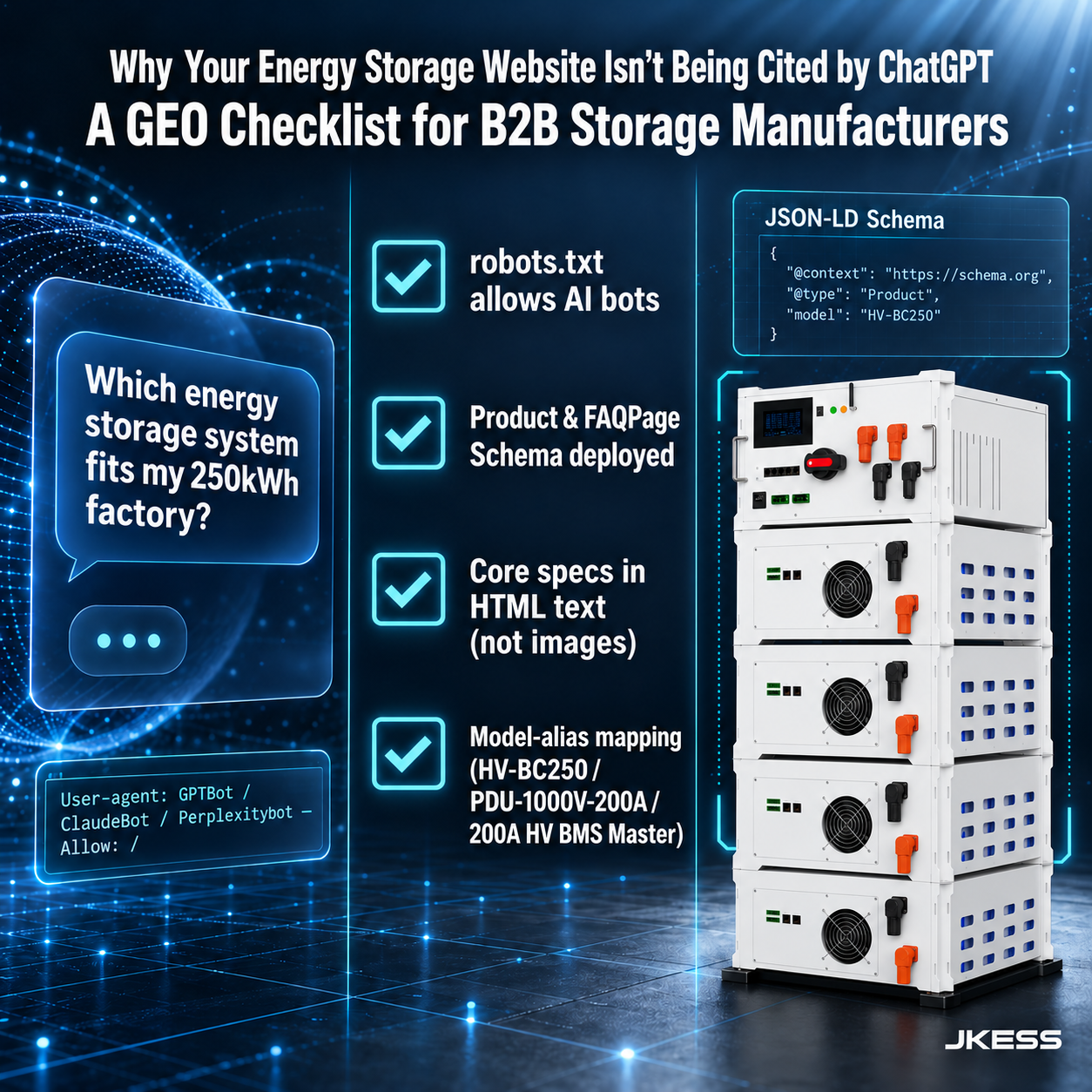
راجع ملف robots.txt وسمح لروابط الزحف الخاصة بمحركات البحث المستهدفة.
افصل بين إعدادات الوصول للبحث وإعدادات تفضيلات تدريب النماذج. تعرّف شركة OpenAI على OAI-SearchBot باعتباره روبوت الزحف الخاص بها للبحث، وعلى GPTBot باعتباره روبوت الزحف الخاص بتدريب النماذج. ويدعم PerplexityBot عمليات البحث في منصة Perplexity، بينما يدعم Claude-SearchBot عمليات البحث في منصة Claude، أما ClaudeBot فيتعلق بتطوير النماذج. ويتحكم Googlebot في زحف محتوى الويب لخدمة بحث جوجل، بما في ذلك ميزاتها المدعومة بالذكاء الاصطناعي؛ أما Google-Extended فهو تحكم منفصل يستخدم لأغراض أخرى.
تحقق من مجموعات وكلاء المستخدم الحالية، وقواعد التنبيه العام (wildcard)، والقيود المفروضة على المسارات، وإعدادات شبكة التوصيل المحتوى (CDN) أو جدران الحماية. ووفق السلوك القياسي لملف robots.txt، فإن غياب قاعدة صريحة لا يؤدي تلقائيًّا إلى حظر الوصول.
Allowويمكن أن توضّح القاعدة الصريحة السياسة المقصودة بشكل أدق.# Example for a public marketing website.# Merge with the existing policy; preserve intentional path restrictions.User-agent: OAI-SearchBotAllow: /User-agent: PerplexityBotAllow: /User-agent: Claude-SearchBotAllow: /User-agent: GooglebotAllow: /اضبط سياسات GPTBot وClaudeBot وGoogle-Extended بشكل منفصل وفقًا لغرض استخدام المحتوى المقصود. وتحقق من صحة القواعد المدمجة النهائية وطلبات الزواحف الفعلية.
المراجع: توثيق زاحف OpenAI ,زواحف Perplexity ,توثيق زاحف Anthropic ، و ضوابط زاحف Google .
-
نفّذ مخطط Schema الذي يصف الصفحة المرئية بدقة.
استخدم البيانات المنظمة لتوضيح المُعرِّفات والخصائص بشكل صريح. ويجب أن يصف مخطط Schema الصفحة التي يراها الزائر فعليًّا، دون إضافة ادّعاءات غير مدعومة أو دمج متغيرات منتجات مختلفة.
- منتج + خاصية إضافية: معلمات خاصة بالنموذج، ووحدات القياس، والخصائص الموثَّقة.
- صفحة الأسئلة الشائعة (FAQPage): أسئلة حقيقية ومرئية مع إجاباتها المقابلة.
- كيف تفعل ذلك: دليل تثبيت أو تشغيل فعلي يحتوي على جميع الخطوات والنطاق الكامل.
- مقال: العنوان التحريري، والمؤلف، وتاريخ النشر، ورابط الصفحة الأصلي.
- التقسيم والتنظيم: اسم الشركة الموحّد، ورابطها الإلكتروني، ومعلومات الاتصال المؤكدة.
تحقق من صحة بنية ملف JSON ومعاني الحقول، ثم قارن كل عبارة مُعلَّمة مع الصفحة المعروضة. بلوق يناقش عدة منتجات ليس بالضرورة صفحة تفاصيل منتج.
الأهلية ليست وعداً. توضح جوجل أن ميزات البحث الذكية الخاصة بها لا تتطلب وجود ملفات Schema خاصة أو ملفات مخصصة للذكاء الاصطناعي. أما صحة ملفات Schema.org، ودعم المنصة، وإدراج المحتوى فعلاً فهي أسئلة منفصلة.
المراجع: Schema.org additionalProperty ,FAQPage ، و إرشادات ميزات الذكاء الاصطناعي من جوجل .
-
زيادة كثافة الحقائق المفيدة
استبدال الصفات غير المدعومة بادعاء يمكن للمشتري التحقق منه. اذكر الاستنتاج أولاً، واجعل كل فقرة مركزًا على فكرة واحدة، ووَفِّر الطراز والوحدة وحالة التشغيل والمصدر اللازم لتفسير القيمة.
قبل / ترويجي «توفر شركة JKESS تقنية موازنة نشطة رائدة في القطاع مع أداء متفوق.»بعد / محدَّد وقابل للنسب «تشرح الوثائق الفنية لشركة JKESS وحدة إدارة البطارية BMU-H5-16 بأنها تدعم موازنة نشطة بتيار ٢ أمبير، ودقة عينة جهد الخلية ±٠٫٠٠٥ فولت، وثمانية مستشعرات حرارية من نوع NTC، وتدعم بطاريات ليثيوم حديد فوسفات ذات ١٦ خلية (16S LiFePO4). يُرجى التأكد من صحة هذه القيم مقابل الإصدار الدقيق المُورَّد.»لا تدمج القيم من وثائق متضاربة لإنشاء مواصفة جديدة. فإذا اختلفت صفحة المنتج عن ورقة البيانات، فاحلّ هذا التناقض بالتشاور مع مالك المنتج، وحدّث كلا المصدرين قبل اعتبار أيٍّ منهما مرجعًا قاطعًا.
مثال على المصدر: مناقشة فنية من شركة JKESS حول وحدة إدارة البطارية BMU-H5-16 يمكن أن تحتوي الصفحات العامة على اختلافات في المراجعة؛ ويظل ورقة البيانات المعتمدة حاليًّا المرجع الرسمي للنشر.
-
أنشئ خريطة مُوثَّقة تربط النموذج بالاسم المستعار.
اعطِ كل منتج اسمًا رئيسيًّا واحدًا وصفحة منتج قياسية واحدة. واحفظ سجلاً يربط بين الاسم التسويقي، والمعرِّف الهندسي، ومراجعة المنتج، وأي أسماء إقليمية بديلة.
المثال المقدَّم للتسمية هو HV-BC250 / PDU-1000V-200A-A001-NY / 200A HV BMS Master Box وهذا علاقة اسم مستعار يجب التحقق منها، وليس دليلاً على أن المعرِّفات قابلة للتبديل. فإذا أكَّد القسم الهندسي التطابق، اكتب: «HV-BC250، والمعروف أيضًا باسم PDU-1000V-200A-A001-NY، هو صندوق التحكم الرئيسي عالي الجهد (HV BMS) بسعة ٢٠٠ أمبير.»
استخدم الاسم الرئيسي في العنوان وفي العنصر H1؛ وضَع الأسماء المستعارة المؤكدة في الفقرة الافتتاحية وفي الحقول المناسبة للمنتج مثل
alternateNameأوmpnاحفظ هوية منفصلة عندما تؤدي مراجعة ما إلى تغيير في التصنيفات أو الوصلات أو نطاق التوريد. -
احفظ المواصفات الأساسية في HTML مرئيٍّ واضحٍ.
اكتب القيم الأساسية مباشرةً داخل الصفحة نفسها. يجب أن تظل الجهد والتيار والدقة والأبعاد وظروف الاختبار ونطاق التوريد متاحة كنص عادي ودلالي
cells.
Image extraction and JavaScript rendering differ between crawlers and retrieval tools. Text inside a photograph, iframe, or canvas is therefore an unreliable sole source for a critical parameter. Alt text helps describe an image, but it does not replace a visible specification table.
Publish a dated datasheet alongside the HTML table. Distinguish nominal voltage from the operating envelope, continuous current from peak current, and empty-kit weight from the weight of an assembled module.
Answer real buyer questions directly
Build a useful set of questions around the buying decision: “How many slave boxes can one master box support?” “Does the kit include battery cells?” “Which communication protocols are provided?” Answer first, then give the limits and source.
Five to ten FAQs can be a practical editorial target when the topic warrants them; there is no universal minimum. Native
When adding FAQPage markup, use the same question and answer wording as the visible page. Do not add invisible FAQ claims just to target search queries. This article includes ten visible FAQs and marks up five of them.
Consider an optional llms.txt reading guide
llms.txtis a proposed Markdown convention for guiding agents to useful website content. A concise guide can list the company, core products, application pages, and maintained technical documents. It is useful only to consumers that choose to read it.# JKESS Electronic Technology BMS and active balancing solutions for energy storage.## Core Products- [HV-BC250 200A Master Box](https://www.jkess.com/200a-hv-bms-master)- [HV-B6U Slave Battery Box Kits](https://www.jkess.com/hv-slave-6u-kits)- [261kWh Liquid-Cooled BESS Kits](https://www.jkess.com/commercial--industrial-energy-storage-system-kits)## Application Guides- [Modular HV Energy Storage Kits](https://www.jkess.com/home-energy-storage-system-kits)## Technical DocumentsUse the current specifications and scope-of-supply notes on the product pages.Add approved, versioned datasheet links when those documents are published.Illustrative content, not a report of the live site’s configuration. Use verified links and clean Markdown versions where available. Maintaining this file does not deploy robots.txt rules or create search eligibility.
References: the llms.txt proposal and Google’s generative AI optimization guidance. Google Search does not use llms.txt as a special visibility or ranking input.
04 / Content in practice
Before and After: Rewriting a Storage Product Page for AI Citation
The following five examples replace broad promotion with a more useful answer. Numerical illustrations include their assumptions; commercial and certification statements require current, model-specific evidence.
Illustrative rewrites. Calculations are not measured performance guarantees. Before / Marketing copy After / Evidence-led copy “Our advanced active balancing BMS delivers superior performance and extends battery life.” “For an illustrative 314Ah cell with a 0.5% charge difference, ΔQ = 314 × 0.005 = 1.57Ah. At a constant 2A transfer current, the idealized duration is 1.57 ÷ 2 = 0.785 hours, or about 47 minutes. Real duration depends on current limits, control behavior, and losses.” “The system supports a wide voltage range for various applications.” “The HV-BC250 listing specifies an 80–1000V DC master range. A 4–16 slave-box configuration is described as approximately 64–256kWh when each box is approximately 16kWh. With 16 cells per box and 3.2V nominal per cell, 16 boxes yield 256S / 819.2V nominal. Verify the full charge/discharge range and selected cell capacity.” “Our battery boxes are designed for easy installation.” “Define the scope as one master plus five slave boxes: six enclosures in total. State empty-kit and assembled-module weights separately, together with the lifting and installation plan. A claimed 28.55kg kit weight or two-technician, 2–3 day schedule requires a matching product record and a defined site scope.” “We provide reliable products with international certifications.” “List the exact model and revision, applicable CE declaration, RoHS documentation, FCC evidence, and test-report identifiers. If citing GB34131-2017 or insulation resistance ≥1 MΩ at 1,000 VDC, verify the applicable standard edition, test method, and report scope rather than extending a component claim to the whole system.” “Contact us for more information.” “Send your required capacity, DC range, current, communication protocol, scope of supply, quantity, and delivery location to [email protected]. Request confirmation of available regional stock and a written dispatch estimate for that configuration.” Product references: HV-BC250 and modular storage kits. The 64–256kWh shorthand is configuration-dependent; a hardware kit without cells does not itself contain that stored energy.
05 / Access and extraction
Technical Access: Can AI Crawlers Actually Read Your Website?
Check 1 / robots.txt and access controls
Open
https://yourdomain.com/robots.txtand evaluate the user-agent group and path rules that apply to each intended crawler. Inspect firewall challenges, blocked IP ranges, redirects, and server errors as well.Absence of an explicit Allow is not a failure by itself. Use the actual response and verified crawler logs to determine what is accessible.
Check 2 / Core content in HTML
Disable JavaScript and reload the product page. Check the original HTML response for the model name, specification table, scope of supply, and answers.
If they disappear, the page depends on rendering that some tools may not perform. Prefer server-rendered or static core content, and use a search engine’s inspection tools where available. Also check
noindex, snippet restrictions, andX-Robots-Tagheaders.Check 3 / Descriptive alt text
Describe informative product photographs, diagrams, and screenshots with suitable alt text. Keep purely decorative images from adding noise.
Repeat important values in the visible body or a real HTML table. A long alt attribute is not a substitute for a readable technical specification.
Check 4 / Reliable loading and delivery
Confirm that the canonical page returns a successful response and delivers useful content promptly. Reduce unnecessary third-party scripts, oversized payloads, and client-side dependencies.
Timeouts, errors, and rendering limits can interfere with retrieval. A model’s context budget is a separate issue from network performance; there is no universal “AI loading time” threshold.
Check 5 / Canonical URLs and model identity
Identify duplicate URLs for the same item and use a consistent canonical URL, internal links, and sitemap entries. For example, reconcile two product paths that describe the same HV-BC250 revision.
A canonical URL signals a preferred page; it does not by itself resolve conflicting specifications or prove that two product names are equivalent.
Access references: robots.txt interpretation and the crawler documentation linked in checkpoint 1.
06 / Evidence of progress
How to Measure Whether GEO Is Working
Pair answer-level observations with business outcomes. Metric Traditional SEO measure GEO measure Visibility Search impressions and keyword positions. Share of sampled AI answers citing an owned URL; track brand mentions separately. Traffic Organic search clicks and visits. Identifiable AI referrals; brand-search changes as supporting, non-causal evidence. Content Engagement and landing-page performance. Which facts and pages are cited, and whether values and limitations are correct. Conversion Forms, qualified leads, and sales. Qualified inquiries with an AI discovery source or attributable referral. Competition Relative search visibility. Citation share and co-mentions within the same fixed question set. Audit Indexability, search-intent coverage, and page quality. Entity consistency, evidence freshness, extractable facts, and markup accuracy. A practical weekly baseline: run ten fixed buyer questions in ChatGPT search, Perplexity, and Google AI Overviews where an overview appears. Repeat the sample and log platform, date, locale, model or mode, exact question, cited URL, brand mention, and answer accuracy.
Citation rate = answers linking to your domain ÷ eligible sampled answers. Report the sample size and the number of queries without an AI answer. A brand mention without a source link is not a citation. Use a separate measure for citations to this specific article.
For example, six cited answers out of 30 eligible observations produce a 20% sample citation rate. This is an illustrative calculation, not a JKESS result. Keep the question set stable when comparing periods, and avoid treating a single answer or a small change as proof that one edit caused an improvement.
07 / Applying the method
How JKESS Applies GEO to Its Own Product Pages
The reviewed JKESS master-box and 261kWh application pages expose technical information in readable tables. That is a useful starting point. The following seven practices form an implementation and maintenance checklist, rather than a claim that every page has already passed a site-wide audit.
- Maintain structured specification tables. Keep each voltage, current, accuracy, dimension, and weight value in visible HTML, tied to a model, revision, and source. Separate component ratings from complete-system limits.
- Keep FAQs useful and consistent. Write five to ten relevant answers when justified by the product; align any FAQPage markup with the exact visible wording and recheck answers after product changes.
- Use model-specific Product markup. Validate Product and additionalProperty on the appropriate HV-BC250, HV-B6U, and 261kWh pages. Record evidence of the deployed markup rather than assuming site-wide coverage.
- Control aliases. Confirm any relationship between HV-BC250 and PDU-1000V-200A-A001-NY, then use one primary name with the approved aliases. Keep HV-BC150-100A as a distinct product identity.
- Reconcile quantitative claims. Check the 2A active balancing and ±0.005V sampling values against the supplied BMU revision. Keep the 4–16 slave-box and 64–256kWh statements linked to their cell and configuration assumptions.
- Maintain an optional llms.txt guide. If deployed, list current canonical product and documentation URLs, remove stale links, and treat it as documentation support rather than an indexing requirement.
- Verify search access. Review the live robots.txt policy and crawler delivery logs. Confirm intended access for search bots while managing training-related controls independently.
JKESS product and specification anchors
HV-BC250 · 200A HV BMS Master · HV-BC150-100A · 100A master configuration · HV-B6U · 6U slave battery box kits · BMU-H5-16 · technical reference · 261kWh liquid-cooled system
Values to keep in context: 2A active balancing · ±0.005V sampling accuracy · 4–16 slave battery boxes · approximately 64–256kWh · 80–1000V DC master range. These refer to different components or configurations, not a single universal specification. Kits are offered without battery cells; confirm the final scope of supply.
08 / Questions buyers ask
Frequently Asked Questions
What is GEO and how does it differ from traditional SEO?
GEO (Generative Engine Optimization) is the practice of making useful content easier to retrieve, understand, and cite in AI-generated answers. Traditional SEO emphasizes visibility in search results, while GEO also tracks how accurately a brand and its facts appear in generated responses. Both benefit from accessible pages, clear product identities, and reliable evidence; neither guarantees inclusion.
Why is my energy storage website not being cited by ChatGPT?
Possible causes include blocked search crawlers, unindexed pages, specifications that are difficult to extract, inconsistent model names, or weak evidence for the question being asked. For ChatGPT search, review OAI-SearchBot access rather than assuming GPTBot controls search visibility. Missing Schema or llms.txt alone does not prove why a page was omitted; compare crawl evidence, content relevance, and repeated query results.
What is llms.txt and why does it matter for B2B storage websites?
llms.txt is a proposed Markdown-based guide to a website’s useful content, which can point agents to product documentation and application guides. It can help tools that choose to use it, but adoption and behavior differ between services. Treat it as optional documentation infrastructure, not a requirement for AI citation or a replacement for HTML pages and sitemaps.
How do I check if AI crawlers can access my website?
Inspect the robots.txt groups and path rules that apply to OAI-SearchBot, PerplexityBot, Claude-SearchBot, and Googlebot, then review server and firewall logs. A missing explicit Allow rule does not by itself mean access is denied. Also check HTTP responses, indexing and snippet controls, and whether product specifications are available without JavaScript; a browser-only test does not confirm a crawler’s actual access.
What Schema markup should a B2B storage website prioritize?
Use Product with additionalProperty on product pages, Article on editorial pages, and Organization for the company identity. FAQPage can describe visible questions and answers, and HowTo can describe a genuine procedural guide. Keep markup aligned with the visible content and applicable platform documentation; valid Schema does not guarantee a rich result or an AI citation.
How does inconsistent product naming affect AI visibility?
Different names for the same item can make it harder for readers and retrieval systems to connect the information. Select one primary model name and record verified aliases, product revisions, and one canonical URL. Publish an “also known as” relationship only after the model owner confirms that the labels identify the same product and configuration.
What is fact density and why does it matter for GEO?
Fact density is an editorial measure of how much useful, verifiable information a passage contains relative to general promotional language. A model-specific value with units, operating conditions, and a dated source is more useful than an unsupported adjective. Values such as 2A active balancing, ±0.005V sampling accuracy, and an 80–1000V DC range must stay attached to the correct component; fact density is not a published universal AI ranking score.
How do I measure GEO performance for my storage website?
Run a fixed set of buyer questions repeatedly and log the date, platform, search mode, locale, cited URLs, and answer accuracy. Report URL citation rate separately from unlinked brand mentions, and track identifiable referral visits and qualified inquiries. Results fluctuate, so a small weekly sample is directional evidence rather than a complete view of all buyers or proof of causation.
Does GEO replace traditional SEO for B2B storage manufacturers?
No. Search indexing, useful content, internal links, and a dependable website remain relevant to both conventional search and AI-assisted research. GEO adds attention to answer-level representation, traceable facts, and citation measurement. An effective program maintains those foundations while checking whether buyers receive accurate product information.
How does JKESS apply GEO principles to its own product pages?
The JKESS pages reviewed for this article provide examples of HTML specifications and question-and-answer content for products including the HV-BC250 and the 261kWh liquid-cooled system. The seven-part workflow below extends that approach to the HV-BC150-100A, HV-B6U, and BMU-H5-16 through consistent naming, source review, and structured content. This article does not certify site-wide Schema coverage, crawler settings, or an existing llms.txt deployment; those require a current implementation audit.
Want to Audit Your Storage Website’s AI Visibility?
Share your website URL with our team. We’ll review your robots.txt, Schema markup, fact density, and entity consistency — and help identify where crawlers or readers may be missing your product information.
Request a Custom Quote→