
 EN
EN
JKESS Engineering Insights
C&I Energy Storage
C&I Battery Storage System Design: Why Load Analysis Comes Before Battery Sizing
Most buyers ask "how many kWh do I need?" The better question is: "what operational problem am I solving?" Here is the 5-step workflow that engineers use before sizing a single battery.
Key Takeaways
- The first step in BESS sizing is not calculating kWh. It is answering: what operational problem must this system solve?
- 15-minute interval load data is the design foundation. Annual electricity consumption alone cannot support proper system sizing.
- Analyze the timing, magnitude and duration of demand peaks together: peak reduction establishes kW, while event duration also determines the required kWh.
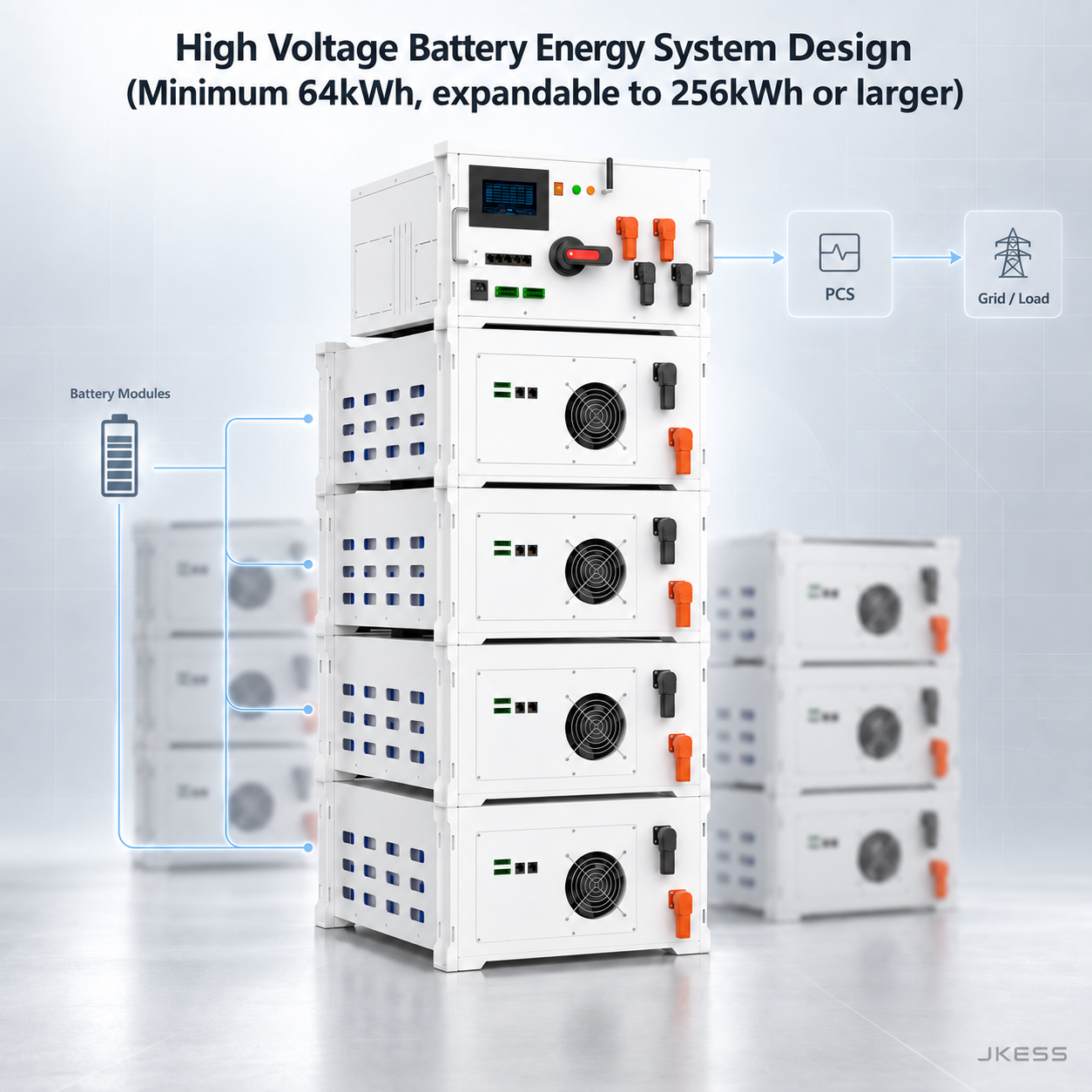
- Derive the architecture from demand: establish PCS power, then the slave battery box count (4–16 units), and finally the 64–256 kWh capacity class described in this article.
- Adding battery capacity does not always solve the problem—the bottleneck may be discharge power, not stored energy.
01 / Start with the operating objective
The Wrong First Question
In the early quotation stage of a commercial and industrial (C&I) battery energy storage system (BESS) project, buyers often ask: "How many kWh of storage do I need?" It sounds reasonable, but it cannot be answered properly until a more fundamental question is resolved: "What operational problem must this system solve?"
Reducing demand charges, increasing solar self-consumption, providing backup power and participating in demand response each place different demands on system power and energy. A peak shaving system and a backup power system can have the same total capacity yet require very different power conversion system (PCS) ratings, discharge durations and cycling strategies.
Skipping load analysis and going straight to equipment quotations is a common early-stage mistake in C&I storage projects. It can lead to excess capacity that reduces investment returns, or insufficient discharge power that leaves demand peaks largely unchanged.
Define the operational problem first. Size the hardware second.
02 / Establish the design basis
The 5-Step Load Analysis Workflow
The following workflow establishes the design basis before equipment selection. The output from each step directly constrains the system configuration that follows.
| Step | What You Do | Data Required | Output That Constrains System Design |
|---|---|---|---|
| STEP 01Define the Operational Problem | Identify the specific objective: peak shaving, solar self-consumption, backup power or demand response. | Utility bill structure, outage frequency, solar generation profiles and production shifts. | Operating mode: daily cycling, standby backup or a hybrid strategy. |
| STEP 02Extract 15-Minute Interval Load Data | Export at least 12 months of 15-minute interval load data from the meter or supervisory control and data acquisition (SCADA) system. | 15-min kW interval data and the corresponding tariff periods. | The timing and duration of demand peaks. |
| STEP 03Identify Peak Events & Duration | Measure peak-event frequency, average duration and peak power level. | Peak kW, duration in minutes and event frequency. | Minimum PCS power requirement (kW) and minimum discharge duration (min). |
| STEP 04Calculate Energy vs Power Requirement | Convert the peak reduction target into separate energy (kWh) and power (kW) requirements. | Target kW reduction, target duration and cycle-efficiency assumptions. | Whether energy, power or both constrain the system. |
| STEP 05Size the Battery Architecture | Use the power and energy requirements to select the master control box and slave battery box count. | PCS power, system capacity and operating voltage range. | Slave box count (4–16 units) and system capacity class (64–256 kWh), subject to configuration approval. |
On smaller screens, scroll the table horizontally to read every column.
This workflow applies to behind-the-meter C&I projects. Front-of-meter and grid-scale projects follow a different process.
03 / Separate kWh from kW
Energy Bottleneck vs Power Bottleneck: Which One Limits Your System?
Long-duration energy requirement
Energy-Limited
- Typical symptom
- Demand peaks last a long time—over 2 hours in this illustrative comparison.
- Requirement
- The peak shaving target requires a substantial amount of energy in kWh.
- Design direction
- Increase the slave battery box count through a confirmed series or parallel expansion design.
- Typical applications
- Solar self-consumption and long-duration peak shaving.
- Illustrative configuration
- 1 master + 8–16 slave boxes
128–256 kWh capacity class
Key insight: Prioritize battery capacity expansion while checking the complete voltage and power envelope.
Short-duration power requirement
Power-Limited
- Typical symptom
- Demand peaks are brief but intense—under 30 minutes in this illustrative comparison.
- Requirement
- High discharge power is needed, but the total energy requirement is relatively small.
- Design direction
- Evaluate a higher-current master control box (100 A vs 200 A), together with battery voltage and PCS capability.
- Typical applications
- Demand charge reduction and short-duration backup power.
- Illustrative configuration
- 1 master + 4–6 slave boxes + 200 A master
64–96 kWh capacity class
Key insight: Current rating matters, but usable discharge power must be checked from voltage, current and PCS limits together.
The durations and configurations above are illustrative patterns, not validated selection thresholds. Check both power and energy for the actual project.
Before purchasing, identify the actual constraint. A 200 A master with 4 slave boxes (approximately 64 kWh) is not automatically more suitable for high-power peak shaving than a 100 A master with 16 boxes (approximately 256 kWh). More current does not necessarily mean more power when the system voltage is different.
04 / Work through the numbers
From Load Data to System Configuration: A Worked Example
The following simulated mid-sized factory illustrates how a load profile becomes a sizing requirement. The input values come from the supplied article brief; they are not measured results from a customer installation.
| Parameter | Value | Source / Basis |
|---|---|---|
| Annual electricity consumption | 2,400,000 kWh | Utility bills |
| Maximum demand peak | 850 kW | 15-minute interval data |
| Average peak duration | 45 minutes | 15-minute interval data |
| Peak event frequency | 18–22 per month | 12-month data analysis |
| Target power reduction | 300 kW | Owner's target |
| Target reduction duration | 45 minutes | Matched to peak duration |
| Required discharge energy | 225 kWh | 300 kW × 0.75 h |
| System round-trip efficiency | 90% | Reference assumption in the brief |
| Illustrative nominal-capacity estimate | ≈250 kWh | 225 ÷ 0.9; assumption requires review |
Source-brief arithmetic / preliminary allowance
300 kW × 0.75 h ÷ 0.9 = 250 kWh
The 300 kW × 0.75 h term establishes a 225 kWh discharge-energy target. Applying the brief's 90% factor gives 250 kWh, but does not validate the capacity assumption or prove that the proposed hardware can deliver 300 kW.
Configuration derivation
- Power requirement: Delivering 300 kW requires a PCS rated for at least that output, and a battery-side continuous current capability consistent with 300 kW ÷ operating system voltage.
- Energy arithmetic: Approximately 16 slave boxes match the source brief's 250 kWh estimate under its cell assumptions: 16 × 16S × 3.2 V × 314 Ah ≈ 257 kWh. This is nominal energy, not a verified usable-energy result.
- Nominal voltage: Sixteen boxes in series give 256S × 3.2 V ≈ 819.2 V. That nominal value lies within the brief's stated 80–1000 V range; this does not establish compatibility across the full operating voltage window.
- Design conclusion: The nominal-energy arithmetic is close to the preliminary target, but the proposed 200 A single-string configuration fails the 300 kW power check. The example cannot be classified as simply energy-limited or released as a complete configuration without redesign and review.
05 / Avoid expensive assumptions
5 Sizing Mistakes That Kill Project IRR
Internal rate of return (IRR) depends on matching the investment to the operating problem. Avoid these five shortcuts before requesting a final system quotation.
1. Estimating system capacity from annual electricity consumption
Annual electricity consumption is a total energy figure, while peak shaving responds to 15-minute demand events. Using annual kWh as a capacity shortcut can substantially overestimate the requirement and lead to overinvestment.
2. Ignoring peak duration
An 850 kW peak lasting 15 minutes and the same peak lasting 2 hours imply an eightfold difference in energy when the same reduction target is applied throughout. Without duration analysis, the slave battery box count cannot be determined correctly.
3. Confusing PCS power with battery capacity
The PCS rating is a power constraint; battery capacity helps determine how long that power can be sustained. Design them separately, and confirm that the battery's voltage and current limits support the PCS rating. One number cannot describe both kW and kWh.
4. Underestimating the long-term impact of cell imbalance
Cell-to-cell imbalance can reduce usable battery capacity over time. Consider the battery management system's (BMS) balancing capability rather than assuming that the original nominal capacity will always remain available.
Evidence note: The source brief cites 10–15% less usable capacity by year 5 without adequate balancing. No supporting test report or operating conditions were supplied; this percentage is not presented as a verified JKESS performance figure or a design guarantee.
5. Working backward from equipment to load requirements
Selecting a supplier's equipment first, then trying to “match” the load to its specifications, reverses the design logic. The correct sequence is load analysis → power and energy requirements → system configuration.
06 / Gather the right inputs
Where to Get the Data You Need
| Data Type | How to Obtain It | What to Watch |
|---|---|---|
| 15-minute interval load data | Meter exports, SCADA systems or the utility's customer portal. | Use at least 12 months of data to cover seasonal variation. |
| Demand charge structure | Utility bills and the utility's published tariff schedule. | Check the demand billing window and whether the charge is assessed monthly, daily or in real time. |
| Solar generation profile | Inverter monitoring platforms and irradiance data. | Overlay generation and load profiles when evaluating solar-coupled storage. |
| Outage frequency and duration | Utility reliability reports and the facility's internal outage records. | Use these records to assess the value of backup power. |
07 / Practical sizing questions
Frequently Asked Questions
01Why can't I size a battery system based on my annual electricity consumption?
Annual consumption is a total energy figure (kWh), but a BESS responds to short-duration power events (kW peaks). A facility with the same annual consumption can have very different peak profiles depending on shift patterns, equipment startup sequences, and HVAC loads. Sizing from annual kWh typically overestimates required capacity and reduces project IRR.
02How much historical load data do I need for proper BESS sizing?
At minimum, 12 months of 15-minute interval data. This captures seasonal variations in both energy consumption and demand peaks. For facilities with significant process changes, such as new production lines or facility expansions, consider 24 months of data. Monthly utility bills are insufficient because they aggregate away the 15-minute peak events that the BESS is designed to address.
03What is the difference between energy-limited and power-limited BESS projects?
An energy-limited project needs a large total kWh capacity because the peak events are long-duration, typically over 2 hours in the illustrative comparison above. A power-limited project needs high kW output but relatively small total energy because peaks are short but intense. Energy-limited projects prioritize expandable battery capacity; power-limited projects prioritize sufficient PCS power and battery-side voltage and current capability. Event duration is an indicator, not a stand-alone classification rule: verify both kW and kWh.
04How do I determine the required PCS power rating for my C&I BESS?
The PCS power rating must be at least equal to the target peak shaving power (kW). If the goal is to reduce an 850 kW peak by 300 kW, the PCS must deliver at least 300 kW continuously during the peak event. The battery system's voltage range and maximum current must support that power level across the full operating SOC window.
05Can I start with a small BESS and expand later?
Yes, if the system architecture supports modular expansion. The supplied JKESS configuration brief describes starting with 4 slave battery boxes (approximately 64 kWh) and expanding to 16 boxes (approximately 256 kWh) in a daisy-chain communication topology without replacing the master control box. Treat that expansion path as a configuration claim to confirm against the approved product documentation, selected cells and PCS voltage range. Do not assume every intermediate box count or series/parallel arrangement is approved.
06What happens if I oversize the battery system?
Oversizing increases upfront capital cost without proportional revenue benefit. For peak shaving projects, a battery that is 2× larger than needed will rarely discharge to full depth, meaning the same demand charge reduction is achieved with double the investment. Oversizing also increases O&M complexity and may trigger additional fire safety or space requirements.
07How does cell balancing affect the accuracy of my sizing calculation?
Cell-to-cell imbalance reduces the usable capacity of the battery pack over time. The source brief cites a possible 10–15% reduction within 5 years, but provides no test data or operating conditions to substantiate that figure. Active balancing, such as the specified 2 A balancing capability, is a design consideration for maintaining cell consistency. Do not use the unverified percentage as a guaranteed degradation rate or as a validated sizing allowance.
08What role does round-trip efficiency play in BESS sizing?
The supplied example applies a 90% round-trip efficiency (RTE) factor to a 225 kWh discharge-energy target, yielding approximately 250 kWh. That arithmetic reproduces the brief; it does not establish a validated nominal-capacity requirement. The supplied RTE value is not identified as discharge-only efficiency, and no usable SOC window or end-of-life allowance is provided. Confirm these assumptions at the expected C-rate, temperature and SOC range before sizing.
09How do I validate my load analysis before committing to a full system?
The modular pilot described in this article starts with one master control box and four slave boxes, approximately 64 kWh. Use the WiFi or cloud monitoring option to compare measured operation with the load analysis over 3–6 months. A pilot validates only the power and energy it can actually deliver; it cannot demonstrate the full 300 kW target unless its hardware supports that level. Confirm the approved expansion plan before scaling.
10Does JKESS provide system design support for C&I projects?
JKESS provides modular HV BESS hardware; the supplied configuration brief lists master control boxes HV-BC250 (200 A) and HV-BC150-100A (100 A), plus HV-B6U slave battery box kits with 16S per box and 2 A active balancing. It describes 4–16 slave boxes, CAN/RS485 interfaces, daisy-chain communication and a WiFi monitoring option, with final model specifications and PCS integration to be confirmed for the project. JKESS does not sell cells; buyers source LiFePO4 cells separately so the system can be configured around their cell specifications and load requirements. Share the load profile with the JKESS engineering team to review the proposed configuration.
Not Sure If Your Project Is Energy-Limited or Power-Limited?
Share your load profile with our engineering team. We'll help you map peak events to a modular BESS configuration—starting from an approximately 64 kWh pilot and scaling as your data validates, subject to confirmed power capability and an approved expansion plan.
Request a Custom Quote→