
 EN
JKESS / Tekniske indsigter
Få et tilbud→Hvorfor din energilagringsside ikke bliver citeret af ChatGPT: En GEO-tjekliste til B2B-lagringstillverkere
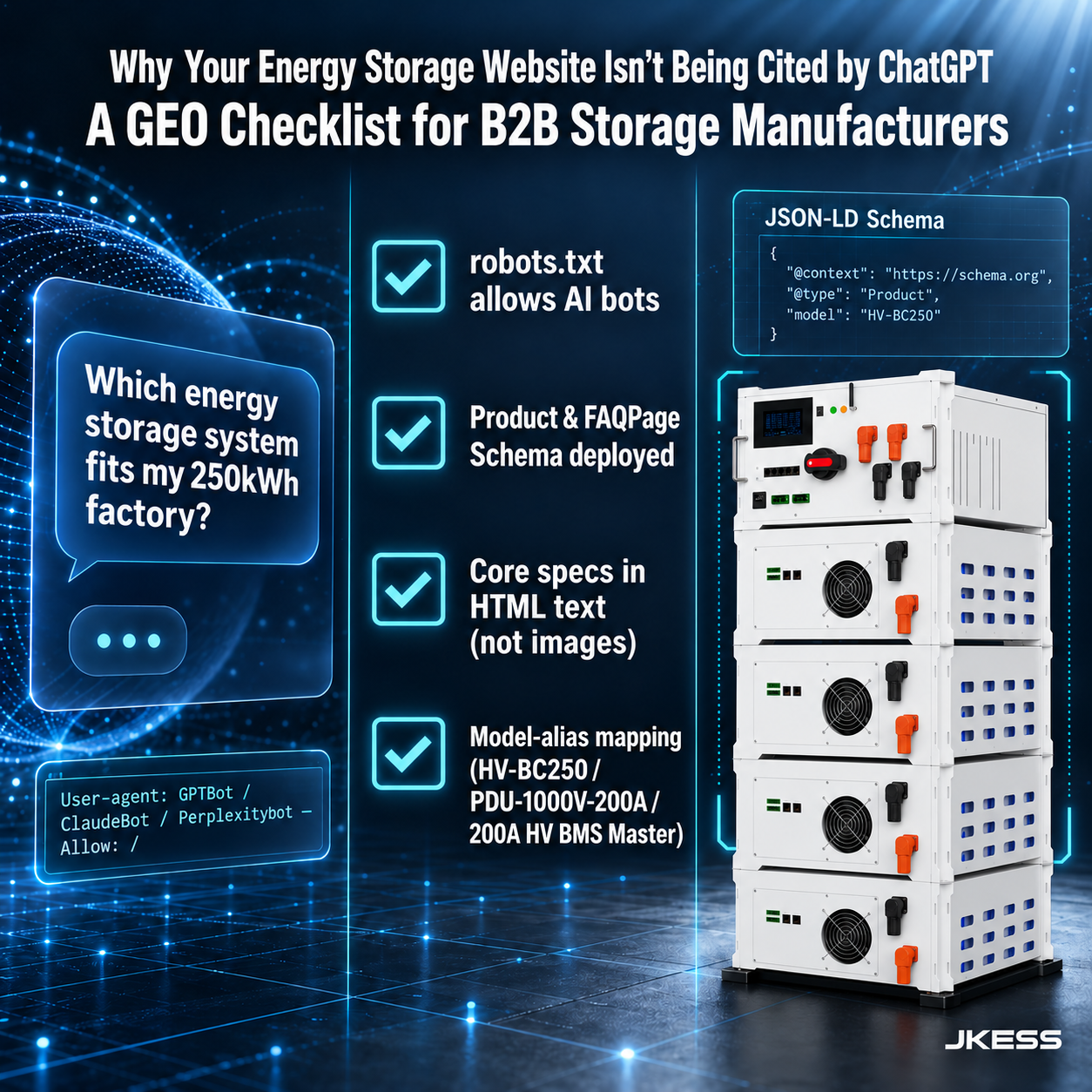
Din køber kan spørge ChatGPT, før han sammenligner leverandørens hjemmesider. Hvis dine produktspecifikationer kun findes i billeder, din side blokerer for søgemaskinekræbere, eller dine modelnumre er inkonsistente, kan din information mangle i svaret.
Nøglepunkter
- Indkøbsprocessen omfatter nu AI-understøttet research. En køber kan spørge: «Hvilket system opfylder mine krav til en 250 kWh-fabrik?», før han åbner enkelte leverandørsider.
- Gør dine fakta nemme at hente og verificere. Udgiv tekniske specifikationer som synlig HTML-tekst med enheder, driftsbetingelser, kilder og tydelige produktidentiteter.
- Tjek syv AI-synligheds-kontrolpunkter: crawleradgang, passende Schema, faktatæthed, konsistens i model-alias, HTML-specifikationer, spørgsmål-og-svar-struktur samt en valgfri llms.txt-vejledning. Disse omfatter praktiske adgangs- og indholdsrisici; de er ikke syv obligatoriske rangeringskrav.
- Et produkt kræver én konsekvent identitet. Juster navne som HV-BC250, en intern PDU-identifikator, og «200A HV BMS Master» kun, efter at det er bekræftet, at de henviser til samme revision.
- GEO er en løbende indholdshåndtering. Bevar beviserne, overvåg citater og ret upræcise svar. Ingen tjekliste kan garantere forrangsplacering i ChatGPT, Perplexity eller Google AI-overblik.
01 / Køberrejsen
B2B-indkøbsfunnelen er allerede ændret
Den kendte indkøbsrejse starter med en søgning, fortsætter på flere leverandørers hjemmesider og slutter med en kortliste eller en forespørgselsformular. KI-assistenter introducerer et andet adgangspunkt: En køber kan stille spørgsmål om en teknisk forklaring eller sammenligning, inden han besøger en producents hjemmeside. Det gør kvaliteten af den information, der er tilgængelig uden for din forsideside, i stigende grad relevant.
Overvej de spørgsmål, som en lagerintegrator eller EPC-entreprenør måske stiller: «Hvilket højspændings-BESS understøtter 4–16 slave-batteribokse?» «Hvad er de tekniske parametre for et 2A aktivt balancerings-BMS?» «Hvad ændrer sig i en C&I-lagerdesign for et svagt net?» Dette er eksempler på køberens intention, ikke målte antagelsesstatistikker. Hver enkelt kræver et præcist svar, der skelner mellem en komponentvurdering og en komplet-systemfunktion.
Hvis de relevante fakta er svære at få adgang til eller modstridende, kan et genereret svar udelade dit produkt eller beskrive det forkert. Den praktiske løsning er at publicere et klart, tilskriveligt svar på en pålidelig side. AI-genererede svar kræver stadig verifikation, og synlighed i dem supplerer de etablerede søge-, distributions- og direktesalgskanaler.
02 / Søgning og citater
Traditionel SEO versus GEO: Hvad ændrer sig faktisk?
De to discipliner overlapper hinanden. Denne sammenligning beskriver deres primære fokusområder; nyttigt indhold, teknisk adgang og troværdig dokumentation er vigtige for begge.
| Traditionel SEO | GEO (Generative Engine Optimization) |
|---|---|
| Mål Opnå visibilitet i relevante søgeresultater. | Mål Bliv en nyttig, citeret kilde i AI-genererede svar. |
| Optimeringsfokus Søgehensigt, relevant indhold, links og teknisk kvalitet. | Optimeringsfokus Genvindelige fakta, beviser, klare entiteter og passende strukturerede data. |
| Køberadfærd Gennemse resultater og besøg leverandørspages. | Køberadfærd Læs et svar, stil opfølgende spørgsmål og undersøg understøttende links. |
| Indholdssformat Brugbare produkt- og redaktionelle sider, der er afstemt med søgeintentionen. | Indholdssformat Svar-først-afsnit, verificerbare værdier, betingelser og eksplicitte udelukkelser. |
| Crawleradgang Googlebot, Bingbot og den relevante indekseringsinfrastruktur. | Crawleradgang OAI-SearchBot, PerplexityBot, Claude-SearchBot og Googlebot til Googles søge-AI-funktioner. |
| Strukturerede data Beskriv kvalificeret sideindhold og understøt anvendelige søgefunktioner. | Strukturerede data Præcisér egenskaber og relationer, hvor de bruges; er ikke en universel forudsætning for henvisning. |
| Konkurrence Synlighed og relevans på hele søgeresultatsiden. | Konkurrence Om svaret vælger, tilskriver og præcist repræsenterer din bevidsthed. |
| Billeder Brugbare visuelle elementer understøttet af beskrivende tekst og passende alt-attributter. | Billeder Gentag kritiske specifikationer i HTML; evnen til at læse billeder varierer mellem tjenester. |
| Mærke- og modelnavne Genkendelige navne på titler, sider og links. | Mærke- og modelnavne Konsekvente primære identifikatorer, verificerede alias og revisiongrænser. |
| Måling Indtryk, placeringer, klik og kvalificerede konverteringer. | Måling URL-henvisninger, præcise mærkenavne, henvisninger og kvalificerede forespørgsler. |
| SEO hjælper købere med at finde dig. | GEO hjælper din dokumentation med at blive en del af svaret. |
03 / Den fungerende tjekliste
7-punkts GEO-tjekliste til B2B-lagringswebsites
-
Gennemgå robots.txt og tillad de ønskede søgecrawler.
Adskil søgeadgang fra præferencer for modeltræning. OpenAI identificerer OAI-SearchBot som sin søgecrawler og GPTBot som en træningscrawler. PerplexityBot understøtter Perplexity-søgning; Claude-SearchBot understøtter Claude-søgning, mens ClaudeBot vedrører modeludvikling. Googlebot styrer crawling til Google Søgning, herunder dens AI-funktioner; Google-Extended er en separat kontrol til andre formål.
Tjek eksisterende user-agent-grupper, wildcard-regler, sti-begrænsninger samt CDN- eller firewall-indstillinger. I henhold til standard robots.txt-opførsel betyder fraværet af en eksplicit
Allowikke automatisk, at adgang nægtes. En eksplicit gruppe kan gøre den tilsigtede politik tydeligere.# Example for a public marketing website.# Merge with the existing policy; preserve intentional path restrictions.User-agent: OAI-SearchBotAllow: /User-agent: PerplexityBotAllow: /User-agent: Claude-SearchBotAllow: /User-agent: GooglebotAllow: /Indstil GPTBot-, ClaudeBot- og Google-Extended-politikkerne separat i henhold til den tilsigtede indholdsbrug. Valider de endelige flettede regler og de faktiske crawler-anmodninger.
Referencer: OpenAI-crawlerdokumentation ,Perplexity-crawlers ,Anthropic-crawlerdokumentation og Google-crawlerkontrol .
-
Implementér Schema, der præcist beskriver den synlige side
Brug strukturerede data til at gøre identifikatorer og egenskaber eksplicitte. Schema skal beskrive den side, som en besøgende rent faktisk ser, uden at tilføje uunderstøttede påstande eller blande forskellige produktvarianter.
- Produkt + additionalProperty: modelspecifikke parametre, enheder og dokumenterede egenskaber.
- FAQPage: ægte, synlige spørgsmål med deres tilsvarende svar.
- Sådan gør du: en faktisk installations- eller idriftsættelsesvejledning med komplette trin og omfang.
- Artikel: redaktionel overskrift, forfatter, udgivelsesdato og kanonisk side.
- Organisation: virksomhedens konsekvente navn, URL og verificeret kontaktinformation.
Valider JSON-syntaks og feltbetydning, og sammenlign derefter hver markeret udtalelse med den gengivne side. En blog, der diskuterer flere produkter, er ikke automatisk en produktdetailside.
Kvalifikation er ikke en forpligtelse. Google oplyser, at dets AI-søgefunktioner ikke kræver særlig Schema eller AI-specifikke filer. Schema.org-gyldighed, platformunderstøttelse og faktisk inklusion er separate spørgsmål.
Referencer: Schema.org additionalProperty ,FAQPage og Googles vejledning til AI-funktioner .
-
Øg tætheden af nyttige fakta
Erstat uunderstøttede adjektiver med en påstand, som en køber kan verificere. Præsenter konklusionen først, hold hvert afsnit fokuseret, og angiv modellen, enheden, driftsbetingelserne og kilden, der er nødvendig for at fortolke værdien.
Før / Promotional "JKESS leverer brancheførende aktiv balancerings-teknologi med fremragende ydeevne."Efter / Specifik og tilskrivelig "JKESS’ tekniske dokumentation beskriver BMU-H5-16 med 2 A aktiv balancering, ±0,005 V præcision ved måling af celle-spænding, otte NTC-temperatursensorer og understøttelse af 16S LiFePO4. Bekræft disse værdier mod den præcise revision, der leveres."Kombiner ikke værdier fra modstridende dokumenter til en ny specifikation. Hvis en produktside og et datablad er uenige, løses uoverensstemmelsen i samarbejde med produktansvarlig, og begge kilder opdateres, inden én af dem betragtes som afgørende.
Eksempel på kilde: JKESS’ tekniske diskussion af BMU-H5-16 . Offentlige sider kan indeholde revisionsforskelle; et aktuelt godkendt datablad forbliver referencen for offentliggørelse.
-
Opret et verificeret model-til-alias-kort
Giv hvert produkt ét primært navn og én kanonisk produktside. Vedligehold en registrering, der forbinder markedsføringsnavnet, teknisk identifikator, produktrevision og eventuelle regionale navnevarianter.
Det leverede navnegivningseksempel er HV-BC250 / PDU-1000V-200A-A001-NY / 200A HV BMS Master Box . Dette er en aliasrelation, der skal verificeres, ikke et bevis for, at identifikatorerne er udskiftelige. Hvis teknikken bekræfter overensstemmelsen, skrives: «HV-BC250, også kendt som PDU-1000V-200A-A001-NY, er 200A HV BMS Master Box.»
Brug det primære navn i titlen og H1; placer bekræftede alias i indledende afsætning og i relevante produktfelter såsom
alternateNameellermpn. Bevær en separat identitet, når en revision ændrer ydelser, grænseflader eller leveringsomfang. -
Placer kerne-specifikationer i synlig HTML
Skriv de centrale værdier direkte ind på siden. Spænding, strøm, nøjagtighed, dimensioner, testbetingelser og leveringsomfang skal forblive tilgængelige som almindelig tekst og semantik
cells.
Image extraction and JavaScript rendering differ between crawlers and retrieval tools. Text inside a photograph, iframe, or canvas is therefore an unreliable sole source for a critical parameter. Alt text helps describe an image, but it does not replace a visible specification table.
Publish a dated datasheet alongside the HTML table. Distinguish nominal voltage from the operating envelope, continuous current from peak current, and empty-kit weight from the weight of an assembled module.
Answer real buyer questions directly
Build a useful set of questions around the buying decision: “How many slave boxes can one master box support?” “Does the kit include battery cells?” “Which communication protocols are provided?” Answer first, then give the limits and source.
Five to ten FAQs can be a practical editorial target when the topic warrants them; there is no universal minimum. Native
When adding FAQPage markup, use the same question and answer wording as the visible page. Do not add invisible FAQ claims just to target search queries. This article includes ten visible FAQs and marks up five of them.
Consider an optional llms.txt reading guide
llms.txtis a proposed Markdown convention for guiding agents to useful website content. A concise guide can list the company, core products, application pages, and maintained technical documents. It is useful only to consumers that choose to read it.# JKESS Electronic Technology BMS and active balancing solutions for energy storage.## Core Products- [HV-BC250 200A Master Box](https://www.jkess.com/200a-hv-bms-master)- [HV-B6U Slave Battery Box Kits](https://www.jkess.com/hv-slave-6u-kits)- [261kWh Liquid-Cooled BESS Kits](https://www.jkess.com/commercial--industrial-energy-storage-system-kits)## Application Guides- [Modular HV Energy Storage Kits](https://www.jkess.com/home-energy-storage-system-kits)## Technical DocumentsUse the current specifications and scope-of-supply notes on the product pages.Add approved, versioned datasheet links when those documents are published.Illustrative content, not a report of the live site’s configuration. Use verified links and clean Markdown versions where available. Maintaining this file does not deploy robots.txt rules or create search eligibility.
References: the llms.txt proposal and Google’s generative AI optimization guidance. Google Search does not use llms.txt as a special visibility or ranking input.
04 / Content in practice
Before and After: Rewriting a Storage Product Page for AI Citation
The following five examples replace broad promotion with a more useful answer. Numerical illustrations include their assumptions; commercial and certification statements require current, model-specific evidence.
Illustrative rewrites. Calculations are not measured performance guarantees. Before / Marketing copy After / Evidence-led copy “Our advanced active balancing BMS delivers superior performance and extends battery life.” “For an illustrative 314Ah cell with a 0.5% charge difference, ΔQ = 314 × 0.005 = 1.57Ah. At a constant 2A transfer current, the idealized duration is 1.57 ÷ 2 = 0.785 hours, or about 47 minutes. Real duration depends on current limits, control behavior, and losses.” “The system supports a wide voltage range for various applications.” “The HV-BC250 listing specifies an 80–1000V DC master range. A 4–16 slave-box configuration is described as approximately 64–256kWh when each box is approximately 16kWh. With 16 cells per box and 3.2V nominal per cell, 16 boxes yield 256S / 819.2V nominal. Verify the full charge/discharge range and selected cell capacity.” “Our battery boxes are designed for easy installation.” “Define the scope as one master plus five slave boxes: six enclosures in total. State empty-kit and assembled-module weights separately, together with the lifting and installation plan. A claimed 28.55kg kit weight or two-technician, 2–3 day schedule requires a matching product record and a defined site scope.” “We provide reliable products with international certifications.” “List the exact model and revision, applicable CE declaration, RoHS documentation, FCC evidence, and test-report identifiers. If citing GB34131-2017 or insulation resistance ≥1 MΩ at 1,000 VDC, verify the applicable standard edition, test method, and report scope rather than extending a component claim to the whole system.” “Contact us for more information.” “Send your required capacity, DC range, current, communication protocol, scope of supply, quantity, and delivery location to [email protected]. Request confirmation of available regional stock and a written dispatch estimate for that configuration.” Product references: HV-BC250 and modular storage kits. The 64–256kWh shorthand is configuration-dependent; a hardware kit without cells does not itself contain that stored energy.
05 / Access and extraction
Technical Access: Can AI Crawlers Actually Read Your Website?
Check 1 / robots.txt and access controls
Open
https://yourdomain.com/robots.txtand evaluate the user-agent group and path rules that apply to each intended crawler. Inspect firewall challenges, blocked IP ranges, redirects, and server errors as well.Absence of an explicit Allow is not a failure by itself. Use the actual response and verified crawler logs to determine what is accessible.
Check 2 / Core content in HTML
Disable JavaScript and reload the product page. Check the original HTML response for the model name, specification table, scope of supply, and answers.
If they disappear, the page depends on rendering that some tools may not perform. Prefer server-rendered or static core content, and use a search engine’s inspection tools where available. Also check
noindex, snippet restrictions, andX-Robots-Tagheaders.Check 3 / Descriptive alt text
Describe informative product photographs, diagrams, and screenshots with suitable alt text. Keep purely decorative images from adding noise.
Repeat important values in the visible body or a real HTML table. A long alt attribute is not a substitute for a readable technical specification.
Check 4 / Reliable loading and delivery
Confirm that the canonical page returns a successful response and delivers useful content promptly. Reduce unnecessary third-party scripts, oversized payloads, and client-side dependencies.
Timeouts, errors, and rendering limits can interfere with retrieval. A model’s context budget is a separate issue from network performance; there is no universal “AI loading time” threshold.
Check 5 / Canonical URLs and model identity
Identify duplicate URLs for the same item and use a consistent canonical URL, internal links, and sitemap entries. For example, reconcile two product paths that describe the same HV-BC250 revision.
A canonical URL signals a preferred page; it does not by itself resolve conflicting specifications or prove that two product names are equivalent.
Access references: robots.txt interpretation and the crawler documentation linked in checkpoint 1.
06 / Evidence of progress
How to Measure Whether GEO Is Working
Pair answer-level observations with business outcomes. Metric Traditional SEO measure GEO measure Visibility Search impressions and keyword positions. Share of sampled AI answers citing an owned URL; track brand mentions separately. Traffic Organic search clicks and visits. Identifiable AI referrals; brand-search changes as supporting, non-causal evidence. Content Engagement and landing-page performance. Which facts and pages are cited, and whether values and limitations are correct. Conversion Forms, qualified leads, and sales. Qualified inquiries with an AI discovery source or attributable referral. Competition Relative search visibility. Citation share and co-mentions within the same fixed question set. Audit Indexability, search-intent coverage, and page quality. Entity consistency, evidence freshness, extractable facts, and markup accuracy. A practical weekly baseline: run ten fixed buyer questions in ChatGPT search, Perplexity, and Google AI Overviews where an overview appears. Repeat the sample and log platform, date, locale, model or mode, exact question, cited URL, brand mention, and answer accuracy.
Citation rate = answers linking to your domain ÷ eligible sampled answers. Report the sample size and the number of queries without an AI answer. A brand mention without a source link is not a citation. Use a separate measure for citations to this specific article.
For example, six cited answers out of 30 eligible observations produce a 20% sample citation rate. This is an illustrative calculation, not a JKESS result. Keep the question set stable when comparing periods, and avoid treating a single answer or a small change as proof that one edit caused an improvement.
07 / Applying the method
How JKESS Applies GEO to Its Own Product Pages
The reviewed JKESS master-box and 261kWh application pages expose technical information in readable tables. That is a useful starting point. The following seven practices form an implementation and maintenance checklist, rather than a claim that every page has already passed a site-wide audit.
- Maintain structured specification tables. Keep each voltage, current, accuracy, dimension, and weight value in visible HTML, tied to a model, revision, and source. Separate component ratings from complete-system limits.
- Keep FAQs useful and consistent. Write five to ten relevant answers when justified by the product; align any FAQPage markup with the exact visible wording and recheck answers after product changes.
- Use model-specific Product markup. Validate Product and additionalProperty on the appropriate HV-BC250, HV-B6U, and 261kWh pages. Record evidence of the deployed markup rather than assuming site-wide coverage.
- Control aliases. Confirm any relationship between HV-BC250 and PDU-1000V-200A-A001-NY, then use one primary name with the approved aliases. Keep HV-BC150-100A as a distinct product identity.
- Reconcile quantitative claims. Check the 2A active balancing and ±0.005V sampling values against the supplied BMU revision. Keep the 4–16 slave-box and 64–256kWh statements linked to their cell and configuration assumptions.
- Maintain an optional llms.txt guide. If deployed, list current canonical product and documentation URLs, remove stale links, and treat it as documentation support rather than an indexing requirement.
- Verify search access. Review the live robots.txt policy and crawler delivery logs. Confirm intended access for search bots while managing training-related controls independently.
JKESS product and specification anchors
HV-BC250 · 200A HV BMS Master · HV-BC150-100A · 100A master configuration · HV-B6U · 6U slave battery box kits · BMU-H5-16 · technical reference · 261kWh liquid-cooled system
Values to keep in context: 2A active balancing · ±0.005V sampling accuracy · 4–16 slave battery boxes · approximately 64–256kWh · 80–1000V DC master range. These refer to different components or configurations, not a single universal specification. Kits are offered without battery cells; confirm the final scope of supply.
08 / Questions buyers ask
Frequently Asked Questions
What is GEO and how does it differ from traditional SEO?
GEO (Generative Engine Optimization) is the practice of making useful content easier to retrieve, understand, and cite in AI-generated answers. Traditional SEO emphasizes visibility in search results, while GEO also tracks how accurately a brand and its facts appear in generated responses. Both benefit from accessible pages, clear product identities, and reliable evidence; neither guarantees inclusion.
Why is my energy storage website not being cited by ChatGPT?
Possible causes include blocked search crawlers, unindexed pages, specifications that are difficult to extract, inconsistent model names, or weak evidence for the question being asked. For ChatGPT search, review OAI-SearchBot access rather than assuming GPTBot controls search visibility. Missing Schema or llms.txt alone does not prove why a page was omitted; compare crawl evidence, content relevance, and repeated query results.
What is llms.txt and why does it matter for B2B storage websites?
llms.txt is a proposed Markdown-based guide to a website’s useful content, which can point agents to product documentation and application guides. It can help tools that choose to use it, but adoption and behavior differ between services. Treat it as optional documentation infrastructure, not a requirement for AI citation or a replacement for HTML pages and sitemaps.
How do I check if AI crawlers can access my website?
Inspect the robots.txt groups and path rules that apply to OAI-SearchBot, PerplexityBot, Claude-SearchBot, and Googlebot, then review server and firewall logs. A missing explicit Allow rule does not by itself mean access is denied. Also check HTTP responses, indexing and snippet controls, and whether product specifications are available without JavaScript; a browser-only test does not confirm a crawler’s actual access.
What Schema markup should a B2B storage website prioritize?
Use Product with additionalProperty on product pages, Article on editorial pages, and Organization for the company identity. FAQPage can describe visible questions and answers, and HowTo can describe a genuine procedural guide. Keep markup aligned with the visible content and applicable platform documentation; valid Schema does not guarantee a rich result or an AI citation.
How does inconsistent product naming affect AI visibility?
Different names for the same item can make it harder for readers and retrieval systems to connect the information. Select one primary model name and record verified aliases, product revisions, and one canonical URL. Publish an “also known as” relationship only after the model owner confirms that the labels identify the same product and configuration.
What is fact density and why does it matter for GEO?
Fact density is an editorial measure of how much useful, verifiable information a passage contains relative to general promotional language. A model-specific value with units, operating conditions, and a dated source is more useful than an unsupported adjective. Values such as 2A active balancing, ±0.005V sampling accuracy, and an 80–1000V DC range must stay attached to the correct component; fact density is not a published universal AI ranking score.
How do I measure GEO performance for my storage website?
Run a fixed set of buyer questions repeatedly and log the date, platform, search mode, locale, cited URLs, and answer accuracy. Report URL citation rate separately from unlinked brand mentions, and track identifiable referral visits and qualified inquiries. Results fluctuate, so a small weekly sample is directional evidence rather than a complete view of all buyers or proof of causation.
Does GEO replace traditional SEO for B2B storage manufacturers?
No. Search indexing, useful content, internal links, and a dependable website remain relevant to both conventional search and AI-assisted research. GEO adds attention to answer-level representation, traceable facts, and citation measurement. An effective program maintains those foundations while checking whether buyers receive accurate product information.
How does JKESS apply GEO principles to its own product pages?
The JKESS pages reviewed for this article provide examples of HTML specifications and question-and-answer content for products including the HV-BC250 and the 261kWh liquid-cooled system. The seven-part workflow below extends that approach to the HV-BC150-100A, HV-B6U, and BMU-H5-16 through consistent naming, source review, and structured content. This article does not certify site-wide Schema coverage, crawler settings, or an existing llms.txt deployment; those require a current implementation audit.
Want to Audit Your Storage Website’s AI Visibility?
Share your website URL with our team. We’ll review your robots.txt, Schema markup, fact density, and entity consistency — and help identify where crawlers or readers may be missing your product information.
Request a Custom Quote→