
 EN
JKESS / ข้อมูลเชิงลึกด้านวิศวกรรม
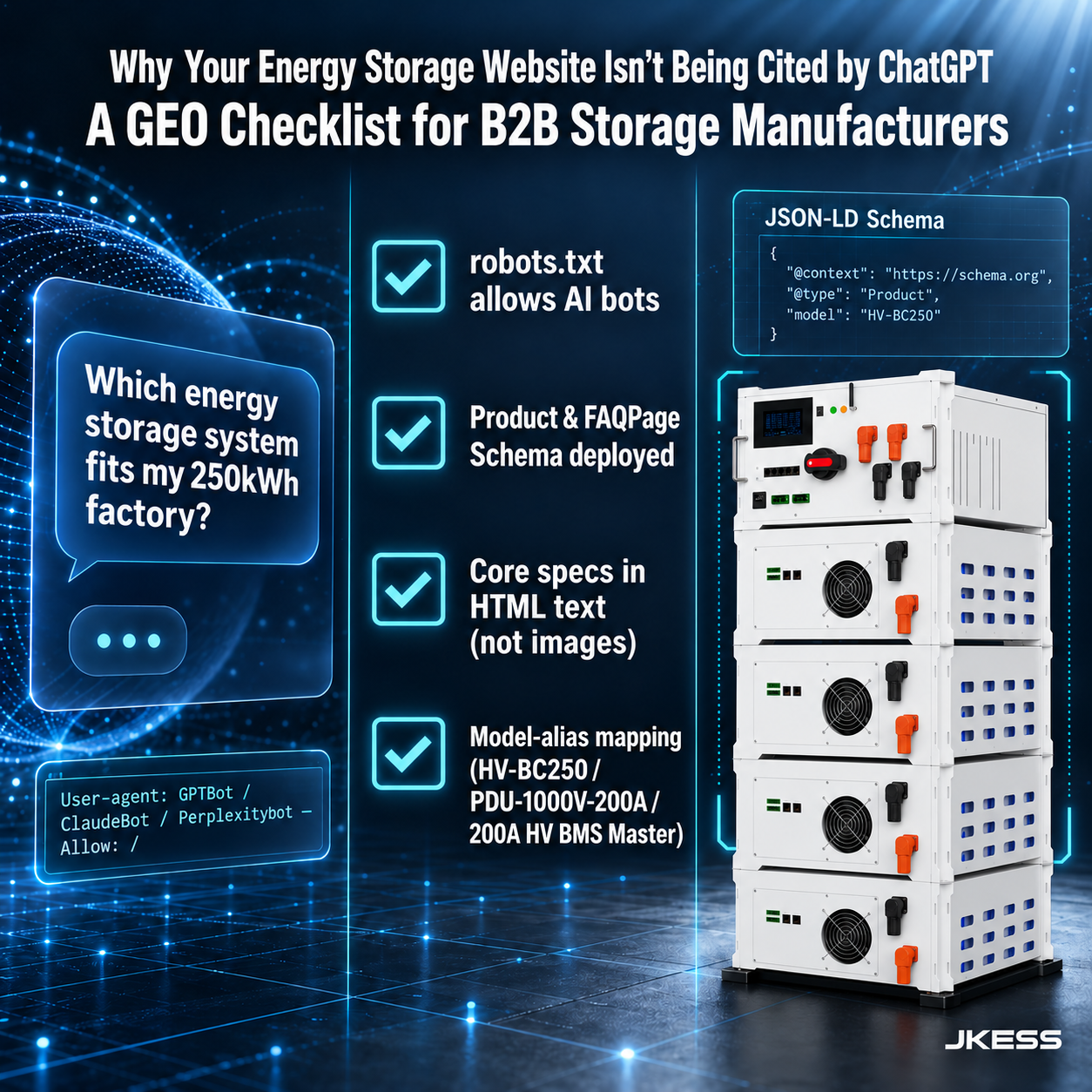
ขอใบเสนอราคา→เหตุใดเว็บไซต์ระบบจัดเก็บพลังงานของคุณจึงไม่ถูกอ้างอิงโดย ChatGPT: รายการตรวจสอบ GEO สำหรับผู้ผลิตระบบจัดเก็บพลังงานแบบ B2B
ผู้ซื้ออาจถาม ChatGPT ก่อนเปรียบเทียบเว็บไซต์ของผู้จำหน่าย หากข้อมูลจำเพาะผลิตภัณฑ์ของคุณอยู่ในรูปภาพเท่านั้น เว็บไซต์ของคุณบล็อกการสแกนของเครื่องมือค้นหา หรือรหัสรุ่นของคุณไม่สอดคล้องกัน ข้อมูลของคุณอาจไม่ปรากฏในคำตอบ
ข้อ สําคัญ
- กระบวนการจัดซื้อในปัจจุบันรวมถึงการวิจัยที่ได้รับความช่วยเหลือจาก AI ด้วย ผู้ซื้อสามารถถามว่า “ระบบที่เหมาะกับความต้องการโรงงาน 250 กิโลวัตต์-ชั่วโมง ของฉันคือระบบใด” ก่อนเข้าชมหน้าเว็บของผู้จำหน่ายแต่ละราย
- ทำให้ข้อเท็จจริงของคุณเข้าถึงและตรวจสอบได้ง่าย เผยแพร่ข้อมูลจำเพาะทางเทคนิคเป็นข้อความ HTML ที่มองเห็นได้ พร้อมหน่วยวัด เงื่อนไขการใช้งาน แหล่งที่มา และรหัสระบุผลิตภัณฑ์ที่ชัดเจน
- ตรวจสอบจุดสำคัญเพื่อความพร้อมในการมองเห็นของ AI จำนวนเจ็ดประการ: การเข้าถึงโดยบอท, สคีมาที่เหมาะสม, ความหนาแน่นของข้อเท็จจริง, ความสอดคล้องกันของชื่อแบบจำลอง, ข้อกำหนดด้าน HTML, โครงสร้างคำถาม-คำตอบ และคู่มือ llms.txt แบบไม่บังคับ องค์ประกอบเหล่านี้ครอบคลุมความเสี่ยงด้านการเข้าถึงและเนื้อหาในทางปฏิบัติ ไม่ใช่ข้อกำหนดเชิงอันดับที่บังคับเจ็ดประการ
- สินค้าแต่ละรายการต้องมีเอกลักษณ์ที่สอดคล้องกันเพียงหนึ่งเดียว ปรับความสอดคล้องของชื่อ เช่น HV-BC250 ซึ่งเป็นรหัสระบุภายในสำหรับ PDU กับ “200A HV BMS Master” ก็ต่อเมื่อยืนยันแล้วว่าทั้งสองชื่อนี้หมายถึงรุ่นเดียวกัน
- GEO คือการจัดการเนื้อหาอย่างต่อเนื่อง รักษาหลักฐาน ติดตามการอ้างอิง และแก้ไขคำตอบที่ไม่ถูกต้อง ไม่มีรายการตรวจสอบใดๆ ที่สามารถรับประกันการจัดอันดับสูงใน ChatGPT, Perplexity หรือ Google AI Overviews ได้
01 / เส้นทางการตัดสินใจของผู้ซื้อ
กระบวนการจัดซื้อแบบ B2B ได้เปลี่ยนแปลงไปแล้ว
เส้นทางการจัดซื้อที่คุ้นเคยเริ่มต้นด้วยการค้นหา ดำเนินต่อไปผ่านเว็บไซต์ของผู้จัดจำหน่ายหลายแห่ง และสิ้นสุดลงด้วยรายการผู้ขายที่สนใจหรือแบบฟอร์มสอบถาม ผู้ช่วยปัญญาประดิษฐ์ (AI) นำเสนอช่องทางเข้าอีกแบบหนึ่ง: ผู้ซื้อสามารถถามคำถามเกี่ยวกับคำอธิบายเชิงเทคนิคหรือการเปรียบเทียบก่อนเข้าชมเว็บไซต์ของผู้ผลิต ซึ่งทำให้คุณภาพของข้อมูลที่มีอยู่ภายนอกหน้าแรกของคุณมีความสำคัญเพิ่มขึ้นเรื่อย ๆ
พิจารณาคำถามที่ผู้ติดตั้งระบบจัดเก็บพลังงานหรือผู้รับเหมา EPC อาจถาม เช่น “ระบบจัดเก็บพลังงานแบตเตอรี่แรงดันสูง (BESS) รุ่นใดรองรับกล่องแบตเตอรี่ย่อยได้ 4–16 กล่อง” “พารามิเตอร์เชิงเทคนิคของระบบจัดการแบตเตอรี่ (BMS) แบบแอคทีฟบาลานซิง 2A คืออะไร” หรือ “การออกแบบระบบจัดเก็บพลังงานสำหรับภาคธุรกิจและอุตสาหกรรม (C&I) จะเปลี่ยนแปลงอย่างไรเมื่อใช้งานในโครงข่ายไฟฟ้าที่มีความมั่นคงต่ำ” คำถามเหล่านี้เป็นตัวอย่างของเจตนาการซื้อ ไม่ใช่สถิติการนำไปใช้งานจริงที่วัดได้ แต่ละคำถามจำเป็นต้องได้รับคำตอบที่แม่นยำ ซึ่งสามารถแยกแยะความแตกต่างระหว่างค่าเฉพาะของชิ้นส่วนกับความสามารถของระบบทั้งระบบได้อย่างชัดเจน
หากข้อเท็จจริงที่เกี่ยวข้องเข้าถึงได้ยากหรือขัดแย้งกัน คำตอบที่สร้างขึ้นโดยระบบปัญญาประดิษฐ์อาจไม่กล่าวถึงผลิตภัณฑ์ของท่าน หรืออธิบายผิดพลาด วิธีปฏิบัติที่เหมาะสมคือการเผยแพร่คำตอบที่ชัดเจนและระบุแหล่งที่มาได้บนหน้าเว็บที่เชื่อถือได้ แม้คำตอบที่สร้างขึ้นโดยระบบปัญญาประดิษฐ์จะยังคงต้องได้รับการตรวจสอบอย่างรอบคอบ แต่การปรากฏตัวในคำตอบดังกล่าวก็เสริมประสิทธิภาพให้กับช่องทางการค้นหาแบบดั้งเดิม ช่องทางตัวแทนจำหน่าย และช่องทางขายโดยตรง
02 / การค้นหาและการอ้างอิง
SEO แบบดั้งเดิม เทียบกับ GEO: สิ่งที่เปลี่ยนแปลงจริง ๆ คืออะไร
ทั้งสองสาขานี้มีจุดร่วมกัน ตารางเปรียบเทียบฉบับนี้อธิบายถึงประเด็นหลักที่แต่ละฝ่ายให้ความสำคัญ ซึ่งเนื้อหาที่มีประโยชน์ ความสามารถในการเข้าถึงเชิงเทคนิค และหลักฐานที่น่าเชื่อถือ ล้วนมีความสำคัญต่อทั้งสองแนวทาง
| SEO แบบดั้งเดิม | GEO (Generative Engine Optimization) |
|---|---|
| ประตู สร้างการมองเห็นในผลลัพธ์การค้นหาที่เกี่ยวข้อง | ประตู กลายเป็นแหล่งข้อมูลที่มีประโยชน์และถูกอ้างอิงในคำตอบที่สร้างขึ้นโดยระบบปัญญาประดิษฐ์ |
| จุดเน้นการปรับปรุง เจตนาในการค้นหา เนื้อหาที่เกี่ยวข้อง ลิงก์ และคุณภาพเชิงเทคนิค | จุดเน้นการปรับปรุง ข้อเท็จจริงที่ดึงกลับมาได้ หลักฐาน หน่วยงานที่ชัดเจน และข้อมูลโครงสร้างที่เหมาะสม |
| พฤติกรรมของผู้ซื้อ เรียกดูผลลัพธ์และเข้าชมหน้าเว็บของผู้จัดจำหน่าย | พฤติกรรมของผู้ซื้อ อ่านคำตอบ ถามคำถามเพิ่มเติม และตรวจสอบลิงก์สนับสนุน |
| รูปแบบเนื้อหา หน้าผลิตภัณฑ์และหน้าเนื้อหาเชิงบรรณาธิการที่มีประโยชน์ ซึ่งสอดคล้องกับเจตนาการค้นหา | รูปแบบเนื้อหา ย่อหน้าที่ให้คำตอบเป็นอันดับแรก ค่าที่ตรวจสอบได้ เงื่อนไข และข้อจำกัดที่ระบุอย่างชัดแจ้ง |
| การเข้าถึงโดยโปรแกรมรวบรวมข้อมูล Googlebot, Bingbot และโครงสร้างพื้นฐานการจัดทำดัชนีที่เกี่ยวข้อง | การเข้าถึงโดยโปรแกรมรวบรวมข้อมูล OAI-SearchBot, PerplexityBot, Claude-SearchBot และ Googlebot สำหรับคุณสมบัติ AI ในการค้นหาของ Google |
| ข้อมูลโครงสร้าง อธิบายเนื้อหาของหน้าที่มีคุณสมบัติเหมาะสม และรองรับคุณสมบัติการค้นหาที่เกี่ยวข้อง | ข้อมูลโครงสร้าง ชี้แจงคุณสมบัติและแนวความสัมพันธ์ที่เกี่ยวข้องในขณะที่ผู้ใช้รับชมเนื้อหา ไม่ใช่ข้อกำหนดเบื้องต้นที่จำเป็นสำหรับการอ้างอิงทั่วไป |
| การแข่งขัน ความชัดเจนและความเกี่ยวข้องทั่วทั้งหน้าผลลัพธ์การค้นหา | การแข่งขัน คำตอบนั้นเลือก อ้างอิง และแสดงหลักฐานของคุณได้อย่างถูกต้องหรือไม่ |
| ภาพ ภาพประกอบที่มีประโยชน์ พร้อมข้อความบรรยายที่อธิบายได้ชัดเจน และแอตทริบิวต์ alt ที่เหมาะสม | ภาพ ระบุข้อกำหนดสำคัญซ้ำใน HTML เนื่องจากความสามารถในการอ่านภาพอาจแตกต่างกันไปตามบริการแต่ละประเภท |
| ชื่อแบรนด์และรุ่น ชื่อที่จดจำได้ง่าย ปรากฏอย่างสอดคล้องกันในหัวเรื่อง หน้าเว็บ และลิงก์ | ชื่อแบรนด์และรุ่น ตัวระบุหลักที่สอดคล้องกัน ชื่อทางเลือกที่ได้รับการยืนยันแล้ว และขอบเขตของการปรับปรุงเวอร์ชัน |
| การวัด จำนวนครั้งที่แสดงผล อันดับตำแหน่ง จำนวนคลิก และการแปลงที่ผ่านเกณฑ์ | การวัด การอ้างอิง URL การกล่าวถึงชื่อแบรนด์อย่างถูกต้อง การแนะนำต่อ และคำถามที่ผ่านเกณฑ์ |
| SEO ช่วยให้ผู้ซื้อค้นหาคุณพบได้ | GEO ช่วยให้หลักฐานของคุณกลายเป็นส่วนหนึ่งของคำตอบ |
03 / รายการตรวจสอบการทำงาน
รายการตรวจสอบ GEO แบบ 7 ข้อ สำหรับเว็บไซต์จัดเก็บข้อมูลแบบ B2B
-
ทบทวนไฟล์ robots.txt และอนุญาตให้โปรแกรมค้นหาที่ตั้งใจไว้เข้าถึงได้
แยกการเข้าถึงสำหรับการค้นหากับการตั้งค่าเพื่อการฝึกโมเดลออกจากกัน OpenAI ระบุ OAI-SearchBot เป็นโปรแกรมค้นหาของตนเอง และ GPTBot เป็นโปรแกรมที่ใช้ในการฝึกโมเดล PerplexityBot รองรับการค้นหาของ Perplexity ส่วน Claude-SearchBot รองรับการค้นหาของ Claude และ ClaudeBot เกี่ยวข้องกับการพัฒนาโมเดล Googlebot ควบคุมการรวบรวมข้อมูลสำหรับ Google Search รวมถึงฟีเจอร์ AI ของ Google ส่วน Google-Extended เป็นการควบคุมแยกต่างหากสำหรับการใช้งานอื่น ๆ
ตรวจสอบกลุ่ม user-agent ที่มีอยู่แล้ว กฎแบบ wildcards ข้อจำกัดตามเส้นทาง (path restrictions) และการตั้งค่า CDN หรือไฟร์วอลล์ ภายใต้พฤติกรรมมาตรฐานของไฟล์ robots.txt การไม่มีการระบุอย่างชัดเจน
Allowจะไม่ทำให้การเข้าถึงถูกปฏิเสธโดยอัตโนมัติ แต่การระบุกลุ่มอย่างชัดเจนสามารถทำให้นโยบายที่ตั้งใจไว้เข้าใจได้ชัดเจนยิ่งขึ้น# Example for a public marketing website.# Merge with the existing policy; preserve intentional path restrictions.User-agent: OAI-SearchBotAllow: /User-agent: PerplexityBotAllow: /User-agent: Claude-SearchBotAllow: /User-agent: GooglebotAllow: /ตั้งค่าแนวทางการใช้งานของ GPTBot, ClaudeBot และ Google-Extended แยกกันตามวัตถุประสงค์ในการใช้เนื้อหาที่ตั้งใจไว้ ตรวจสอบกฎที่ผสานรวมแล้วให้ครบถ้วน และยืนยันคำขอจริงจากโปรแกรมเก็บข้อมูล
ส่งข้อมูล: เอกสารประกอบการใช้งานโปรแกรมเก็บข้อมูลของ OpenAI ,โปรแกรมเก็บข้อมูลของ Perplexity ,เอกสารประกอบการใช้งานโปรแกรมเก็บข้อมูลของ Anthropic และ การควบคุมโปรแกรมเก็บข้อมูลของ Google .
-
ปรับใช้ Schema ที่อธิบายหน้าเว็บที่มองเห็นได้อย่างแม่นยำ
ใช้ข้อมูลแบบมีโครงสร้างเพื่อระบุตัวระบุและคุณลักษณะอย่างชัดเจน Schema ควรอธิบายหน้าเว็บที่ผู้เข้าชมเห็นจริง โดยไม่เพิ่มข้อความอ้างอิงที่ไม่มีหลักฐานสนับสนุน หรือผสมผสานรุ่นผลิตภัณฑ์ที่ต่างกัน
- ผลิตภัณฑ์ + คุณสมบัติเพิ่มเติม: พารามิเตอร์เฉพาะรุ่น หน่วย และลักษณะที่มีการบันทึกไว้
- หน้าคำถามที่พบบ่อย: คำถามที่แท้จริงและมองเห็นได้ พร้อมคำตอบที่สอดคล้องกัน
- วิธีทำ: คู่มือการติดตั้งหรือเปิดใช้งานจริง ที่มีขั้นตอนและขอบเขตครบถ้วน
- รายการ: หัวเรื่องบรรณาธิการ ผู้เขียน วันที่เผยแพร่ และหน้าเว็บหลัก
- ระบบจัดระเบียบ: ชื่อบริษัท ที่อยู่ URL และข้อมูลติดต่อที่ตรวจสอบแล้ว ซึ่งใช้อย่างสม่ำเสมอ
ตรวจสอบไวยากรณ์ JSON และความหมายของแต่ละฟิลด์ จากนั้นเปรียบเทียบคำแถลงที่มีการใส่ markup ทุกข้อกับหน้าเว็บที่แสดงผลจริง เว็บบล็อกที่พูดถึงผลิตภัณฑ์หลายรายการไม่ถือว่าเป็นหน้ารายละเอียดผลิตภัณฑ์โดยอัตโนมัติ
การมีคุณสมบัติตรงตามเกณฑ์ไม่ใช่การรับประกัน Google ระบุว่าคุณสมบัติการค้นหาด้วย AI ของตนไม่จำเป็นต้องใช้ Schema พิเศษหรือไฟล์เฉพาะสำหรับ AI ความถูกต้องของ Schema.org การรองรับจากแพลตฟอร์ม และการรวมจริง ถือเป็นคำถามที่แยกจากกัน
ส่งข้อมูล: Schema.org additionalProperty ,FAQPage และ คำแนะนำเกี่ยวกับคุณสมบัติปัญญาประดิษฐ์ของ Google .
-
เพิ่มความหนาแน่นของข้อเท็จจริงที่มีประโยชน์
แทนที่คำคุณศัพท์ที่ไม่รองรับด้วยข้ออ้างที่ผู้ซื้อสามารถตรวจสอบได้เอง วางข้อสรุปไว้ก่อน แต่ละย่อหน้าควรเน้นประเด็นเดียว และระบุแบบจำลอง หน่วย สภาพการใช้งาน และแหล่งที่มาที่จำเป็นต่อการตีความค่าดังกล่าว
ก่อน / โปรโมชัน “JKESS มอบเทคโนโลยีการปรับสมดุลแบบแอคทีฟที่เป็นผู้นำในอุตสาหกรรม พร้อมประสิทธิภาพเหนือกว่า”หลัง / เฉพาะเจาะจงและอ้างอิงได้ “เอกสารทางเทคนิคของ JKESS ระบุว่า BMU-H5-16 มีการปรับสมดุลแบบแอคทีฟที่ 2A ความแม่นยำในการวัดแรงดันเซลล์ที่ ±0.005V มีเซนเซอร์วัดอุณหภูมิด้วย NTC จำนวนแปดตัว และรองรับแบตเตอรี่ LiFePO4 แบบ 16S โปรดยืนยันค่าเหล่านี้กับเวอร์ชันที่จัดส่งจริง”ห้ามรวมค่าจากเอกสารที่ขัดแย้งกันเข้าด้วยกันเพื่อสร้างข้อกำหนดใหม่ หากหน้าผลิตภัณฑ์กับแผ่นข้อมูลขัดแย้งกัน ให้แก้ไขความไม่สอดคล้องนั้นร่วมกับผู้รับผิดชอบผลิตภัณฑ์ และปรับปรุงแหล่งข้อมูลทั้งสองฉบับก่อนถือว่าแหล่งใดแหล่งหนึ่งเป็นข้อมูลอ้างอิงที่เชื่อถือได้
ตัวอย่างแหล่งที่มา: การอภิปรายเชิงเทคนิคของ JKESS เกี่ยวกับ BMU-H5-16 หน้าเว็บสาธารณะอาจมีความแตกต่างกันตามการปรับปรุงรุ่น; แผ่นข้อมูลที่ได้รับการอนุมัติล่าสุดยังคงเป็นเอกสารอ้างอิงสำหรับการเผยแพร่
-
สร้างแผนที่เชื่อมโยงระหว่างแบบจำลองกับชื่อเล่นที่ผ่านการตรวจสอบแล้ว
กำหนดชื่อหลักเพียงหนึ่งชื่อและหน้าผลิตภัณฑ์มาตรฐานหนึ่งหน้าให้แต่ละผลิตภัณฑ์ พร้อมจัดทำบันทึกที่เชื่อมโยงชื่อทางการตลาด รหัสวิศวกรรม รุ่นของผลิตภัณฑ์ และชื่อที่ใช้แตกต่างกันตามภูมิภาค
ตัวอย่างการตั้งชื่อที่ให้มานี้คือ HV-BC250 / PDU-1000V-200A-A001-NY / 200A HV BMS Master Box นี่คือความสัมพันธ์แบบชื่อเล่นที่ต้องตรวจสอบ ไม่ใช่หลักฐานว่ารหัสระบุเหล่านั้นสามารถใช้แทนกันได้ หากฝ่ายวิศวกรรมยืนยันว่าตรงกัน ให้เขียนว่า “HV-BC250 หรือที่เรียกกันว่า PDU-1000V-200A-A001-NY คือกล่องควบคุมระบบจัดการแบตเตอรี่แรงดันสูง (HV BMS) แบบมาสเตอร์ 200 แอมแปร์”
ใช้ชื่อหลักในส่วนหัวและแท็ก H1 ใส่ชื่อเล่นที่ยืนยันแล้วไว้ในย่อหน้าแรกและในช่องข้อมูลผลิตภัณฑ์ที่เกี่ยวข้อง เช่น
alternateNameหรือmpnรักษารูปแบบเอกลักษณ์แยกต่างหากเมื่อการปรับปรุงรุ่นส่งผลต่อค่าพารามิเตอร์ พอร์ตเชื่อมต่อ หรือขอบเขตของการจัดจำหน่าย -
แสดงข้อมูลจำเพาะหลักใน HTML ที่มองเห็นได้โดยตรง
เขียนค่าสำคัญลงในเนื้อหาของหน้าเว็บโดยตรง แรงดันไฟฟ้า กระแสไฟฟ้า ความแม่นยำ ขนาด ภาวะการทดสอบ และขอบเขตของการจัดหาควรคงไว้เป็นข้อความธรรมดาและเชิงความหมาย
cells.
Image extraction and JavaScript rendering differ between crawlers and retrieval tools. Text inside a photograph, iframe, or canvas is therefore an unreliable sole source for a critical parameter. Alt text helps describe an image, but it does not replace a visible specification table.
Publish a dated datasheet alongside the HTML table. Distinguish nominal voltage from the operating envelope, continuous current from peak current, and empty-kit weight from the weight of an assembled module.
Answer real buyer questions directly
Build a useful set of questions around the buying decision: “How many slave boxes can one master box support?” “Does the kit include battery cells?” “Which communication protocols are provided?” Answer first, then give the limits and source.
Five to ten FAQs can be a practical editorial target when the topic warrants them; there is no universal minimum. Native
When adding FAQPage markup, use the same question and answer wording as the visible page. Do not add invisible FAQ claims just to target search queries. This article includes ten visible FAQs and marks up five of them.
Consider an optional llms.txt reading guide
llms.txtis a proposed Markdown convention for guiding agents to useful website content. A concise guide can list the company, core products, application pages, and maintained technical documents. It is useful only to consumers that choose to read it.# JKESS Electronic Technology BMS and active balancing solutions for energy storage.## Core Products- [HV-BC250 200A Master Box](https://www.jkess.com/200a-hv-bms-master)- [HV-B6U Slave Battery Box Kits](https://www.jkess.com/hv-slave-6u-kits)- [261kWh Liquid-Cooled BESS Kits](https://www.jkess.com/commercial--industrial-energy-storage-system-kits)## Application Guides- [Modular HV Energy Storage Kits](https://www.jkess.com/home-energy-storage-system-kits)## Technical DocumentsUse the current specifications and scope-of-supply notes on the product pages.Add approved, versioned datasheet links when those documents are published.Illustrative content, not a report of the live site’s configuration. Use verified links and clean Markdown versions where available. Maintaining this file does not deploy robots.txt rules or create search eligibility.
References: the llms.txt proposal and Google’s generative AI optimization guidance. Google Search does not use llms.txt as a special visibility or ranking input.
04 / Content in practice
Before and After: Rewriting a Storage Product Page for AI Citation
The following five examples replace broad promotion with a more useful answer. Numerical illustrations include their assumptions; commercial and certification statements require current, model-specific evidence.
Illustrative rewrites. Calculations are not measured performance guarantees. Before / Marketing copy After / Evidence-led copy “Our advanced active balancing BMS delivers superior performance and extends battery life.” “For an illustrative 314Ah cell with a 0.5% charge difference, ΔQ = 314 × 0.005 = 1.57Ah. At a constant 2A transfer current, the idealized duration is 1.57 ÷ 2 = 0.785 hours, or about 47 minutes. Real duration depends on current limits, control behavior, and losses.” “The system supports a wide voltage range for various applications.” “The HV-BC250 listing specifies an 80–1000V DC master range. A 4–16 slave-box configuration is described as approximately 64–256kWh when each box is approximately 16kWh. With 16 cells per box and 3.2V nominal per cell, 16 boxes yield 256S / 819.2V nominal. Verify the full charge/discharge range and selected cell capacity.” “Our battery boxes are designed for easy installation.” “Define the scope as one master plus five slave boxes: six enclosures in total. State empty-kit and assembled-module weights separately, together with the lifting and installation plan. A claimed 28.55kg kit weight or two-technician, 2–3 day schedule requires a matching product record and a defined site scope.” “We provide reliable products with international certifications.” “List the exact model and revision, applicable CE declaration, RoHS documentation, FCC evidence, and test-report identifiers. If citing GB34131-2017 or insulation resistance ≥1 MΩ at 1,000 VDC, verify the applicable standard edition, test method, and report scope rather than extending a component claim to the whole system.” “Contact us for more information.” “Send your required capacity, DC range, current, communication protocol, scope of supply, quantity, and delivery location to [email protected]. Request confirmation of available regional stock and a written dispatch estimate for that configuration.” Product references: HV-BC250 and modular storage kits. The 64–256kWh shorthand is configuration-dependent; a hardware kit without cells does not itself contain that stored energy.
05 / Access and extraction
Technical Access: Can AI Crawlers Actually Read Your Website?
Check 1 / robots.txt and access controls
Open
https://yourdomain.com/robots.txtand evaluate the user-agent group and path rules that apply to each intended crawler. Inspect firewall challenges, blocked IP ranges, redirects, and server errors as well.Absence of an explicit Allow is not a failure by itself. Use the actual response and verified crawler logs to determine what is accessible.
Check 2 / Core content in HTML
Disable JavaScript and reload the product page. Check the original HTML response for the model name, specification table, scope of supply, and answers.
If they disappear, the page depends on rendering that some tools may not perform. Prefer server-rendered or static core content, and use a search engine’s inspection tools where available. Also check
noindex, snippet restrictions, andX-Robots-Tagheaders.Check 3 / Descriptive alt text
Describe informative product photographs, diagrams, and screenshots with suitable alt text. Keep purely decorative images from adding noise.
Repeat important values in the visible body or a real HTML table. A long alt attribute is not a substitute for a readable technical specification.
Check 4 / Reliable loading and delivery
Confirm that the canonical page returns a successful response and delivers useful content promptly. Reduce unnecessary third-party scripts, oversized payloads, and client-side dependencies.
Timeouts, errors, and rendering limits can interfere with retrieval. A model’s context budget is a separate issue from network performance; there is no universal “AI loading time” threshold.
Check 5 / Canonical URLs and model identity
Identify duplicate URLs for the same item and use a consistent canonical URL, internal links, and sitemap entries. For example, reconcile two product paths that describe the same HV-BC250 revision.
A canonical URL signals a preferred page; it does not by itself resolve conflicting specifications or prove that two product names are equivalent.
Access references: robots.txt interpretation and the crawler documentation linked in checkpoint 1.
06 / Evidence of progress
How to Measure Whether GEO Is Working
Pair answer-level observations with business outcomes. Metric Traditional SEO measure GEO measure Visibility Search impressions and keyword positions. Share of sampled AI answers citing an owned URL; track brand mentions separately. Traffic Organic search clicks and visits. Identifiable AI referrals; brand-search changes as supporting, non-causal evidence. Content Engagement and landing-page performance. Which facts and pages are cited, and whether values and limitations are correct. Conversion Forms, qualified leads, and sales. Qualified inquiries with an AI discovery source or attributable referral. Competition Relative search visibility. Citation share and co-mentions within the same fixed question set. Audit Indexability, search-intent coverage, and page quality. Entity consistency, evidence freshness, extractable facts, and markup accuracy. A practical weekly baseline: run ten fixed buyer questions in ChatGPT search, Perplexity, and Google AI Overviews where an overview appears. Repeat the sample and log platform, date, locale, model or mode, exact question, cited URL, brand mention, and answer accuracy.
Citation rate = answers linking to your domain ÷ eligible sampled answers. Report the sample size and the number of queries without an AI answer. A brand mention without a source link is not a citation. Use a separate measure for citations to this specific article.
For example, six cited answers out of 30 eligible observations produce a 20% sample citation rate. This is an illustrative calculation, not a JKESS result. Keep the question set stable when comparing periods, and avoid treating a single answer or a small change as proof that one edit caused an improvement.
07 / Applying the method
How JKESS Applies GEO to Its Own Product Pages
The reviewed JKESS master-box and 261kWh application pages expose technical information in readable tables. That is a useful starting point. The following seven practices form an implementation and maintenance checklist, rather than a claim that every page has already passed a site-wide audit.
- Maintain structured specification tables. Keep each voltage, current, accuracy, dimension, and weight value in visible HTML, tied to a model, revision, and source. Separate component ratings from complete-system limits.
- Keep FAQs useful and consistent. Write five to ten relevant answers when justified by the product; align any FAQPage markup with the exact visible wording and recheck answers after product changes.
- Use model-specific Product markup. Validate Product and additionalProperty on the appropriate HV-BC250, HV-B6U, and 261kWh pages. Record evidence of the deployed markup rather than assuming site-wide coverage.
- Control aliases. Confirm any relationship between HV-BC250 and PDU-1000V-200A-A001-NY, then use one primary name with the approved aliases. Keep HV-BC150-100A as a distinct product identity.
- Reconcile quantitative claims. Check the 2A active balancing and ±0.005V sampling values against the supplied BMU revision. Keep the 4–16 slave-box and 64–256kWh statements linked to their cell and configuration assumptions.
- Maintain an optional llms.txt guide. If deployed, list current canonical product and documentation URLs, remove stale links, and treat it as documentation support rather than an indexing requirement.
- Verify search access. Review the live robots.txt policy and crawler delivery logs. Confirm intended access for search bots while managing training-related controls independently.
JKESS product and specification anchors
HV-BC250 · 200A HV BMS Master · HV-BC150-100A · 100A master configuration · HV-B6U · 6U slave battery box kits · BMU-H5-16 · technical reference · 261kWh liquid-cooled system
Values to keep in context: 2A active balancing · ±0.005V sampling accuracy · 4–16 slave battery boxes · approximately 64–256kWh · 80–1000V DC master range. These refer to different components or configurations, not a single universal specification. Kits are offered without battery cells; confirm the final scope of supply.
08 / Questions buyers ask
Frequently Asked Questions
What is GEO and how does it differ from traditional SEO?
GEO (Generative Engine Optimization) is the practice of making useful content easier to retrieve, understand, and cite in AI-generated answers. Traditional SEO emphasizes visibility in search results, while GEO also tracks how accurately a brand and its facts appear in generated responses. Both benefit from accessible pages, clear product identities, and reliable evidence; neither guarantees inclusion.
Why is my energy storage website not being cited by ChatGPT?
Possible causes include blocked search crawlers, unindexed pages, specifications that are difficult to extract, inconsistent model names, or weak evidence for the question being asked. For ChatGPT search, review OAI-SearchBot access rather than assuming GPTBot controls search visibility. Missing Schema or llms.txt alone does not prove why a page was omitted; compare crawl evidence, content relevance, and repeated query results.
What is llms.txt and why does it matter for B2B storage websites?
llms.txt is a proposed Markdown-based guide to a website’s useful content, which can point agents to product documentation and application guides. It can help tools that choose to use it, but adoption and behavior differ between services. Treat it as optional documentation infrastructure, not a requirement for AI citation or a replacement for HTML pages and sitemaps.
How do I check if AI crawlers can access my website?
Inspect the robots.txt groups and path rules that apply to OAI-SearchBot, PerplexityBot, Claude-SearchBot, and Googlebot, then review server and firewall logs. A missing explicit Allow rule does not by itself mean access is denied. Also check HTTP responses, indexing and snippet controls, and whether product specifications are available without JavaScript; a browser-only test does not confirm a crawler’s actual access.
What Schema markup should a B2B storage website prioritize?
Use Product with additionalProperty on product pages, Article on editorial pages, and Organization for the company identity. FAQPage can describe visible questions and answers, and HowTo can describe a genuine procedural guide. Keep markup aligned with the visible content and applicable platform documentation; valid Schema does not guarantee a rich result or an AI citation.
How does inconsistent product naming affect AI visibility?
Different names for the same item can make it harder for readers and retrieval systems to connect the information. Select one primary model name and record verified aliases, product revisions, and one canonical URL. Publish an “also known as” relationship only after the model owner confirms that the labels identify the same product and configuration.
What is fact density and why does it matter for GEO?
Fact density is an editorial measure of how much useful, verifiable information a passage contains relative to general promotional language. A model-specific value with units, operating conditions, and a dated source is more useful than an unsupported adjective. Values such as 2A active balancing, ±0.005V sampling accuracy, and an 80–1000V DC range must stay attached to the correct component; fact density is not a published universal AI ranking score.
How do I measure GEO performance for my storage website?
Run a fixed set of buyer questions repeatedly and log the date, platform, search mode, locale, cited URLs, and answer accuracy. Report URL citation rate separately from unlinked brand mentions, and track identifiable referral visits and qualified inquiries. Results fluctuate, so a small weekly sample is directional evidence rather than a complete view of all buyers or proof of causation.
Does GEO replace traditional SEO for B2B storage manufacturers?
No. Search indexing, useful content, internal links, and a dependable website remain relevant to both conventional search and AI-assisted research. GEO adds attention to answer-level representation, traceable facts, and citation measurement. An effective program maintains those foundations while checking whether buyers receive accurate product information.
How does JKESS apply GEO principles to its own product pages?
The JKESS pages reviewed for this article provide examples of HTML specifications and question-and-answer content for products including the HV-BC250 and the 261kWh liquid-cooled system. The seven-part workflow below extends that approach to the HV-BC150-100A, HV-B6U, and BMU-H5-16 through consistent naming, source review, and structured content. This article does not certify site-wide Schema coverage, crawler settings, or an existing llms.txt deployment; those require a current implementation audit.
Want to Audit Your Storage Website’s AI Visibility?
Share your website URL with our team. We’ll review your robots.txt, Schema markup, fact density, and entity consistency — and help identify where crawlers or readers may be missing your product information.
Request a Custom Quote→