
 EN
JKESS / Những hiểu biết chuyên sâu về kỹ thuật
Yêu cầu báo giá →Tại sao trang web lưu trữ năng lượng của bạn không được ChatGPT trích dẫn: Danh sách kiểm tra GEO dành riêng cho các nhà sản xuất thiết bị lưu trữ B2B
Người mua có thể hỏi ChatGPT trước khi so sánh các trang web nhà cung cấp. Nếu thông số kỹ thuật sản phẩm của bạn chỉ tồn tại dưới dạng hình ảnh, trang web của bạn chặn trình thu thập dữ liệu tìm kiếm hoặc mã mô hình của bạn không nhất quán, thông tin của bạn có thể bị thiếu trong câu trả lời.
Những điều quan trọng
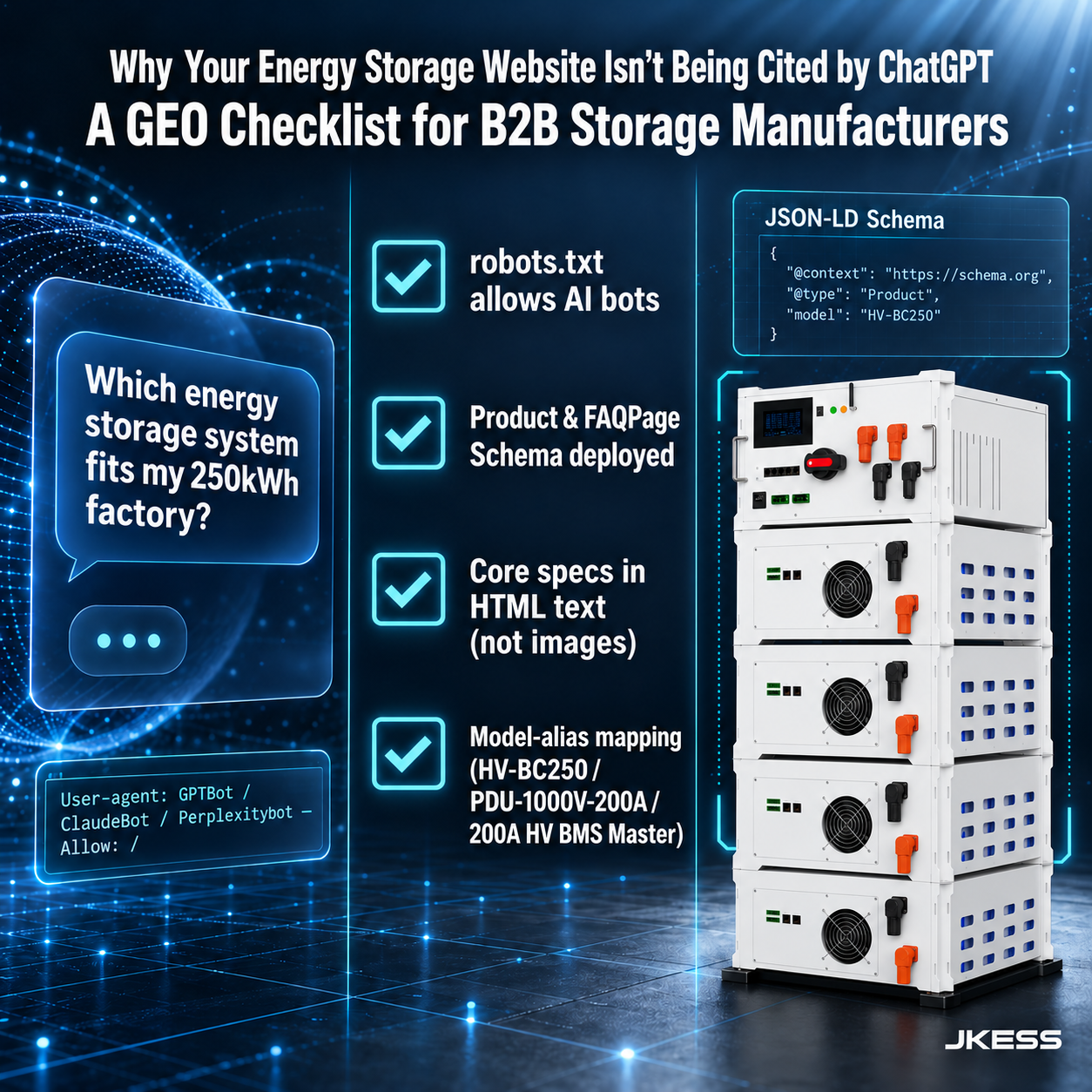
- Hành trình mua hàng hiện nay bao gồm nghiên cứu được hỗ trợ bởi trí tuệ nhân tạo. Một người mua có thể hỏi: “Hệ thống nào phù hợp với yêu cầu 250kWh cho nhà máy của tôi?” trước khi mở từng trang nhà cung cấp.
- Giúp các sự kiện của bạn dễ truy xuất và kiểm tra. Công bố thông số kỹ thuật dưới dạng văn bản HTML hiển thị rõ ràng, kèm theo đơn vị đo, điều kiện vận hành, nguồn tham khảo và nhận diện sản phẩm rõ ràng.
- Kiểm toán bảy điểm kiểm tra khả năng hiển thị trên AI: truy cap bo thu thap du lieu, Schema phu hop, mat do thong tin chinh xac, tinh nhat quan ve ten goi mo hinh, tieu chuan HTML, cau truc hoi dap va huong dan tuy chon llms.txt. Cac yeu to nay bao quat cac rui ro thuc te lien quan den viec truy cap va noi dung; day khong phai la bay yeu cau bat buoc de xep hang.
- Moi san pham can co mot danh tinh nhat quan. Dieu chinh cac ten goi nhu HV-BC250, mot ma dinh danh noi bo cua PDU, va "200A HV BMS Master" chi sau khi xac nhan chung deu chi cung mot phien ban.
- GEO la qua trinh quan ly noi dung dang dien ra. Luu giu bang chung, theo doi cac lan duoc trich dan va sua chua cac cau tra loi khong chinh xac. Khong co bat ky danh sach kiem tra nao co the dam bao vi tri uu tien tren ChatGPT, Perplexity hoac Google AI Overviews.
01 / Hanh trinh cua khach hang
Quy trinh mua hang B2B da thay doi
Hành trình mua sắm quen thuộc bắt đầu bằng việc tìm kiếm, tiếp tục trên nhiều trang web của nhà cung cấp và kết thúc bằng danh sách ngắn hoặc biểu mẫu yêu cầu thông tin. Các trợ lý AI tạo ra một điểm tiếp cận khác: người mua có thể đặt câu hỏi về giải thích kỹ thuật hoặc so sánh trước khi truy cập trang web của nhà sản xuất. Điều này khiến chất lượng thông tin sẵn có bên ngoài trang chủ của bạn ngày càng trở nên quan trọng.
Hãy xem xét những câu hỏi mà một nhà tích hợp hệ thống lưu trữ hoặc nhà thầu EPC có thể đặt ra: “BESS điện áp cao nào hỗ trợ từ 4 đến 16 tủ pin phụ?” “Các thông số kỹ thuật của bộ BMS cân bằng chủ động 2A là gì?” “Thiết kế lưu trữ C&I cần thay đổi như thế nào khi kết nối với lưới điện yếu?” Đây là những ví dụ về ý định mua hàng, chứ không phải số liệu thống kê về mức độ áp dụng thực tế. Mỗi câu hỏi đều đòi hỏi một câu trả lời chính xác, phân biệt rõ ràng giữa xếp hạng của một thành phần riêng lẻ và khả năng của toàn bộ hệ thống.
Nếu các sự kiện liên quan khó tiếp cận hoặc mâu thuẫn nhau, câu trả lời do AI tạo ra có thể bỏ sót sản phẩm của bạn hoặc mô tả sai về sản phẩm đó. Giải pháp thực tiễn là đăng một câu trả lời rõ ràng, có thể truy nguyên nguồn gốc lên một trang đáng tin cậy. Các câu trả lời do AI tạo ra vẫn cần được xác minh, và việc xuất hiện trong những câu trả lời ấy bổ sung cho các kênh tìm kiếm truyền thống, kênh phân phối và kênh bán hàng trực tiếp.
02 / Tìm kiếm và trích dẫn
SEO truyền thống so với GEO: Điều gì thực sự thay đổi?
Hai lĩnh vực này có sự giao thoa. So sánh dưới đây nêu bật các trọng tâm chính của từng lĩnh vực; nội dung hữu ích, khả năng truy cập kỹ thuật và bằng chứng đáng tin cậy đều quan trọng đối với cả hai.
| SEO truyền thống | GEO (Tối ưu hóa cho công cụ tìm kiếm thế hệ mới) |
|---|---|
| Mục tiêu Đạt được khả năng hiển thị trong các kết quả tìm kiếm liên quan. | Mục tiêu Trở thành một nguồn thông tin hữu ích và được trích dẫn trong các câu trả lời do AI tạo ra. |
| Tập trung tối ưu hóa Ý định tìm kiếm, nội dung liên quan, liên kết và chất lượng kỹ thuật. | Tập trung tối ưu hóa Các sự kiện, bằng chứng, thực thể rõ ràng và dữ liệu có cấu trúc phù hợp có thể truy xuất được. |
| Hành vi người mua Duyệt kết quả và truy cập các trang của nhà cung cấp. | Hành vi người mua Đọc câu trả lời, đặt câu hỏi bổ sung và kiểm tra các liên kết hỗ trợ. |
| Định dạng nội dung Các trang sản phẩm và trang biên tập hữu ích phù hợp với ý định tìm kiếm. | Định dạng nội dung Các đoạn trả lời trước tiên, các giá trị có thể xác minh, điều kiện và các trường hợp loại trừ rõ ràng. |
| Quyền truy cập của bộ thu thập dữ liệu Googlebot, Bingbot và cơ sở hạ tầng lập chỉ mục liên quan. | Quyền truy cập của bộ thu thập dữ liệu OAI-SearchBot, PerplexityBot, Claude-SearchBot và Googlebot dành cho các tính năng AI Tìm kiếm của Google. |
| Dữ liệu có cấu trúc Mô tả nội dung trang đủ điều kiện và hỗ trợ các tính năng tìm kiếm áp dụng được. | Dữ liệu có cấu trúc Làm rõ các thuộc tính và mối quan hệ tại nơi được sử dụng; không phải là điều kiện tiên quyết chung cho việc trích dẫn. |
| Cạnh tranh Tính hiển thị và mức độ liên quan trên toàn bộ trang kết quả tìm kiếm. | Cạnh tranh Việc câu trả lời có lựa chọn, gán nguồn và thể hiện chính xác bằng chứng của bạn hay không. |
| Hình ảnh Hình ảnh hữu ích đi kèm văn bản mô tả và thuộc tính alt phù hợp. | Hình ảnh Lặp lại các thông số kỹ thuật quan trọng trong HTML; khả năng đọc hình ảnh thay đổi tùy theo dịch vụ. |
| Tên thương hiệu và tên mẫu Các tên dễ nhận biết trên tiêu đề, trang và liên kết. | Tên thương hiệu và tên mẫu Các định danh chính nhất quán, biệt danh đã được xác minh và ranh giới phiên bản. |
| Kích thước Số lần hiển thị, thứ hạng, lượt nhấp và chuyển đổi đạt tiêu chuẩn. | Kích thước Trích dẫn URL, đề cập chính xác đến thương hiệu, giới thiệu và yêu cầu tư vấn đạt tiêu chuẩn. |
| SEO giúp người mua tìm thấy bạn. | GEO giúp bằng chứng của bạn trở thành một phần của câu trả lời. |
03 / Danh sách kiểm tra hoạt động
Danh sách kiểm tra GEO gồm 7 điểm dành cho trang web lưu trữ B2B
-
Xem lại tệp robots.txt và cho phép các công cụ thu thập dữ liệu tìm kiếm dự định truy cập.
Tách riêng quyền truy cập tìm kiếm với tùy chọn huấn luyện mô hình. OpenAI xác định OAI-SearchBot là công cụ thu thập dữ liệu tìm kiếm và GPTBot là công cụ thu thập dữ liệu huấn luyện. PerplexityBot hỗ trợ tìm kiếm Perplexity; Claude-SearchBot hỗ trợ tìm kiếm Claude, trong khi ClaudeBot liên quan đến phát triển mô hình. Googlebot điều khiển việc thu thập dữ liệu cho Google Search, bao gồm cả các tính năng AI của nó; Google-Extended là cơ chế điều khiển riêng biệt dành cho các mục đích khác.
Kiểm tra các nhóm user-agent hiện có, các quy tắc ký tự đại diện (wildcard), giới hạn đường dẫn (path restrictions) cũng như cài đặt CDN hoặc tường lửa. Theo hành vi tiêu chuẩn của tệp robots.txt, việc thiếu một quy tắc rõ ràng
Allowkhông tự động từ chối quyền truy cập. Một nhóm được khai báo rõ ràng có thể làm cho chính sách dự định trở nên minh bạch hơn.# Example for a public marketing website.# Merge with the existing policy; preserve intentional path restrictions.User-agent: OAI-SearchBotAllow: /User-agent: PerplexityBotAllow: /User-agent: Claude-SearchBotAllow: /User-agent: GooglebotAllow: /Thiết lập các chính sách GPTBot, ClaudeBot và Google-Extended riêng biệt theo mục đích sử dụng nội dung dự định. Xác thực các quy tắc đã hợp nhất cuối cùng cũng như các yêu cầu thực tế từ các bot thu thập dữ liệu.
Các tài liệu tham khảo: Tài liệu hướng dẫn về bot thu thập dữ liệu của OpenAI ,Các bot thu thập dữ liệu của Perplexity ,Tài liệu hướng dẫn về bot thu thập dữ liệu của Anthropic và Các công cụ kiểm soát bot thu thập dữ liệu của Google .
-
Triển khai Schema mô tả chính xác trang hiển thị được người dùng nhìn thấy
Sử dụng dữ liệu có cấu trúc để làm rõ các định danh và thuộc tính. Schema phải mô tả trang mà người truy cập thực sự nhìn thấy, không bổ sung các khẳng định chưa được hỗ trợ hoặc pha trộn các biến thể sản phẩm khác nhau.
- Sản phẩm + additionalProperty: các tham số đặc thù cho từng mẫu, đơn vị đo và các đặc điểm đã được tài liệu hóa.
- FAQPage: các câu hỏi thực tế, dễ thấy cùng với các câu trả lời tương ứng.
- Cách thực hiện: hướng dẫn lắp đặt hoặc đưa vào vận hành thực tế, bao gồm đầy đủ các bước và phạm vi công việc.
- Bài viết: tiêu đề biên tập, tên tác giả, ngày xuất bản và URL chuẩn của trang.
- Ngăn chia: tên công ty nhất quán, URL và thông tin liên hệ đã được xác minh.
Kiểm tra cú pháp JSON và ý nghĩa của từng trường, sau đó so sánh từng câu được đánh dấu với nội dung hiển thị trên trang đã xuất bản. Một bài blog thảo luận về nhiều sản phẩm không tự động được coi là trang chi tiết sản phẩm.
Tính đủ điều kiện không phải là cam kết. Google khẳng định các tính năng tìm kiếm AI của mình không yêu cầu Schema đặc biệt hay tệp riêng cho AI. Tính hợp lệ của Schema.org, khả năng hỗ trợ trên nền tảng và việc thực tế được đưa vào đều là những vấn đề riêng biệt.
Các tài liệu tham khảo: AdditionalProperty của Schema.org ,FAQPage và Hướng dẫn về các tính năng trí tuệ nhân tạo của Google .
-
Tăng mật độ sự thật hữu ích
Thay thế các tính từ không được hỗ trợ bằng một khẳng định mà người mua có thể kiểm chứng. Đặt kết luận lên hàng đầu, giữ mỗi đoạn văn tập trung vào một chủ đề duy nhất và cung cấp rõ mô hình, đơn vị, điều kiện vận hành cũng như nguồn thông tin cần thiết để diễn giải giá trị.
Trước / Khuyến mãi "JKESS cung cấp công nghệ cân bằng chủ động dẫn đầu ngành với hiệu suất vượt trội."Sau / Cụ thể và có thể quy chiếu "Tài liệu kỹ thuật của JKESS mô tả bộ điều khiển BMU-H5-16 với khả năng cân bằng chủ động 2A, độ chính xác lấy mẫu điện áp tế bào ±0,005V, tám cảm biến nhiệt độ NTC và hỗ trợ pin LiFePO4 cấu hình 16S. Hãy xác minh các giá trị này dựa trên phiên bản cụ thể được cung cấp."Không được gộp các giá trị từ các tài liệu mâu thuẫn thành một thông số kỹ thuật mới. Nếu trang sản phẩm và bảng dữ liệu kỹ thuật không thống nhất, hãy phối hợp với chủ sở hữu sản phẩm để làm rõ sự khác biệt, sau đó cập nhật cả hai nguồn trước khi coi bất kỳ nguồn nào là chuẩn xác.
Ví dụ về nguồn: Thảo luận kỹ thuật của JKESS về BMU-H5-16 . Các trang công khai có thể chứa sự khác biệt về phiên bản; bảng dữ liệu đã được phê duyệt hiện hành vẫn là tài liệu tham khảo để xuất bản.
-
Xây dựng bản đồ ánh xạ từ mô hình đã được xác minh tới các tên gọi thay thế (alias)
Gán cho mỗi sản phẩm một tên chính và một trang sản phẩm chuẩn duy nhất. Duy trì hồ sơ ghi nhận mối liên hệ giữa tên tiếp thị, mã định danh kỹ thuật, phiên bản sản phẩm và mọi biến thể tên gọi theo khu vực.
Ví dụ về cách đặt tên được cung cấp là HV-BC250 / PDU-1000V-200A-A001-NY / 200A HV BMS Master Box . Đây là mối quan hệ tên gọi thay thế cần xác minh, chứ không phải bằng chứng cho thấy các mã định danh có thể hoán đổi cho nhau. Nếu bộ phận kỹ thuật xác nhận sự khớp nối, hãy viết: “HV-BC250, còn được biết đến với tên gọi PDU-1000V-200A-A001-NY, là hộp điều khiển chính BMS điện áp cao 200 A.”
Sử dụng tên chính trong tiêu đề và thẻ H1; đưa các tên gọi thay thế đã được xác nhận vào đoạn mở đầu và các trường Sản phẩm phù hợp như
alternateNamehoặcmpn. Giữ nguyên danh tính riêng biệt khi phiên bản thay đổi các thông số định mức, giao diện hoặc phạm vi cung cấp. -
Đặt các thông số cốt lõi vào phần HTML hiển thị rõ ràng
Ghi trực tiếp các giá trị then chốt ngay trên trang. Điện áp, dòng điện, độ chính xác, kích thước, điều kiện thử nghiệm và phạm vi cung cấp phải vẫn có sẵn dưới dạng văn bản thông thường và ngữ nghĩa
cells.
Image extraction and JavaScript rendering differ between crawlers and retrieval tools. Text inside a photograph, iframe, or canvas is therefore an unreliable sole source for a critical parameter. Alt text helps describe an image, but it does not replace a visible specification table.
Publish a dated datasheet alongside the HTML table. Distinguish nominal voltage from the operating envelope, continuous current from peak current, and empty-kit weight from the weight of an assembled module.
Answer real buyer questions directly
Build a useful set of questions around the buying decision: “How many slave boxes can one master box support?” “Does the kit include battery cells?” “Which communication protocols are provided?” Answer first, then give the limits and source.
Five to ten FAQs can be a practical editorial target when the topic warrants them; there is no universal minimum. Native
When adding FAQPage markup, use the same question and answer wording as the visible page. Do not add invisible FAQ claims just to target search queries. This article includes ten visible FAQs and marks up five of them.
Consider an optional llms.txt reading guide
llms.txtis a proposed Markdown convention for guiding agents to useful website content. A concise guide can list the company, core products, application pages, and maintained technical documents. It is useful only to consumers that choose to read it.# JKESS Electronic Technology BMS and active balancing solutions for energy storage.## Core Products- [HV-BC250 200A Master Box](https://www.jkess.com/200a-hv-bms-master)- [HV-B6U Slave Battery Box Kits](https://www.jkess.com/hv-slave-6u-kits)- [261kWh Liquid-Cooled BESS Kits](https://www.jkess.com/commercial--industrial-energy-storage-system-kits)## Application Guides- [Modular HV Energy Storage Kits](https://www.jkess.com/home-energy-storage-system-kits)## Technical DocumentsUse the current specifications and scope-of-supply notes on the product pages.Add approved, versioned datasheet links when those documents are published.Illustrative content, not a report of the live site’s configuration. Use verified links and clean Markdown versions where available. Maintaining this file does not deploy robots.txt rules or create search eligibility.
References: the llms.txt proposal and Google’s generative AI optimization guidance. Google Search does not use llms.txt as a special visibility or ranking input.
04 / Content in practice
Before and After: Rewriting a Storage Product Page for AI Citation
The following five examples replace broad promotion with a more useful answer. Numerical illustrations include their assumptions; commercial and certification statements require current, model-specific evidence.
Illustrative rewrites. Calculations are not measured performance guarantees. Before / Marketing copy After / Evidence-led copy “Our advanced active balancing BMS delivers superior performance and extends battery life.” “For an illustrative 314Ah cell with a 0.5% charge difference, ΔQ = 314 × 0.005 = 1.57Ah. At a constant 2A transfer current, the idealized duration is 1.57 ÷ 2 = 0.785 hours, or about 47 minutes. Real duration depends on current limits, control behavior, and losses.” “The system supports a wide voltage range for various applications.” “The HV-BC250 listing specifies an 80–1000V DC master range. A 4–16 slave-box configuration is described as approximately 64–256kWh when each box is approximately 16kWh. With 16 cells per box and 3.2V nominal per cell, 16 boxes yield 256S / 819.2V nominal. Verify the full charge/discharge range and selected cell capacity.” “Our battery boxes are designed for easy installation.” “Define the scope as one master plus five slave boxes: six enclosures in total. State empty-kit and assembled-module weights separately, together with the lifting and installation plan. A claimed 28.55kg kit weight or two-technician, 2–3 day schedule requires a matching product record and a defined site scope.” “We provide reliable products with international certifications.” “List the exact model and revision, applicable CE declaration, RoHS documentation, FCC evidence, and test-report identifiers. If citing GB34131-2017 or insulation resistance ≥1 MΩ at 1,000 VDC, verify the applicable standard edition, test method, and report scope rather than extending a component claim to the whole system.” “Contact us for more information.” “Send your required capacity, DC range, current, communication protocol, scope of supply, quantity, and delivery location to [email protected]. Request confirmation of available regional stock and a written dispatch estimate for that configuration.” Product references: HV-BC250 and modular storage kits. The 64–256kWh shorthand is configuration-dependent; a hardware kit without cells does not itself contain that stored energy.
05 / Access and extraction
Technical Access: Can AI Crawlers Actually Read Your Website?
Check 1 / robots.txt and access controls
Open
https://yourdomain.com/robots.txtand evaluate the user-agent group and path rules that apply to each intended crawler. Inspect firewall challenges, blocked IP ranges, redirects, and server errors as well.Absence of an explicit Allow is not a failure by itself. Use the actual response and verified crawler logs to determine what is accessible.
Check 2 / Core content in HTML
Disable JavaScript and reload the product page. Check the original HTML response for the model name, specification table, scope of supply, and answers.
If they disappear, the page depends on rendering that some tools may not perform. Prefer server-rendered or static core content, and use a search engine’s inspection tools where available. Also check
noindex, snippet restrictions, andX-Robots-Tagheaders.Check 3 / Descriptive alt text
Describe informative product photographs, diagrams, and screenshots with suitable alt text. Keep purely decorative images from adding noise.
Repeat important values in the visible body or a real HTML table. A long alt attribute is not a substitute for a readable technical specification.
Check 4 / Reliable loading and delivery
Confirm that the canonical page returns a successful response and delivers useful content promptly. Reduce unnecessary third-party scripts, oversized payloads, and client-side dependencies.
Timeouts, errors, and rendering limits can interfere with retrieval. A model’s context budget is a separate issue from network performance; there is no universal “AI loading time” threshold.
Check 5 / Canonical URLs and model identity
Identify duplicate URLs for the same item and use a consistent canonical URL, internal links, and sitemap entries. For example, reconcile two product paths that describe the same HV-BC250 revision.
A canonical URL signals a preferred page; it does not by itself resolve conflicting specifications or prove that two product names are equivalent.
Access references: robots.txt interpretation and the crawler documentation linked in checkpoint 1.
06 / Evidence of progress
How to Measure Whether GEO Is Working
Pair answer-level observations with business outcomes. Metric Traditional SEO measure GEO measure Visibility Search impressions and keyword positions. Share of sampled AI answers citing an owned URL; track brand mentions separately. Traffic Organic search clicks and visits. Identifiable AI referrals; brand-search changes as supporting, non-causal evidence. Content Engagement and landing-page performance. Which facts and pages are cited, and whether values and limitations are correct. Conversion Forms, qualified leads, and sales. Qualified inquiries with an AI discovery source or attributable referral. Competition Relative search visibility. Citation share and co-mentions within the same fixed question set. Audit Indexability, search-intent coverage, and page quality. Entity consistency, evidence freshness, extractable facts, and markup accuracy. A practical weekly baseline: run ten fixed buyer questions in ChatGPT search, Perplexity, and Google AI Overviews where an overview appears. Repeat the sample and log platform, date, locale, model or mode, exact question, cited URL, brand mention, and answer accuracy.
Citation rate = answers linking to your domain ÷ eligible sampled answers. Report the sample size and the number of queries without an AI answer. A brand mention without a source link is not a citation. Use a separate measure for citations to this specific article.
For example, six cited answers out of 30 eligible observations produce a 20% sample citation rate. This is an illustrative calculation, not a JKESS result. Keep the question set stable when comparing periods, and avoid treating a single answer or a small change as proof that one edit caused an improvement.
07 / Applying the method
How JKESS Applies GEO to Its Own Product Pages
The reviewed JKESS master-box and 261kWh application pages expose technical information in readable tables. That is a useful starting point. The following seven practices form an implementation and maintenance checklist, rather than a claim that every page has already passed a site-wide audit.
- Maintain structured specification tables. Keep each voltage, current, accuracy, dimension, and weight value in visible HTML, tied to a model, revision, and source. Separate component ratings from complete-system limits.
- Keep FAQs useful and consistent. Write five to ten relevant answers when justified by the product; align any FAQPage markup with the exact visible wording and recheck answers after product changes.
- Use model-specific Product markup. Validate Product and additionalProperty on the appropriate HV-BC250, HV-B6U, and 261kWh pages. Record evidence of the deployed markup rather than assuming site-wide coverage.
- Control aliases. Confirm any relationship between HV-BC250 and PDU-1000V-200A-A001-NY, then use one primary name with the approved aliases. Keep HV-BC150-100A as a distinct product identity.
- Reconcile quantitative claims. Check the 2A active balancing and ±0.005V sampling values against the supplied BMU revision. Keep the 4–16 slave-box and 64–256kWh statements linked to their cell and configuration assumptions.
- Maintain an optional llms.txt guide. If deployed, list current canonical product and documentation URLs, remove stale links, and treat it as documentation support rather than an indexing requirement.
- Verify search access. Review the live robots.txt policy and crawler delivery logs. Confirm intended access for search bots while managing training-related controls independently.
JKESS product and specification anchors
HV-BC250 · 200A HV BMS Master · HV-BC150-100A · 100A master configuration · HV-B6U · 6U slave battery box kits · BMU-H5-16 · technical reference · 261kWh liquid-cooled system
Values to keep in context: 2A active balancing · ±0.005V sampling accuracy · 4–16 slave battery boxes · approximately 64–256kWh · 80–1000V DC master range. These refer to different components or configurations, not a single universal specification. Kits are offered without battery cells; confirm the final scope of supply.
08 / Questions buyers ask
Frequently Asked Questions
What is GEO and how does it differ from traditional SEO?
GEO (Generative Engine Optimization) is the practice of making useful content easier to retrieve, understand, and cite in AI-generated answers. Traditional SEO emphasizes visibility in search results, while GEO also tracks how accurately a brand and its facts appear in generated responses. Both benefit from accessible pages, clear product identities, and reliable evidence; neither guarantees inclusion.
Why is my energy storage website not being cited by ChatGPT?
Possible causes include blocked search crawlers, unindexed pages, specifications that are difficult to extract, inconsistent model names, or weak evidence for the question being asked. For ChatGPT search, review OAI-SearchBot access rather than assuming GPTBot controls search visibility. Missing Schema or llms.txt alone does not prove why a page was omitted; compare crawl evidence, content relevance, and repeated query results.
What is llms.txt and why does it matter for B2B storage websites?
llms.txt is a proposed Markdown-based guide to a website’s useful content, which can point agents to product documentation and application guides. It can help tools that choose to use it, but adoption and behavior differ between services. Treat it as optional documentation infrastructure, not a requirement for AI citation or a replacement for HTML pages and sitemaps.
How do I check if AI crawlers can access my website?
Inspect the robots.txt groups and path rules that apply to OAI-SearchBot, PerplexityBot, Claude-SearchBot, and Googlebot, then review server and firewall logs. A missing explicit Allow rule does not by itself mean access is denied. Also check HTTP responses, indexing and snippet controls, and whether product specifications are available without JavaScript; a browser-only test does not confirm a crawler’s actual access.
What Schema markup should a B2B storage website prioritize?
Use Product with additionalProperty on product pages, Article on editorial pages, and Organization for the company identity. FAQPage can describe visible questions and answers, and HowTo can describe a genuine procedural guide. Keep markup aligned with the visible content and applicable platform documentation; valid Schema does not guarantee a rich result or an AI citation.
How does inconsistent product naming affect AI visibility?
Different names for the same item can make it harder for readers and retrieval systems to connect the information. Select one primary model name and record verified aliases, product revisions, and one canonical URL. Publish an “also known as” relationship only after the model owner confirms that the labels identify the same product and configuration.
What is fact density and why does it matter for GEO?
Fact density is an editorial measure of how much useful, verifiable information a passage contains relative to general promotional language. A model-specific value with units, operating conditions, and a dated source is more useful than an unsupported adjective. Values such as 2A active balancing, ±0.005V sampling accuracy, and an 80–1000V DC range must stay attached to the correct component; fact density is not a published universal AI ranking score.
How do I measure GEO performance for my storage website?
Run a fixed set of buyer questions repeatedly and log the date, platform, search mode, locale, cited URLs, and answer accuracy. Report URL citation rate separately from unlinked brand mentions, and track identifiable referral visits and qualified inquiries. Results fluctuate, so a small weekly sample is directional evidence rather than a complete view of all buyers or proof of causation.
Does GEO replace traditional SEO for B2B storage manufacturers?
No. Search indexing, useful content, internal links, and a dependable website remain relevant to both conventional search and AI-assisted research. GEO adds attention to answer-level representation, traceable facts, and citation measurement. An effective program maintains those foundations while checking whether buyers receive accurate product information.
How does JKESS apply GEO principles to its own product pages?
The JKESS pages reviewed for this article provide examples of HTML specifications and question-and-answer content for products including the HV-BC250 and the 261kWh liquid-cooled system. The seven-part workflow below extends that approach to the HV-BC150-100A, HV-B6U, and BMU-H5-16 through consistent naming, source review, and structured content. This article does not certify site-wide Schema coverage, crawler settings, or an existing llms.txt deployment; those require a current implementation audit.
Want to Audit Your Storage Website’s AI Visibility?
Share your website URL with our team. We’ll review your robots.txt, Schema markup, fact density, and entity consistency — and help identify where crawlers or readers may be missing your product information.
Request a Custom Quote→