
 EN
C&I Energy Storage · Engineering Insights
Get a Quote →Revenue Stacking for C&I BESS: How Peak Shaving, Self-Consumption, and Flexibility Services Compound the Same Asset
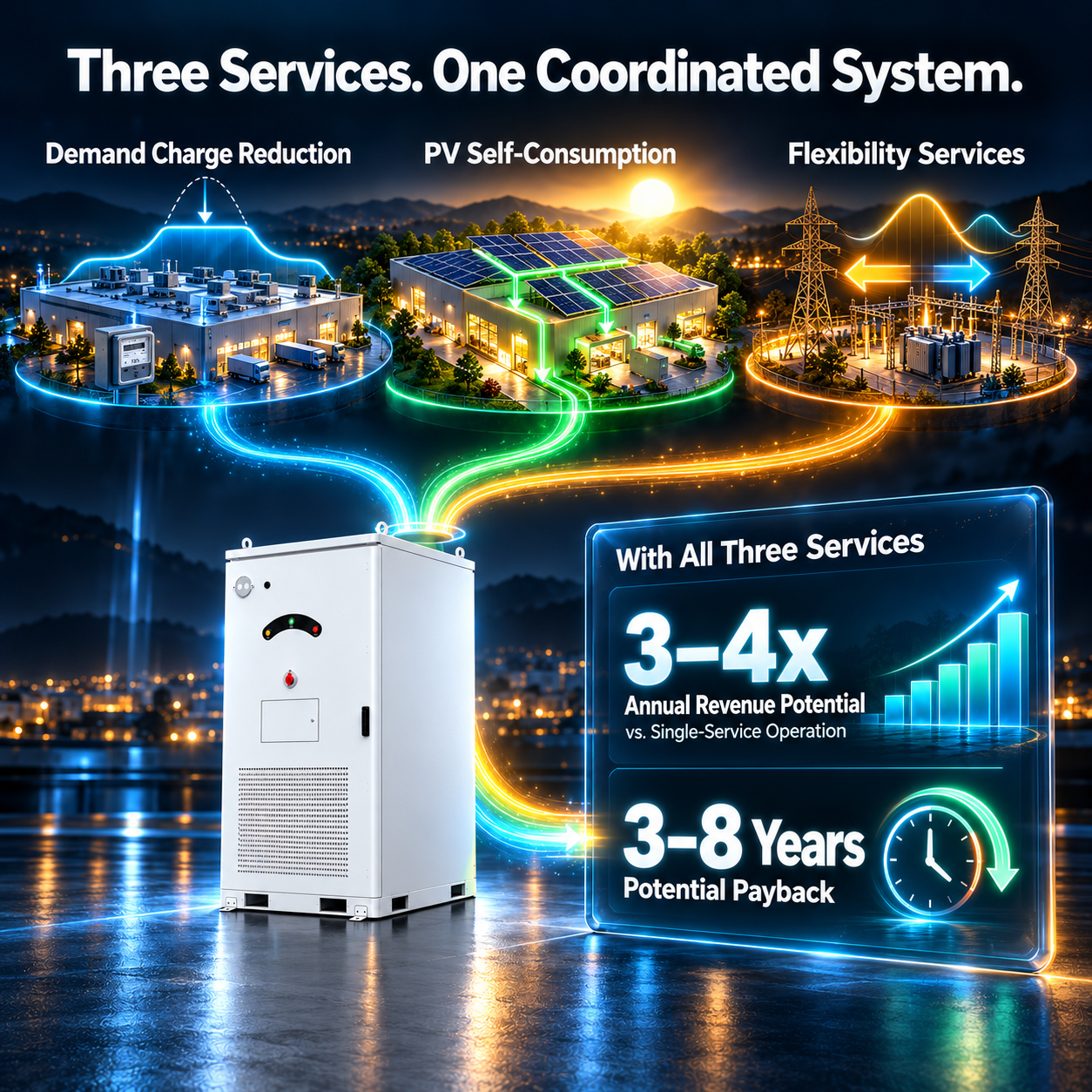
A single-revenue BESS model often needs 6–8 years to pay back. Stacking demand reduction, PV self-consumption, and flexibility services on the same asset can compress that to 3–5 years. Here is the 4-stream framework and the system capabilities that make it executable.
Key Takeaways
- A peak-valley-arbitrage-only model can leave a C&I battery energy storage system (BESS) with a 6–8-year payback. Stacking suitable services can target 3–5 years, subject to the site-specific economics described below.
- Revenue stacking combines four value streams on the same physical asset: demand charge reduction, PV self-consumption, peak-valley arbitrage, and flexibility/ancillary services.
- The four streams are not simply additive. Their time windows, power requirements, and state-of-charge (SOC) needs can conflict or reinforce each other, requiring layered energy management system (EMS) dispatch.
- Execution requires more than charging and discharging: fast power response, dynamic SOC windows, and coordinated cloud, local-controller, and PCS operation determine which value can actually be captured.
- The JKESS-261KWH-L1 liquid-cooled system integrates a 125kW power conversion system (PCS) and EMS for fast scheduling. Modular HV kits support 4–16 slave boxes, allowing the approved configuration to evolve with the revenue strategy.
Economics context: The 6–8-year and 3–5-year figures are illustrative planning ranges used in this article, not independently verified market averages or guaranteed returns. Actual payback depends on installed cost, tariffs, eligible services, dispatch conflicts, efficiency, degradation, operating costs, and participation fees. The references below explain valuation principles; they do not validate these payback ranges.
The Single-Revenue Trap
Early C&I storage assessments often focus on one calculation: the peak-to-valley electricity price spread multiplied by energy shifted per cycle and daily cycles, compared with system cost. The model is easy to understand but fragile. Changes to time-of-use (TOU) tariffs, demand-charge rules, or solar export compensation can undermine the underlying revenue assumption.
A single-revenue model can also leave the system’s physical capabilities underused. A battery with a 125kW PCS and 261kWh of capacity, dispatched only for one daily arbitrage cycle, may leave much of its power-response capability, SOC flexibility, and communication functionality unused outside those windows.
Revenue stacking puts the same asset to work for several services across different time horizons. It requires more accurate dispatch and stronger communications than a fixed charge/discharge timer. NREL’s discussion of behind-the-meter storage describes the opportunities and constraints of this multi-use approach. See the NREL reference below.
The Four Revenue Streams and How They Interact
Demand savings and avoided electricity purchases are bill reductions; flexibility services may earn market payments. All contribute to project value, but each must be measured against the same baseline and a feasible shared dispatch schedule.
| Revenue Stream | Time Window | System Requirement | Interaction with Other Streams |
|---|---|---|---|
| Demand Charge Reduction | 15-minute peak events; monthly billing cycle, where specified by the tariff | High power output for short durations; fast response to load spikes | Can consume SOC quickly; preserve enough reserve to shave peaks during PV output dips. |
| PV Self-Consumption | Daytime; variable with solar output and site load | Frequent charging/discharging; efficient operation at partial load | Charges during PV surplus; may conflict with morning peak shaving if SOC is not managed. |
| Peak-Valley Arbitrage | Daily; fixed TOU windows | Scheduled charge/discharge cycles; high round-trip efficiency | Competes with demand reduction for evening peak SOC; requires EMS priority logic. |
| Flexibility / Ancillary Services | Seconds to minutes; market-dependent | Fast, precise power control; millisecond-level response where required; communication with the grid operator or aggregator | May require SOC headroom in both directions and may interrupt the arbitrage schedule. |
Avoid double counting: A stored solar kWh used later on site cannot also be counted as a separately purchased arbitrage kWh. Use one interval-by-interval energy balance and billing calculation. Reserve both power and energy for contracted services before assigning the remainder to discretionary dispatch.
Single-Revenue Model vs Stacked-Revenue Model: A Financial Comparison
The comparison describes operating strategies. Payback figures are illustrative and require validation with the site’s tariffs, costs, and eligible market services.
| Dimension | Single-Revenue Model (Peak-Valley Only) |
Stacked-Revenue Model (4 Streams) |
|---|---|---|
| Annual Revenue | Limited to TOU price spread × energy shifted × cycles, adjusted for charging cost and losses | Demand savings + PV self-consumption + arbitrage + flexibility payments, after removing overlaps and costs |
| Payback Period | 6–8 yearsIllustrative single-stream planning range | 3–5 yearsIllustrative stacked case; depends on local tariffs and market rules |
| Revenue Volatility | High exposure to changes in the TOU price spread | Potentially lower exposure through diversification; streams may still be correlated |
| Asset Utilization | Low outside scheduled TOU charge/discharge windows | Higher when the system can serve several compatible needs during the day |
| System Requirements | Basic charge/discharge scheduling | Fast response, precise SOC management, and multi-protocol communication |
| Risk Profile | Concentrated exposure to TOU policy and price spreads | Diversified value streams can offset individual declines, with added dispatch and participation obligations |
Evaluate net cash flow, not gross revenue. A first-pass simple payback estimate divides net installed investment by annual net cash benefit. Account for charging energy, conversion losses, cooling and auxiliary loads, maintenance, degradation, replacement allowances, aggregator fees, and any non-performance penalties without counting a cost twice.
To improve BESS IRR: optimize dispatch against the combined net value of eligible services, then evaluate annual cash flows over the project life. Include changes in usable capacity, financing and tax assumptions, and residual value. Simple payback alone does not determine IRR. Stress-test the project with lower flexibility payments, narrower TOU spreads, and unavailable revenue streams.
What the System Must Do to Execute Revenue Stacking
-
Millisecond-Level Power Response
Flexibility products and demand reduction need power adjustments within the relevant service or metering window. Some services require second-level or millisecond-level control; a fixed charge/discharge schedule alone cannot satisfy those requirements.
The system needs fast power regulation and timely communication between the EMS, local controller, and PCS using the supported CAN/RS485 or Ethernet interface. Measure the entire command-to-power response, including metering and communications. A fast internal scheduling cycle is not itself proof of market compliance.
-
Dynamic SOC Window Management
The streams make competing demands on the battery. Arbitrage uses deeper charge/discharge cycles; demand reduction needs discharge reserve; PV self-consumption needs room to absorb surplus solar production.
The EMS must allocate SOC windows dynamically using electricity prices, load forecasts, PV output, and contracted service obligations. Fixed SOC bands alone cannot express every priority. Keep all dispatch within BMS safety limits and any agreed backup reserve.
-
Coordinated Cloud, Local, and PCS Dispatch
Revenue stacking depends on coordinated operation. The cloud EMS processes market signals and optimizes strategy, the local controller executes real-time decisions, and the PCS converts power.
Web/APP monitoring and remote strategy updates should work alongside local execution. Confirm telemetry, protocol mapping, command priorities, and the local fallback strategy if the network connection is lost.
-
Modular Expansion Capability
A site’s strategy changes as market access and tariffs evolve. The initial system may focus on demand reduction; additional capacity can later support more energy shifting or longer service commitments.
A modular architecture can allow battery capacity to expand without replacing the master controller when that controller is sized for the final design. Verify the approved box count, series voltage, PCS operating window, current limits, protection, firmware, and compatibility of new and existing batteries before expansion.
JKESS Products Designed for Revenue Stacking
Match the cabinet or modular architecture to the final dispatch envelope: required power, usable energy, voltage, communication, and expansion plan.
| Product | Model | Role in Revenue Stacking | Key Specifications |
|---|---|---|---|
| Liquid-Cooled C&I BESS | JKESS-261KWH-L1 | Integrated 125kW PCS + EMS for fast response and multi-stream scheduling | 261kWh; 125kW PCS; 832V DC nominal; liquid cooling; IP55; EMS/Cloud/APP |
| 200A HV Master Box | HV-BC250 | Cluster-level control for modular systems; supports 4–16 slave boxes in an approved configuration | 200A; 80–1000V DC; CAN/RS485 |
| 100A HV Master Box | HV-BC150-100A | Control unit for smaller clusters; supports phased investment within its approved limits | 100A; 80–1000V DC; 33S–270S |
| 6U Slave Battery Box | HV Slave 6U Kits | 16S slave unit with up to 2A active balancing in the specified version, supporting cell consistency | 16S LiFePO4; BMU-H5-16; ±0.005V sampling; cells selected separately |
| Modular Stacked System | HV BMS Master + Slave Kits | Flexible approximately 64–256kWh configuration with approximately 16kWh modules; start small and expand as services grow | 1 master + 4–16 slaves; 80–1000V DC architecture; final energy depends on cell capacity |
Configuration check: Confirm all ratings, balancing current, response time, and EMS functions in the approved datasheet and project bill of materials for the delivered version. Kit capacities refer to completed systems with separately selected cells. Supported box count does not by itself establish usable energy, PCS compatibility, or permission to participate in a grid service.
5 Questions Before You Commit to a Stacked-Revenue Model
-
1. Does the local market allow multiple value streams?
Rules differ by region. Some markets allow a BESS to combine demand reduction with ancillary services; others restrict overlapping commitments or compensation. Confirm the applicable tariff, export permissions, metering requirements, and service contracts first.
-
2. Can the EMS configure priorities across strategies?
When arbitrage, demand reduction, and PV self-consumption conflict, the EMS must adjust dynamically. Ask the supplier to demonstrate priority switching, including the treatment of reserve SOC and binding service commitments.
-
3. Does PCS power response meet the selected flexibility service?
Many flexibility services specify second-level response; some require faster performance. Confirm the required response time and communication latency, and request measured results under the relevant conditions. A target such as ≤100ms is an example acceptance criterion, not a universal requirement or an unverified product guarantee.
-
4. Can the system coordinate cloud and local dispatch?
The cloud optimizes strategy while the local controller executes real-time actions. Confirm Web/APP monitoring, remote strategy updates, and the controller’s fallback operation during a network outage.
-
5. Will expansion require a new master controller?
Check the master’s approved expansion capability, such as support for 4–16 slave boxes, alongside PCS power and voltage headroom. Confirm protection, firmware, cell compatibility, and warranty conditions for the planned final capacity.
Further Reading
-
NREL — Energy Storage Revenue StackingAn Overview of Behind-the-Meter Solar-Plus-Storage Program Design: With Considerations for India · 2020 · NREL/TP-7A40-74131
A framework for customer-sited solar-plus-storage programs, including value stacking and the regulatory and operational conditions that determine which services can be combined.
-
LBNL — Estimating the Value of Energy StorageOpportunities and Challenges to Capturing Distributed Battery Value via Retail Utility Rates and Programs · December 2021
Research on distributed battery value under tariffs and programs. It explains why multiple services need coordinated commitments, a clear priority hierarchy, and allocation by time or battery capacity.
Frequently Asked Questions
What is revenue stacking for C&I BESS?
Revenue stacking is the practice of using the same battery asset to generate income from multiple value streams — such as demand charge reduction, PV self-consumption, peak-valley arbitrage, and flexibility/ancillary services — rather than relying on a single revenue source. It can improve project IRR and reduce exposure to policy changes in any one market, provided incremental benefits exceed the additional operating and participation costs.
Why does a single-revenue model have a longer payback period?
A single-revenue model typically relies only on TOU price spreads, which can limit the system to one or two scheduled cycles per day. The asset may sit idle outside those windows, and revenue is highly sensitive to TOU policy changes. Stacked-revenue models utilize the same asset across multiple time windows, potentially improving annual net value and reducing payback time.
Can all four revenue streams be stacked at the same time?
Not always. Market rules vary by region. Some markets allow a BESS to participate in demand reduction and ancillary services simultaneously, while others impose restrictions. The key is to confirm local market rules and configure the EMS to prioritize streams accordingly. Never commit the same power or stored energy to incompatible obligations.
What system capabilities are required for revenue stacking?
The system needs fast power response (for flexibility services), precise SOC management (to balance competing demands), multi-protocol communication (CAN/RS485/Ethernet), and an EMS that can dynamically switch between strategies. Modular architecture is also important for future expansion. The complete control chain must be tested against the response and telemetry requirements of the selected service.
How does the JKESS-261KWH-L1 support revenue stacking?
The JKESS-261KWH-L1 integrates a 125kW PCS and an EMS with cloud/APP connectivity. It is designed for millisecond-level scheduling and multi-stream operation, supporting projects that intend to stack demand reduction, PV self-consumption, and flexibility services. Verify the delivered firmware, measured end-to-end response, and market qualification for the intended service. Its liquid-cooling design supports thermal management during frequent cycling and high ambient temperatures, within the specified operating and derating limits.
Can I start with a smaller system and expand later?
Yes. The JKESS modular HV BESS architecture supports starting with 4 slave boxes and expanding to 16, subject to the approved configuration. With approximately 16kWh per box, this represents approximately 64–256kWh; actual capacity depends on the cells selected. Retaining the original master control box is possible when it is sized for the final configuration and the PCS voltage window, current rating, protection, firmware, and battery compatibility permit expansion. This allows you to validate revenue assumptions before committing to full capacity.
Does revenue stacking require a specific type of PCS?
The PCS should have fast power response and support standard communication protocols, such as CAN/RS485, with the correct application-layer mapping. It must follow EMS power commands while respecting BMS limits and the permitted SOC windows. JKESS systems are designed with these requirements in mind, and compatibility should be verified during system design.
How does the battery chemistry affect revenue stacking?
LiFePO4 is well-suited for frequent cycling and is a common choice for stacked-revenue projects. Actual power capability and lifetime depend on cell specifications, temperature, C-rate, and operating limits. The BMS must maintain cell consistency across all cycles; the specified JKESS BMU-H5-16 configuration provides up to 2A active balancing to support this requirement. Confirm the balancing rating for the delivered hardware version.
What data do I need to evaluate revenue stacking for my site?
You need at least 12 months of 15-minute interval load data, local demand charge tariffs, TOU price schedules, PV generation profiles (if applicable), and the available market rules for flexibility or ancillary services. Use finer-resolution data where the tariff or service requires it. Add export limits, installed cost, efficiency, degradation, operating costs, and participation fees to evaluate net cash flow and configure stream priorities.
Where can I find authoritative guidance on revenue stacking?
The U.S. National Renewable Energy Laboratory (NREL) discusses storage value stacking in its behind-the-meter solar-plus-storage program-design research. Lawrence Berkeley National Laboratory (LBNL) also publishes research on distributed battery valuation and the coordination of multiple services. The Further Reading section links to these resources. They explain general principles; local market rules and project economics must be verified separately.
Planning a Stacked-Revenue C&I BESS Project?
Share your load profile, tariff structure, and market rules with our engineering team. We’ll help you evaluate which revenue streams are stackable at your site — and configure the right JKESS system to execute the strategy.
Request a Custom Quote →