 EN
EN
Mistake 1: Comparing price without verifying batch consistency
Cells sold as the “same grade” from different batches may vary by as much as 5% in capacity. A 5% purchase-price saving can be outweighed by a 10% reduction in usable pack capacity.

Our kit arrives without cells — and that’s the point. Here is the 7-step verification framework that separates Grade A cells from relabeled rejects, and ensures dimensional fit before you crimp a single terminal.
Choosing the JKESS kit model — enclosure, BMS, and wiring harnesses without cells — gives B2B buyers significant cost flexibility and sourcing control. That flexibility also creates one responsibility that cannot be outsourced: the cell purchasing decision.
Cells typically represent 50%–60% of total energy-storage system cost, and cell-related issues can account for more than 70% of system failures. Yet many B2B buyers still purchase cells based on a supplier PDF datasheet and a verbal promise that “these are our best Grade A cells.”
The problem is that “Grade A” can mean very different things from one supplier to another. For one supplier it may mean capacity at or above 95% of the nominal rating; for another it may simply mean no obvious cosmetic damage. Without a common, verifiable framework, cell sourcing becomes one of the least controlled parts of the project.
There is no globally unified cell-grading standard in the energy-storage industry. The following working definitions summarize public test practices and B2B sourcing experience into a practical screening framework.
| Grade | Capacity Consistency | Internal Resistance Consistency | Self-Discharge Rate | Typical Source | Risk Level |
|---|---|---|---|---|---|
| Grade A | Capacity ≥ 98% of nominal; batch spread ≤ 1% | Variation ≤ 5% | ≤ 2% / month | Original factory supply or authorized channel | Low |
| Grade B | Capacity 90%–97%; batch spread 2%–5% | Variation 5%–15% | 2%–5% / month | End-of-stock lots or recovered cells | Medium |
| Grade C | Capacity < 90%; batch spread > 5% | Variation 15% | 5% / month | Retired batteries or informal channels | High |
Use this checklist to complete incoming cell verification within 48 hours of delivery, so problems are identified before return rights or claim windows are lost.
257kWh example: For a 257kWh system configured as 16S × 314Ah × 3.2V × 16 boxes, a 10% capacity loss removes about 25.7kWh of usable capacity. At one full cycle per day over 10 years, that represents approximately 93,805kWh of lost lifetime energy throughput.
JKESS 4U and 6U kits use the BMU-H5-16 as the slave-control core and support 16S LiFePO4 series configurations. Check the following technical constraints before ordering cells.
| Parameter | JKESS Kit Requirement | Cell Sourcing Check |
|---|---|---|
| Chemistry | LiFePO4 | Do not mix with ternary lithium, sodium-ion, or other chemistries |
| Cell format | Prismatic aluminum case | Pouch and cylindrical cells are not suitable for this kit |
| Capacity range | 280Ah–314Ah | Stay within the recommended range and prioritize batch consistency |
| Nominal voltage | 3.2V | Approximately 3.65V full charge and 2.5V near empty |
| Continuous discharge rate | 0.5C | Not intended for continuous discharge at 1C or above |
| Dimensions (L × W × H) | 174 × 72 × 207 mm | Actual cell tolerance should stay within ±1mm |
| Terminal type | M6 stud | Terminal geometry must match the busbar hole pattern |
| Voltage sampling window | 1–4.5V (BMU-H5-16) | Cell voltage must remain within the sampling range |
Cells sold as the “same grade” from different batches may vary by as much as 5% in capacity. A 5% purchase-price saving can be outweighed by a 10% reduction in usable pack capacity.
Matching nominal dimensions do not guarantee matching actual dimensions. A 1–2mm difference can prevent the cell module from fitting into the kit enclosure. Sample and measure cells within 48 hours of delivery.
The JKESS BMU-H5-16 sampling range is 1–4.5V. If a cell’s full-charge voltage exceeds 4.5V, it cannot be used within the specified sampling window of this kit.
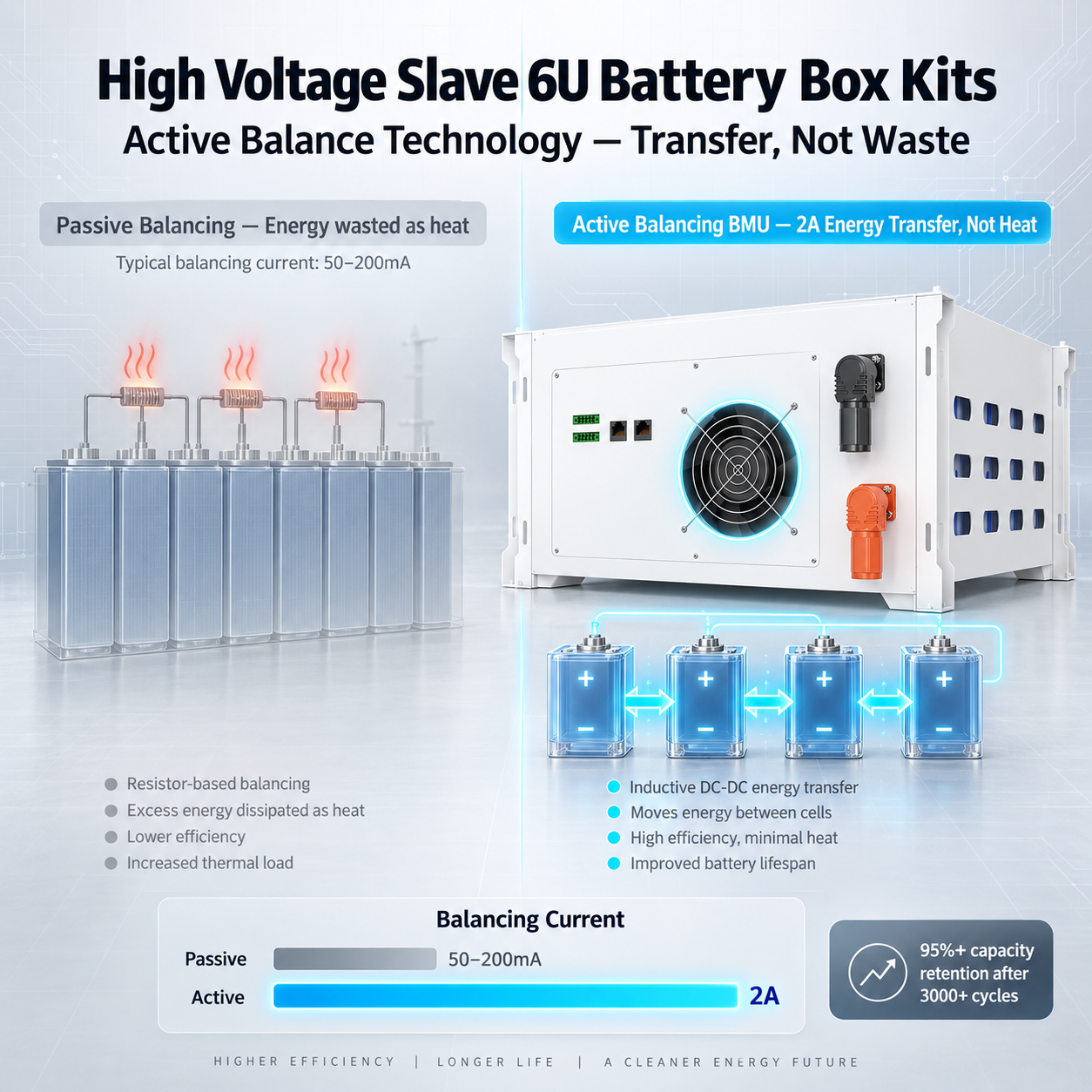
Mixing batches within the same 16S string can accelerate cell-to-cell imbalance. Even with 2A active balancing, extreme variation can exceed the balancing system’s practical compensation range.
A cell with elevated self-discharge continuously drains usable energy from the series string. The problem may not be obvious on arrival, but after months of operation it can appear as persistent cell imbalance.
JKESS sells HV battery box kits as sheet-metal enclosures with pre-installed BMS hardware, wiring harnesses, and thermal management components. Selling without cells gives B2B buyers the flexibility to source LiFePO4 cells based on their own supply chain, budget, and project timeline. It also avoids the complexity of international lithium battery shipping regulations, as cells are subject to stricter transport rules than empty enclosures.
JKESS 16S HV battery box kits (4U and 6U models) are designed for prismatic LiFePO4 cells in the 280Ah–314Ah range. The standard cell dimensions are 174 × 72 × 207 mm. The BMU-H5-16 supports a voltage sampling window of 1–4.5V per cell. Cylindrical and pouch cells are not compatible with this kit design.
There is no global standard for “Grade A” in the energy-storage industry. Verification requires independent evidence: batch-level traceability from the original manufacturer, third-party capacity test reports at 25°C and 0.5C, AC internal-resistance distribution data showing ≤5% standard deviation, dimensional measurement of sampled cells, and a 7-day self-discharge test. Do not rely solely on the supplier’s self-issued datasheet.
JKESS 16S battery box kits are designed for 174 × 72 × 207 mm cells with a dimensional tolerance of ±1mm. Exceeding this tolerance may cause difficulty fitting cells into the module side panels and end panels or may create uneven compression. Measure 5–10 randomly selected cells upon delivery and confirm module fit before committing the entire batch.
Mixing batches within a 16S pack is strongly discouraged. Even cells from the same supplier may show 2%–5% capacity variation across batches, and internal-resistance differences can exceed 10%. This amplifies cell-to-cell imbalance and reduces usable capacity. If mixing is unavoidable, use cells with the closest possible capacity and internal resistance and verify them with a 7-day self-discharge test.
The BMU-H5-16 delivers up to 2A active balancing current per channel, using inductive DC-DC conversion to transfer charge between cells. For a 314Ah cell with 0.5% capacity variation, the energy to balance is approximately 1.57Ah, which takes about 47 minutes to compensate at 2A. Passive balancing at 200mA would require approximately 7.85 hours. Active balancing cannot compensate for extreme variation beyond the design limits.
For BESS applications, cells should have a self-discharge rate of 2% or less per month when stored at 50% SOC and 25°C. Cells with higher self-discharge rates cause continuous imbalance in the series string and may require more frequent balancing cycles. Cells above 2% per month should be isolated and not used in a series-connected pack.
For a 64kWh system using 4 JKESS HV slave boxes, you need 64 cells (16 cells per box × 4 boxes). With 314Ah LiFePO4 cells at 3.2V nominal, a 16S configuration provides approximately 16.1kWh per box (16 × 3.2V × 314Ah = 16.08kWh), and 4 boxes provide approximately 64.3kWh. Exact usable capacity depends on measured cell capacity and operating conditions.
JKESS does not sell cells, but our engineering team can provide the technical specifications required by each kit, including chemistry, capacity range, dimensions, voltage window, and discharge rate. We can also review third-party cell test reports against the kit’s technical requirements. For large B2B orders, verified supplier recommendations in relevant regions may be available upon request.
Installing cells outside the kit’s specifications, such as a different chemistry, capacity range, dimensional envelope, or voltage window, may cause BMS communication errors, incorrect SOC calculation, cell imbalance beyond the balancing capacity, or safety risks. JKESS cannot guarantee kit performance when non-conforming cells are installed. Verify all cell parameters before assembly.
Share your cell specifications and test reports with our engineering team. We’ll review them against the kit’s technical requirements and flag potential issues before you begin assembly.
Request a Custom Quote →