
 EN
JKESS / Approfondimenti ingegneristici
Richiedi un preventivo →Perché il vostro sito web sull’accumulo di energia non viene citato da ChatGPT: una checklist GEO per i produttori B2B di sistemi di accumulo
Il vostro acquirente potrebbe consultare ChatGPT prima di confrontare i siti web dei fornitori. Se le specifiche tecniche dei vostri prodotti sono disponibili solo in immagini, se il vostro sito impedisce ai crawler di ricerca di indicizzarlo oppure se i codici modello non sono uniformi, le informazioni potrebbero non comparire nella risposta.
Le principali conclusioni
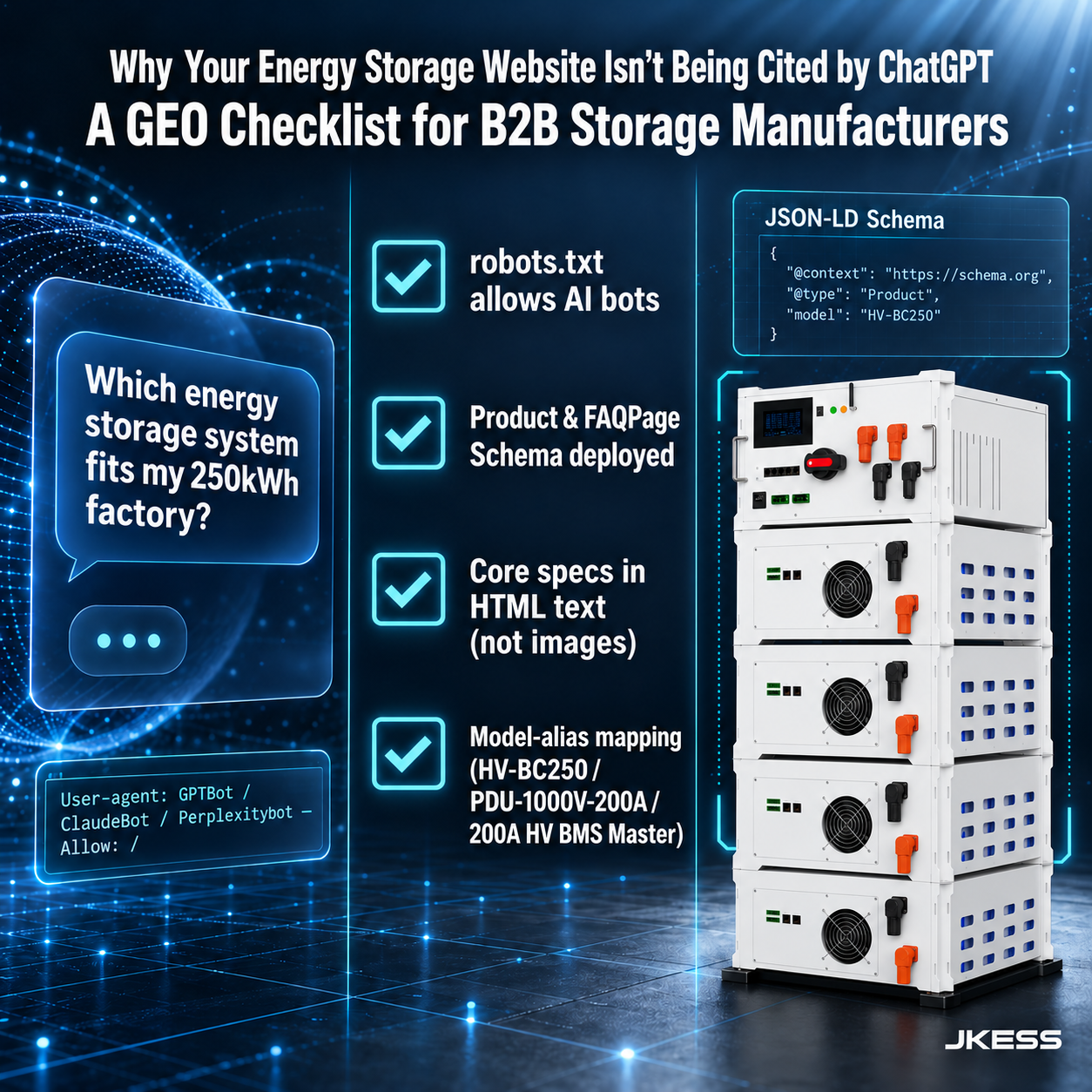
- Il percorso di approvvigionamento include ormai ricerche assistite dall’intelligenza artificiale. Un acquirente può chiedere: «Quale sistema soddisfa il mio fabbisogno di 250 kWh per la fabbrica?», ancor prima di aprire le pagine individuali dei fornitori.
- Rendete i vostri dati facilmente recuperabili e verificabili. Pubblicate le specifiche tecniche come testo HTML visibile, con unità di misura, condizioni operative, fonti e identificativi chiari dei prodotti.
- Verificate sette punti critici per la visibilità AI: accesso tramite crawler, Schema appropriato, densità fattuale, coerenza degli alias del modello, specifiche HTML, struttura domanda-risposta e una guida opzionale llms.txt. Questi elementi coprono i rischi pratici legati all’accesso e ai contenuti; non si tratta di sette requisiti obbligatori per il posizionamento.
- Un prodotto richiede un’identità coerente. Riconciliare denominazioni come HV-BC250, un identificativo interno del PDU, e “200A HV BMS Master” soltanto dopo aver verificato che si riferiscano alla stessa revisione.
- GEO è una gestione continua dei contenuti. Conservare le prove, monitorare le citazioni e correggere le risposte inaccurate. Nessun elenco di controllo può garantire un posizionamento prioritario in ChatGPT, Perplexity o Google AI Overviews.
01 / Il percorso dell’acquirente
Il funnel di approvvigionamento B2B è già cambiato
Il familiare percorso di approvvigionamento inizia con una ricerca, prosegue attraverso diversi siti web di fornitori e termina con una shortlist o un modulo di richiesta. Gli assistenti AI introducono un ulteriore punto di ingresso: un acquirente può chiedere una spiegazione tecnica o un confronto prima ancora di visitare il sito web di un produttore. Ciò rende sempre più rilevante la qualità delle informazioni disponibili al di fuori della tua homepage.
Considera le domande che potrebbe porre un integratore di sistemi di accumulo o un appaltatore EPC: «Quale BESS ad alta tensione supporta da 4 a 16 box batteria slave?» «Quali sono i parametri tecnici di un BMS con bilanciamento attivo da 2 A?» «Quali modifiche occorrono in un progetto di accumulo C&I per una rete debole?» Questi sono esempi di intenti d’acquisto, non di statistiche misurate sull’adozione. Ognuno richiede una risposta precisa che distingua la specifica di un singolo componente dalla capacità di un sistema completo.
Se i fatti rilevanti sono di difficile accesso o contraddittori, una risposta generata potrebbe omettere il vostro prodotto o descriverlo in modo errato. La risposta pratica consiste nel pubblicare una risposta chiara e attribuibile su una pagina affidabile. Le risposte generate dall’intelligenza artificiale richiedono comunque verifica, e la visibilità in tali risposte integra i canali consolidati di ricerca, distribuzione e vendita diretta.
02 / Ricerca e citazione
SEO tradizionale vs GEO: cosa cambia effettivamente
Le due discipline si sovrappongono. Questo confronto descrive le loro principali aree di enfasi; contenuti utili, accessibilità tecnica ed evidenze credibili sono importanti per entrambe.
| SEO tradizionale | GEO (Generative Engine Optimization) |
|---|---|
| Rete Ottenere visibilità nei risultati di ricerca pertinenti. | Rete Diventare una fonte utile e citata nelle risposte generate dall’intelligenza artificiale. |
| Focus sull'Ottimizzazione Intenzione di ricerca, contenuti pertinenti, link e qualità tecnica. | Focus sull'Ottimizzazione Fatti recuperabili, prove, entità chiare e dati strutturati adeguati. |
| Comportamento dell’acquirente Esplorare i risultati e visitare le pagine dei fornitori. | Comportamento dell’acquirente Leggere una risposta, porre domande di approfondimento e verificare i link di supporto. |
| Formato del contenuto Pagine prodotto ed editoriali utili, allineate all’intento di ricerca. | Formato del contenuto Passaggi con risposta in primo piano, valori verificabili, condizioni e esclusioni esplicite. |
| Accesso dello spider Googlebot, Bingbot e l’infrastruttura di indicizzazione pertinente. | Accesso dello spider OAI-SearchBot, PerplexityBot, Claude-SearchBot e Googlebot per le funzionalità AI di ricerca di Google. |
| Dati Strutturati Descrivere i contenuti delle pagine idonee e supportare le funzionalità di ricerca applicabili. | Dati Strutturati Chiarire le proprietà e le relazioni laddove utilizzate; non è un prerequisito universale per la citazione. |
| Concorrenza Visibilità e rilevanza su tutta la pagina dei risultati di ricerca. | Concorrenza Se la risposta seleziona, attribuisce e rappresenta con precisione le prove fornite. |
| Immagini Elementi visivi utili supportati da testo descrittivo e da attributi alt appropriati. | Immagini Ripetere le specifiche critiche in HTML; le capacità di lettura delle immagini variano a seconda del servizio. |
| Nomi del marchio e del modello Nomi facilmente riconoscibili nei titoli, nelle pagine e nei collegamenti. | Nomi del marchio e del modello Identificatori primari coerenti, alias verificati e limiti delle revisioni. |
| Misurazione Impressioni, posizionamenti, clic e conversioni qualificate. | Misurazione Citazioni di URL, menzioni accurate dei marchi, referral e richieste qualificate. |
| L'SEO aiuta gli acquirenti a trovarti. | Il GEO fa sì che le tue prove diventino parte della risposta. |
03 / La checklist operativa
La checklist in 7 punti per il GEO sui siti web B2B dedicati all'archiviazione
-
Esamina il file robots.txt e autorizza i crawler di ricerca previsti
Separa l'accesso per la ricerca dalle preferenze per l'addestramento dei modelli. OpenAI identifica OAI-SearchBot come il proprio crawler di ricerca e GPTBot come crawler per l'addestramento. PerplexityBot supporta la ricerca di Perplexity; Claude-SearchBot supporta la ricerca di Claude, mentre ClaudeBot riguarda lo sviluppo del modello. Googlebot gestisce il crawling per Google Search, inclusi i suoi strumenti AI; Google-Extended è un controllo distinto per altri utilizzi.
Verifica i gruppi esistenti di user-agent, le regole con caratteri jolly, le restrizioni per percorso e le impostazioni di CDN o firewall. Secondo il comportamento standard di robots.txt, l'assenza di un gruppo esplicito
Allownon nega automaticamente l'accesso. Un gruppo esplicito può rendere più chiara la politica intesa.# Example for a public marketing website.# Merge with the existing policy; preserve intentional path restrictions.User-agent: OAI-SearchBotAllow: /User-agent: PerplexityBotAllow: /User-agent: Claude-SearchBotAllow: /User-agent: GooglebotAllow: /Impostare separatamente i criteri di GPTBot, ClaudeBot e Google-Extended in base all’uso previsto del contenuto. Verificare le regole finali unificate e le effettive richieste dei crawler.
Riferimenti: Documentazione del crawler OpenAI ,Crawler Perplexity ,Documentazione del crawler Anthropic e la Controlli del crawler Google .
-
Distribuire uno Schema che descriva con precisione la pagina visibile
Utilizzare i dati strutturati per rendere espliciti identificatori e proprietà. Lo Schema deve descrivere la pagina effettivamente visualizzata da un visitatore, senza aggiungere affermazioni non supportate o mescolare varianti diverse dello stesso prodotto.
- Prodotto + additionalProperty: parametri specifici del modello, unità di misura e caratteristiche documentate.
- FAQPage: domande autentiche e visibili con le relative risposte.
- Come fare: una guida pratica all’installazione o alla messa in servizio, con tutti i passaggi e la portata completa.
- Articolo: il titolo editoriale, l’autore, la data di pubblicazione e l’URL canonico della pagina.
- Organizzazione: il nome ufficiale dell’azienda, l’URL e le informazioni di contatto verificate.
Verificare la sintassi JSON e il significato dei campi, quindi confrontare ogni dichiarazione contrassegnata con la pagina effettivamente visualizzata. Un blog che tratta diversi prodotti non è automaticamente una pagina di dettaglio prodotto.
L’idoneità non costituisce una garanzia. Google afferma che le sue funzionalità di ricerca basate sull’intelligenza artificiale non richiedono Schema specifico né file dedicati all’IA. La validità di Schema.org, il supporto da parte delle piattaforme e l’effettiva inclusione sono questioni distinte.
Riferimenti: Schema.org additionalProperty ,FAQPage e la Linee guida sulle funzionalità di intelligenza artificiale di Google .
-
Aumentare la densità di fatti utili
Sostituire gli aggettivi non supportati con un'affermazione verificabile da parte dell'acquirente. Porre innanzitutto la conclusione, mantenere ogni paragrafo focalizzato e fornire il modello, l'unità, le condizioni operative e la fonte necessari per interpretare il valore.
Prima / Promozionale «JKESS offre una tecnologia di bilanciamento attivo leader di settore con prestazioni superiori.»Dopo / Specifico e attribuibile «La documentazione tecnica JKESS descrive il BMU-H5-16 con bilanciamento attivo da 2 A, accuratezza di campionamento della tensione cella pari a ±0,005 V, otto sensori di temperatura NTC e supporto per batterie LiFePO4 da 16S. Verificare questi valori rispetto alla versione esatta fornita.»Non combinare valori provenienti da documenti in conflitto per creare una nuova specifica. Se una pagina prodotto e un foglio dati sono in disaccordo, risolvere la discrepanza con il responsabile del prodotto e aggiornare entrambe le fonti prima di considerarne una qualsiasi come definitiva.
Esempio di fonte: Discussione tecnica JKESS sul BMU-H5-16 . Le pagine pubbliche possono contenere differenze di revisione; un datasheet attualmente approvato rimane il riferimento per la pubblicazione.
-
Costruisci una mappa verificata da modello ad alias
Assegna a ogni prodotto un nome principale e una pagina prodotto canonica. Conserva un registro che colleghi il nome marketing, l’identificatore ingegneristico, la revisione del prodotto e tutte le varianti regionali di denominazione.
L’esempio di denominazione fornito è HV-BC250 / PDU-1000V-200A-A001-NY / 200A HV BMS Master Box . Questo è un rapporto di alias da verificare, non una prova che gli identificatori siano intercambiabili. Se l’ufficio tecnico conferma la corrispondenza, scrivi: «HV-BC250, noto anche come PDU-1000V-200A-A001-NY, è la 200A HV BMS Master Box.»
Usa il nome principale nel titolo e nell’H1; inserisci gli alias confermati nel primo paragrafo e nei campi Prodotto appropriati, ad esempio
alternateNameompn. Conserva un’identità distinta quando una revisione modifica i valori nominali, le interfacce o l’ambito della fornitura. -
Mantieni le specifiche fondamentali in HTML visibile
Inserisci i valori chiave direttamente nella pagina. Tensione, corrente, accuratezza, dimensioni, condizioni di prova e ambito di fornitura devono rimanere disponibili come testo ordinario e semantico
cells.
Image extraction and JavaScript rendering differ between crawlers and retrieval tools. Text inside a photograph, iframe, or canvas is therefore an unreliable sole source for a critical parameter. Alt text helps describe an image, but it does not replace a visible specification table.
Publish a dated datasheet alongside the HTML table. Distinguish nominal voltage from the operating envelope, continuous current from peak current, and empty-kit weight from the weight of an assembled module.
Answer real buyer questions directly
Build a useful set of questions around the buying decision: “How many slave boxes can one master box support?” “Does the kit include battery cells?” “Which communication protocols are provided?” Answer first, then give the limits and source.
Five to ten FAQs can be a practical editorial target when the topic warrants them; there is no universal minimum. Native
When adding FAQPage markup, use the same question and answer wording as the visible page. Do not add invisible FAQ claims just to target search queries. This article includes ten visible FAQs and marks up five of them.
Consider an optional llms.txt reading guide
llms.txtis a proposed Markdown convention for guiding agents to useful website content. A concise guide can list the company, core products, application pages, and maintained technical documents. It is useful only to consumers that choose to read it.# JKESS Electronic Technology BMS and active balancing solutions for energy storage.## Core Products- [HV-BC250 200A Master Box](https://www.jkess.com/200a-hv-bms-master)- [HV-B6U Slave Battery Box Kits](https://www.jkess.com/hv-slave-6u-kits)- [261kWh Liquid-Cooled BESS Kits](https://www.jkess.com/commercial--industrial-energy-storage-system-kits)## Application Guides- [Modular HV Energy Storage Kits](https://www.jkess.com/home-energy-storage-system-kits)## Technical DocumentsUse the current specifications and scope-of-supply notes on the product pages.Add approved, versioned datasheet links when those documents are published.Illustrative content, not a report of the live site’s configuration. Use verified links and clean Markdown versions where available. Maintaining this file does not deploy robots.txt rules or create search eligibility.
References: the llms.txt proposal and Google’s generative AI optimization guidance. Google Search does not use llms.txt as a special visibility or ranking input.
04 / Content in practice
Before and After: Rewriting a Storage Product Page for AI Citation
The following five examples replace broad promotion with a more useful answer. Numerical illustrations include their assumptions; commercial and certification statements require current, model-specific evidence.
Illustrative rewrites. Calculations are not measured performance guarantees. Before / Marketing copy After / Evidence-led copy “Our advanced active balancing BMS delivers superior performance and extends battery life.” “For an illustrative 314Ah cell with a 0.5% charge difference, ΔQ = 314 × 0.005 = 1.57Ah. At a constant 2A transfer current, the idealized duration is 1.57 ÷ 2 = 0.785 hours, or about 47 minutes. Real duration depends on current limits, control behavior, and losses.” “The system supports a wide voltage range for various applications.” “The HV-BC250 listing specifies an 80–1000V DC master range. A 4–16 slave-box configuration is described as approximately 64–256kWh when each box is approximately 16kWh. With 16 cells per box and 3.2V nominal per cell, 16 boxes yield 256S / 819.2V nominal. Verify the full charge/discharge range and selected cell capacity.” “Our battery boxes are designed for easy installation.” “Define the scope as one master plus five slave boxes: six enclosures in total. State empty-kit and assembled-module weights separately, together with the lifting and installation plan. A claimed 28.55kg kit weight or two-technician, 2–3 day schedule requires a matching product record and a defined site scope.” “We provide reliable products with international certifications.” “List the exact model and revision, applicable CE declaration, RoHS documentation, FCC evidence, and test-report identifiers. If citing GB34131-2017 or insulation resistance ≥1 MΩ at 1,000 VDC, verify the applicable standard edition, test method, and report scope rather than extending a component claim to the whole system.” “Contact us for more information.” “Send your required capacity, DC range, current, communication protocol, scope of supply, quantity, and delivery location to [email protected]. Request confirmation of available regional stock and a written dispatch estimate for that configuration.” Product references: HV-BC250 and modular storage kits. The 64–256kWh shorthand is configuration-dependent; a hardware kit without cells does not itself contain that stored energy.
05 / Access and extraction
Technical Access: Can AI Crawlers Actually Read Your Website?
Check 1 / robots.txt and access controls
Open
https://yourdomain.com/robots.txtand evaluate the user-agent group and path rules that apply to each intended crawler. Inspect firewall challenges, blocked IP ranges, redirects, and server errors as well.Absence of an explicit Allow is not a failure by itself. Use the actual response and verified crawler logs to determine what is accessible.
Check 2 / Core content in HTML
Disable JavaScript and reload the product page. Check the original HTML response for the model name, specification table, scope of supply, and answers.
If they disappear, the page depends on rendering that some tools may not perform. Prefer server-rendered or static core content, and use a search engine’s inspection tools where available. Also check
noindex, snippet restrictions, andX-Robots-Tagheaders.Check 3 / Descriptive alt text
Describe informative product photographs, diagrams, and screenshots with suitable alt text. Keep purely decorative images from adding noise.
Repeat important values in the visible body or a real HTML table. A long alt attribute is not a substitute for a readable technical specification.
Check 4 / Reliable loading and delivery
Confirm that the canonical page returns a successful response and delivers useful content promptly. Reduce unnecessary third-party scripts, oversized payloads, and client-side dependencies.
Timeouts, errors, and rendering limits can interfere with retrieval. A model’s context budget is a separate issue from network performance; there is no universal “AI loading time” threshold.
Check 5 / Canonical URLs and model identity
Identify duplicate URLs for the same item and use a consistent canonical URL, internal links, and sitemap entries. For example, reconcile two product paths that describe the same HV-BC250 revision.
A canonical URL signals a preferred page; it does not by itself resolve conflicting specifications or prove that two product names are equivalent.
Access references: robots.txt interpretation and the crawler documentation linked in checkpoint 1.
06 / Evidence of progress
How to Measure Whether GEO Is Working
Pair answer-level observations with business outcomes. Metric Traditional SEO measure GEO measure Visibility Search impressions and keyword positions. Share of sampled AI answers citing an owned URL; track brand mentions separately. Traffic Organic search clicks and visits. Identifiable AI referrals; brand-search changes as supporting, non-causal evidence. Content Engagement and landing-page performance. Which facts and pages are cited, and whether values and limitations are correct. Conversion Forms, qualified leads, and sales. Qualified inquiries with an AI discovery source or attributable referral. Competition Relative search visibility. Citation share and co-mentions within the same fixed question set. Audit Indexability, search-intent coverage, and page quality. Entity consistency, evidence freshness, extractable facts, and markup accuracy. A practical weekly baseline: run ten fixed buyer questions in ChatGPT search, Perplexity, and Google AI Overviews where an overview appears. Repeat the sample and log platform, date, locale, model or mode, exact question, cited URL, brand mention, and answer accuracy.
Citation rate = answers linking to your domain ÷ eligible sampled answers. Report the sample size and the number of queries without an AI answer. A brand mention without a source link is not a citation. Use a separate measure for citations to this specific article.
For example, six cited answers out of 30 eligible observations produce a 20% sample citation rate. This is an illustrative calculation, not a JKESS result. Keep the question set stable when comparing periods, and avoid treating a single answer or a small change as proof that one edit caused an improvement.
07 / Applying the method
How JKESS Applies GEO to Its Own Product Pages
The reviewed JKESS master-box and 261kWh application pages expose technical information in readable tables. That is a useful starting point. The following seven practices form an implementation and maintenance checklist, rather than a claim that every page has already passed a site-wide audit.
- Maintain structured specification tables. Keep each voltage, current, accuracy, dimension, and weight value in visible HTML, tied to a model, revision, and source. Separate component ratings from complete-system limits.
- Keep FAQs useful and consistent. Write five to ten relevant answers when justified by the product; align any FAQPage markup with the exact visible wording and recheck answers after product changes.
- Use model-specific Product markup. Validate Product and additionalProperty on the appropriate HV-BC250, HV-B6U, and 261kWh pages. Record evidence of the deployed markup rather than assuming site-wide coverage.
- Control aliases. Confirm any relationship between HV-BC250 and PDU-1000V-200A-A001-NY, then use one primary name with the approved aliases. Keep HV-BC150-100A as a distinct product identity.
- Reconcile quantitative claims. Check the 2A active balancing and ±0.005V sampling values against the supplied BMU revision. Keep the 4–16 slave-box and 64–256kWh statements linked to their cell and configuration assumptions.
- Maintain an optional llms.txt guide. If deployed, list current canonical product and documentation URLs, remove stale links, and treat it as documentation support rather than an indexing requirement.
- Verify search access. Review the live robots.txt policy and crawler delivery logs. Confirm intended access for search bots while managing training-related controls independently.
JKESS product and specification anchors
HV-BC250 · 200A HV BMS Master · HV-BC150-100A · 100A master configuration · HV-B6U · 6U slave battery box kits · BMU-H5-16 · technical reference · 261kWh liquid-cooled system
Values to keep in context: 2A active balancing · ±0.005V sampling accuracy · 4–16 slave battery boxes · approximately 64–256kWh · 80–1000V DC master range. These refer to different components or configurations, not a single universal specification. Kits are offered without battery cells; confirm the final scope of supply.
08 / Questions buyers ask
Frequently Asked Questions
What is GEO and how does it differ from traditional SEO?
GEO (Generative Engine Optimization) is the practice of making useful content easier to retrieve, understand, and cite in AI-generated answers. Traditional SEO emphasizes visibility in search results, while GEO also tracks how accurately a brand and its facts appear in generated responses. Both benefit from accessible pages, clear product identities, and reliable evidence; neither guarantees inclusion.
Why is my energy storage website not being cited by ChatGPT?
Possible causes include blocked search crawlers, unindexed pages, specifications that are difficult to extract, inconsistent model names, or weak evidence for the question being asked. For ChatGPT search, review OAI-SearchBot access rather than assuming GPTBot controls search visibility. Missing Schema or llms.txt alone does not prove why a page was omitted; compare crawl evidence, content relevance, and repeated query results.
What is llms.txt and why does it matter for B2B storage websites?
llms.txt is a proposed Markdown-based guide to a website’s useful content, which can point agents to product documentation and application guides. It can help tools that choose to use it, but adoption and behavior differ between services. Treat it as optional documentation infrastructure, not a requirement for AI citation or a replacement for HTML pages and sitemaps.
How do I check if AI crawlers can access my website?
Inspect the robots.txt groups and path rules that apply to OAI-SearchBot, PerplexityBot, Claude-SearchBot, and Googlebot, then review server and firewall logs. A missing explicit Allow rule does not by itself mean access is denied. Also check HTTP responses, indexing and snippet controls, and whether product specifications are available without JavaScript; a browser-only test does not confirm a crawler’s actual access.
What Schema markup should a B2B storage website prioritize?
Use Product with additionalProperty on product pages, Article on editorial pages, and Organization for the company identity. FAQPage can describe visible questions and answers, and HowTo can describe a genuine procedural guide. Keep markup aligned with the visible content and applicable platform documentation; valid Schema does not guarantee a rich result or an AI citation.
How does inconsistent product naming affect AI visibility?
Different names for the same item can make it harder for readers and retrieval systems to connect the information. Select one primary model name and record verified aliases, product revisions, and one canonical URL. Publish an “also known as” relationship only after the model owner confirms that the labels identify the same product and configuration.
What is fact density and why does it matter for GEO?
Fact density is an editorial measure of how much useful, verifiable information a passage contains relative to general promotional language. A model-specific value with units, operating conditions, and a dated source is more useful than an unsupported adjective. Values such as 2A active balancing, ±0.005V sampling accuracy, and an 80–1000V DC range must stay attached to the correct component; fact density is not a published universal AI ranking score.
How do I measure GEO performance for my storage website?
Run a fixed set of buyer questions repeatedly and log the date, platform, search mode, locale, cited URLs, and answer accuracy. Report URL citation rate separately from unlinked brand mentions, and track identifiable referral visits and qualified inquiries. Results fluctuate, so a small weekly sample is directional evidence rather than a complete view of all buyers or proof of causation.
Does GEO replace traditional SEO for B2B storage manufacturers?
No. Search indexing, useful content, internal links, and a dependable website remain relevant to both conventional search and AI-assisted research. GEO adds attention to answer-level representation, traceable facts, and citation measurement. An effective program maintains those foundations while checking whether buyers receive accurate product information.
How does JKESS apply GEO principles to its own product pages?
The JKESS pages reviewed for this article provide examples of HTML specifications and question-and-answer content for products including the HV-BC250 and the 261kWh liquid-cooled system. The seven-part workflow below extends that approach to the HV-BC150-100A, HV-B6U, and BMU-H5-16 through consistent naming, source review, and structured content. This article does not certify site-wide Schema coverage, crawler settings, or an existing llms.txt deployment; those require a current implementation audit.
Want to Audit Your Storage Website’s AI Visibility?
Share your website URL with our team. We’ll review your robots.txt, Schema markup, fact density, and entity consistency — and help identify where crawlers or readers may be missing your product information.
Request a Custom Quote→